




Gone are the days of the intense rivalry between Abahani and Mohammedan.
The animosity that prevailed in the infamous Dhaka Derbies from the late 1970s right till the 1990s is non-existent these days due to a variety of reasons.
Here, Dhaka Tribune takes a look at the golden past through the pages of newspaper archives and interviews of former footballers, and how the popularity has waned drastically in recent decades.
Background in brief
Abahani emerged as one of the key title contenders alongside Mohammedan soon after independence.
Before that, Mohammedan, formed at the end of the British era, were the most successful club during the Pakistan period and their main rivals were Dhaka Wanderers, followed by Victoria.
Abahani meanwhile, began their journey as a social welfare organization in the mid 1960s.
They bought Iqbal Sporting Club, who earned promotion to the first division in 1970, and changed the name to Abahani Krira Chakra.
Having formed a formidable unit and displaying artistic and modern football, the Dhanmondi based club quickly gained the support of many, chiefly the young generation.
The bragging rights also belonged to the Sky Blues who defeated the Black and Whites in their first ever encounter, a 2-0 win in the domestic league on July 12, 1973 with goals from Amalesh Sen and young striker Kazi Salahuddin.
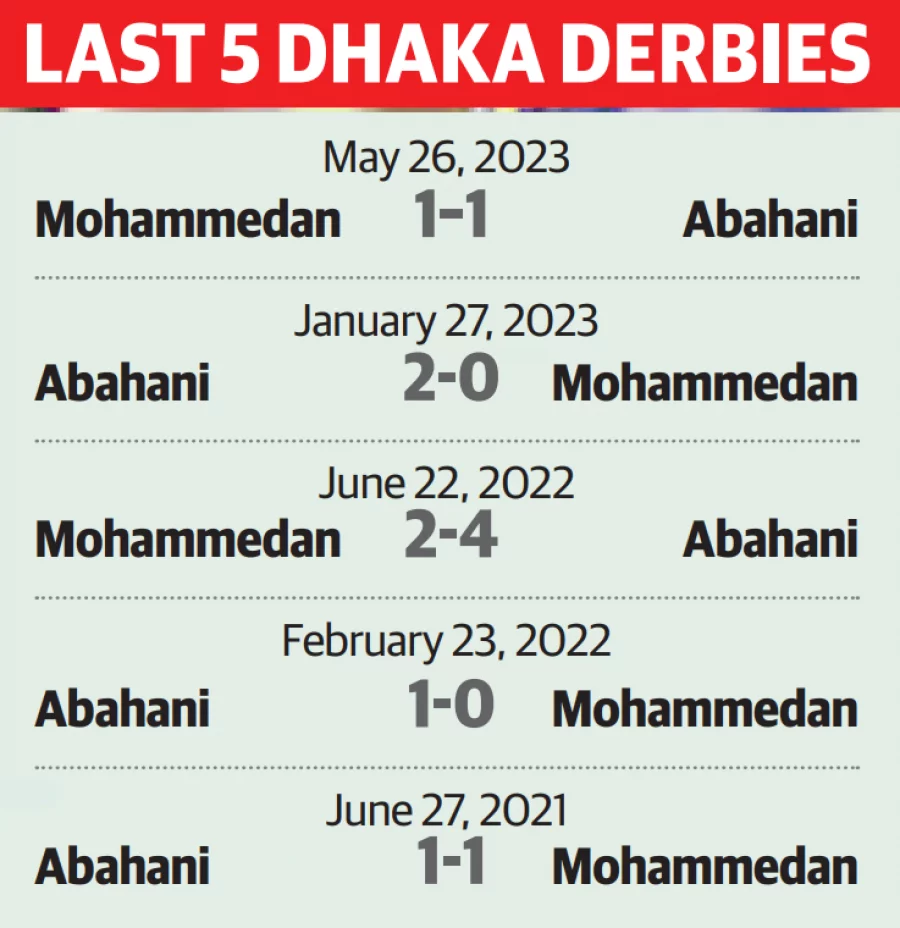
Golden deer that was a prized ticket
It has been a long while football fans showed much interest when the two traditional rivals locked horns with each other.
What was once the most heated match up in the country's football calendar now sees hordes of empty seats in the gallery.
It was not always like this, back in the day a ticket was like a golden deer.
The whole stadium brimmed with boisterous spectators and there was no inch of gallery space that was left empty.
Abahani-Mohamedan match meant a full gallery three-four hours before the game.
Those who could not get tickets or enter the ground tried to force their way into the gallery by tying ropes around their waists and climb over the walls.
For instance, if the game started at 4pm and the gate was opened at 10am, usually by midday the gallery would be packed to the rafters.
Then the wait began.
Some would pass time by playing cards, and others by gossiping.
Flags everywhere, deserted streets
During the World Cup, houses and work places are adorned by Argentina and Brazil flags and it was the same for Abahani and Mohammedan in the halcyon days.
Abahani and Mohammedan flags used to fly atop the houses.
Fans used to appear at the stadium with huge banners and flags.
The flags of the two parties could be seen on the streets, shops and alleys.
There was a competition as to whose flag was larger or who had more flags.
Shops used to exhibit flags to attract customers.
According to an Abahani supporter, their flags and banners were put up across the island between the main roads of the city.
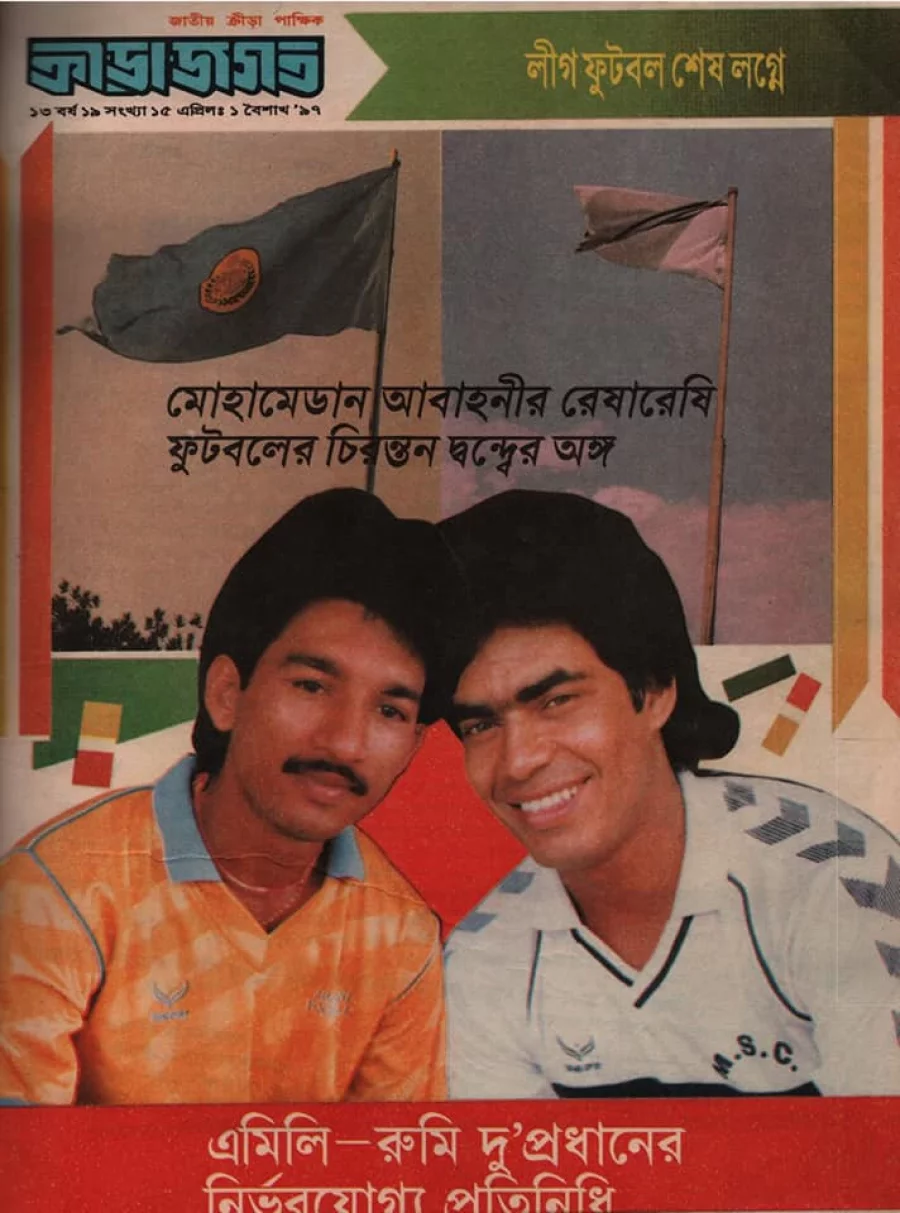
Published in 1979 on sports fortnightly Krira Jagat, renowned journalist Ikramuzzaman wrote an article titled, "In the eyes of the Abahani, Mohammedan fans."
In it he mentioned, "Looking out, I can see the flags of Abahani and Mohammedan flying on roof of many houses in Dhaka. If there is a game between Abahani and Mohammedan in the late afternoon, it can be seen that there are empty chairs and tables in many offices in the neighborhood of Motijheel.
“Afternoon classes in schools, colleges and universities are not attended by many when these two teams take on each other. Same goes for many shop owners or salesmen. Many boy bearers in hotels and restaurants take leave at noon. Many rickshaw pullers do not ply their vehicle. No one wants to miss the afternoon game."
Also Read: Abahani, Mohammedan face off in Federation Cup final after 14 years
Intense gathering to watch training
Fans of Abahani and Mohammedan used to take a long walk just to watch the training sessions, and the day before the derby would see packed gathering.
A former footballer assumed that the number was around 10,000.
Besides, during training, the special presence of fans could be noticed when a new star footballer joined the team.
Many people used to come to the training camp to take a close look at their favorite footballer.
When a new foreign footballer joined, fans flocked to watch him.
How a player performed in practice used to be the talk of the town.
Football in movies, music and commercials
There was once a time Abahani and Mohammedan used to feature in film songs.
There were also many poems and rhymes composed on these two clubs.
The then renowned band “Zinga Shilpi Goshthi”, established in the 1960s, released a song related to the hullabaloo in the football field.
The song is like a story.
A teenager, despite his elder brother's opposition, took money from his elder sister to watch the Dhaka Derby but was admitted to hospital after getting into trouble at the stadium.
The advertising world also wanted to be involved with football.
Abahani's popular footballer Salahuddin modeled for Lifebuoy soap advertisement.

The fuss and vandalism
It was unthinkable that there would be a game between Abahani and Mohammedan without uproars and fights.
A Mohammedan supporter entering Abahani's gallery or vice versa never had a good ending.
Any decision by the referee on the field would lead to huge disapproval.
There were frequent incidents of cutting the barbed wire fence to enter the pitch.
Police used baton charge or tear gas to stop the chaos.
The commotion quickly spread outside the stadium and the old Paltan and Gulistan areas soon became battlefields.
There were incidents of brick and stone pelting, vandalism of cars and street lights.
There have even been several incidents of loss of life.
On July 20, 1978, after the Abahani-Mohammedan game, an eighth-grade student named Farooq Hossain died during a fight.
Despite many articles in the newspapers, it was not possible to stop the hooliganism centering around the Dhaka Derby.
Harun and Yasin lost their lives in another major riot within a few years and hundreds of spectators and innocent passers-by were hospitalized.
The stories of those riots are still often narrated by players and supporters.
Festive mood to celebrate victory
Be it Abahani or Mohammedan, the day- and night-long festival would start soon after they became champions.
The celebrations started from the gallery where sometimes the best player was raised on the shoulder on the field and carried onto the club premises.
Victory procession started from the field and ended at the club ground and fans would arrive to celebrate the victory carrying flags and banners whilst chanting slogans.
Band parties were hired, sometimes to tour the whole city.
Some residents of Old Dhaka said cows were slaughtered and cooked in large bowl, and sweets were distributed.
The club was crowded with supporters.
According to a former national footballer, singing, dancing and playing with colors were among many things that today's players can't even envisage doing in the modern day.
Sometimes the victory festival would last two-three days.
