


Ahmedabad hosted the final of the ICC Cricket World Cup 2023.
After departing from Pune and reaching the western Indian city in the state of Gujarat to cover the grand finale, the main attraction was obviously to visit the Narendra Modi Stadium as this is the biggest sports venue of the world.
While entering through gate number one, which is usually the entry for media personnel, the first impression after observing the stadium structure was, “Whoa…it’s huge!”.
After walking for around five minutes from the entry gate and approaching the main compound of the stadium, the massiveness of the megastructure was felt right away.
Having reached the main compound, a slight confusion arose - where exactly is the media center?
There was a map at one place but the stadium arena seemed so big that the directions looked like a puzzle initially for a person like me who has come to the stadium for the first time.

After finding the way to the media center and while walking towards it, I had a chance to look at the inside of the stadium and it looked stunning.
The stadium, established in 1982 in Motera, was formerly known as the Sardar Patel Stadium, or Motera Stadium.
It went through a series of renovations in the last few decades before turning into this colossal structure.
It is situated on the banks of river Sabarmati and in the outlying region of Ahmedabad.
The Gujarat Cricket Association scrapped the Sardar Patel Stadium in 2015 to build the world's biggest cricket stadium which was later named as Narendra Modi Stadium.
The mega renovation project of Narendra Modi Stadium was carried out for five years, between 2015 and 2020.
It was demolished and rebuilt from scratch and according to reports the estimated cost was 800 crores Indian Rupees or $100m approximately.
The stadium has been designed by Australia-based architectural firm Populous (also designing the Sheikh Hasina International Cricket Stadium in Dhaka) and the building contractor of the arena was Larsen and Toubro.
After the renovation, the stadium first opened to the public in 2020 during the “Namaste Trump” event.
The program was organized for the United States president Donald Trump when he visited India in February of that year.
The renovated stadium was inaugurated in February a year later when hosts India faced England in a day-night Test match.
There is a huge area for parking that can accommodate approximately 3,000 cars and 10,000 two-wheelers.
The stadium has all the modern facilities including four dressing rooms, 11 center pitches, and two practice grounds.
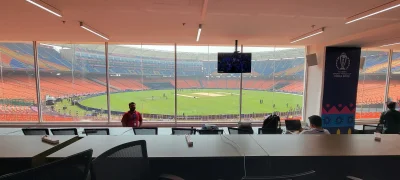
The main press box in the media center is well decorated with around 150 seating capacity.
There is another press box in the overflow area which has been opened due to excess number of media personnel who have come from all over the world to cover the finale.
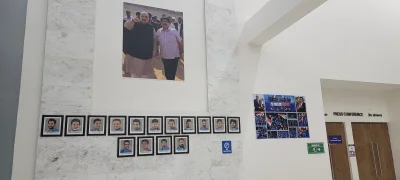
The press conference area is at the ground floor of the media center.
In the lobby, all the Indian squads of World Cup winning teams – 1983, 2007 and 2011 – are displayed.
Australia captain Pat Cummins’ press conference before matchday was scheduled for 10am local time and his Indian counterpart’s at 5:30 in the evening.
So after attending Cummins’ media briefing in the morning, there was plenty of time at noon for me to roam around the stadium and I took the opportunity with both hands.
There was a curiosity of watching the view from the highest row of seats inside the stadium, and after reaching the top level by climbing so many layers of stairs, the scene was amazing and absolutely worth watching.
From the ground level to the top row of the seats, it was around 15-storey high.
The Narendra Modi Stadium is the biggest sports ground of the world with an official capacity of 132,000.
The second largest stadium is Rungrado 1st of May Stadium in Pyongyang in North Korea which can hold 115,000 spectators.
Third in the list is Michigan Stadium in Ann Arbor, Michigan, USA with 107,601 seats.
Fourth is Beaver Stadium, State College, Pennsylvania in the USA with a capacity of 106,572.
And the fifth is Ohio Stadium, Columbus, Ohio, USA with 102,780 capacity.
It takes hours to complete visiting the whole stadium and observe most of the facilities but it was worth it to walk so many steps in the end to witness such a wonder structure.
