




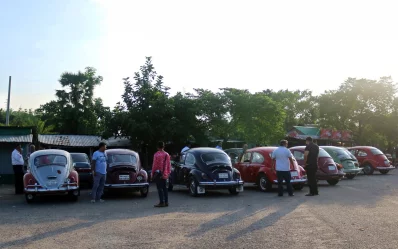
When 10 Volkswagen Beetles in various shades line up against a setting sun amidst the greenery of Purbachal, just outside Dhaka, the atmosphere cannot be bland.
On June 22, the world celebrated the iconic Volkswagen car, the Beetle, across the world and Beetle owners in Bangladesh, under the banner Volkswagen Club, Bangladesh, congregated in Purbachal, approximately 15km from the centre of Dhaka, to mark the day.
Is there anything unremarkable about this car? From the distinctive looks, to the sound, to the placement of the engine, and the overall experience, the VW Beetle is unparalleled.
Air-cooled without a radiator and the engine placed in the rear bonnet or the boot -- the car made in Germany had always been a standout.
Then there is the bug shaped body, which makes it recognizable anywhere. In Bangladesh, it was called “Kaudda gaari” or “Tortoise Car” by the masses.
But that was in the 60s and 70s when the car was ubiquitous on Dhaka roads. Till the mid-80s, Dhaka saw a large number of European cars, including Mini Moke, Fiat 500, Fiat 1000, Renault, Morris, Mini Cooper, and others. However, the Beetle was a clear favourite of the middle-class urbanites.
The reason for such popularity was simple: The car was easy to drive and maintain. Interestingly, there’s also a sociological explanation linked to the widespread acceptability of the car.
Volkswagen in English is the “people’s car” and thus it resonated with a burgeoning socialist ideal dominating the zeitgeist of a post-independent Bangladesh.
However, with the expansion of the market for Japanese cars, the European vehicles slowly disappeared, and were eventually sold to dealers who dismantled the vehicles to be used as scrap metal in other industries.
The craze in the 90s, coinciding with the surge of globalization, was to get luxurious cars, featuring air conditioning and other gadgets. In that wave to get new rides, the old cars were sold off.
Fortunately, some owners doggedly retained their Beetles because they were seen not as a vehicle but as a family member. And those who did just that are now having the last laugh. On the road, when they bring out their restored Beetle, admiration and appreciation pour from all sides.
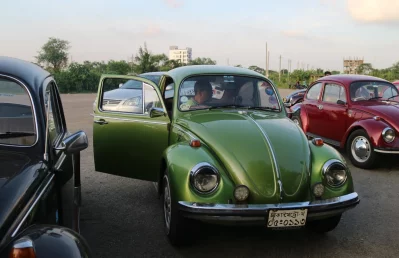
Owners take pride
“The love affair with the Beetle began when I was a child,” observes Rashed Ahmed Shams, Rousseau, adding with conviction: “She is not just a vehicle but more of a trusted companion.”
Rousseau’s fire red Beetle has a jazzy look with a state of the art interior, although the affinity with the vehicle is reinforced by the fact that his mother took her last breath in the car on her way to the hospital.
Another proud owner of several Beetles, Md Didarul Islam Sujan, opened up a fascinating chapter in his life, involving a Beetle.
“In 2004, before GPS and smart-phones, I along with three others went to Kathmandu, Nepal, with four Beetles.”
Sujan still has the car, a 1971 Beetle, in immaculate blue. Referring to the car, he says affectionately: “This has a 1600cc engine, twin exhaust, which means the car can generate more power than most modern sedans.”
Volkswagen in English is the ‘people’s car’ and thus it resonated with a burgeoning socialist ideal dominating the zeitgeist of a post-independent Bangladesh
However, being the true gentleman and an ardent advocate of road safety, Sujan underlines the need to drive cautiously and patiently.
For valid reasons, Didarul Islam’s car is believed to be one of the few in “mint” condition. This car was also featured in a film, Shei Shob Din, depicting the turbulent period during the 1971 War of Liberation.
“It’s not just about the look of the car, but minute details, like the unique sound of the door clicking to the lock when closed; that sound in itself is a throwback to the past.
“Add to that the smell inside, which evokes lost days of a slow-paced unpretentious Dhaka city from the 70s and 80s,” commented Didarul Islam Sujan.
A close-knit community
Responding to a question regarding maintenance, Rousseau lamented the lack of expert mechanics.
“There are three persons, all in their sixties, who were trained by German mechanics in the 70s about Beetle maintenance and we rely on them to help us keep the vehicles in top order.”
Rousseau recently had some small interior parts brought from Europe.
Those who own one or several Beetles usually have links overseas to bring an array of car related accessories from Europe, he informed.
In the Dhaka Volkswagen fraternity, many of the current owners are in their early thirties, having inherited a car from their father.
For Dipon, a young banker, a burgundy coloured Beetle is a family heirloom. An adventurous spirit outside the conventional banking periphery, Dipon has taken his car to Sajek Valley in the Chattogram Hill Tracts.
“I have also been to Khagrachari in this car and did not face any technical issues,” states Dipon.
Dipon’s car still has the original wheel although the gear-shift has been changed to facilitate a smooth ride with an electric fan added to ward off the sweltering Dhaka heat.
“However, to produce more power, the engine is beefed-up because on open highways, I love to press the accelerator a bit,” confessed the young owner.
Zubeir Moin, a business-man, is the president of the Volkswagen Club in Bangladesh and, his answer, when asked about his affair with the Beetle, blew us away: “I was born and raised in a Beetle; therefore, the link started from day one.”
He owns a purple 1969 Beetle, driving it to work every day.
Elaborating his feelings about the Beetle, he asserts: “It’s a way of life and wherever I go, the car receives admiring looks.”
The proud owners of the VW Beetle are engaged in a variety of professions, but one sentiment ties them in a firm bond -- they are determined to hold on to their Beetles.
To be frank, the mere mention of selling the car is sacrilegious.
A spirited family occasion
On June 22, Beetle owners across the world drive their cars to work but since the day fell on a Saturday this year, the underlying theme was to take the Beetle for a day out with family.
In that holiday-weekend spirit, the owners drove out of the cacophony of Dhaka and headed to Purbachal.
Sitting in front of a tea shack outside the city with the cars parked in a row, the club members spent the time recounting stories involving their Beetles.
As evening approached, the fierce sun diminished to create a reddish tinged twilight. It was time to go back.
Lined up in a row, the leader of the pack gave the signal, and off they zoomed, into the twilight -- Dhaka’s Beetle gladiators.
Towheed Feroze is a former journalist and a Beetle fan.
