


Imagine you are a fund manager -maybe you are managing your own money, or a mutual fund or the portfolio of a corporate bank.
Just as the output of a student's academic term is their CGPA, the output of a fund manager or an investment manager is their returns.
Investors are interested in knowing how their investments have performed.
Measuring and understanding a fund manager's performance is vital to improving the management of an investment.
The challenge, however, lies in having an adequate system in place in order to be able to judge a fund manager's performance.
After all, it is not as if their results are published in report cards.
Unfortunately, there exists a distinct lack of performance measurement systems for investment managers in Bangladesh and the rare ones that do exist are far too simplistic.
In Bangladesh, fund performance measurement is rarely done properly by portfolio managers or investors.
Most often, people simply look at the cost value of stocks and market value to judge performance.
Similarly, people tend to consider “realized gains and losses” as actual gains or losses and thus ignore “unrealized gains and losses”.
These practices lead to a number of mistakes in performance measurement which we have listed below.
Mistake 1: Not considering time horizon
One common mistake is not considering the time horizon that the investment was managed for.
Let’s illustrate why this is an issue using an example: Imagine you had invested Tk5,000 in a mutual fund in 2010, and by 2020, it is worth Tk10,000.
A 100% return may look fantastic at first glance, however, did your fund manager really perform well if it took 10 years for them to generate this return?
Let's consider another example: Person A invests Tk100 upfront.
Person B invests Tk20 every year for 5 years. Both investments are worth Tk120 at the end of 5 years.
In this scenario, although both investors are earning similar absolute returns, the second investor is earning a much higher rate of return compared to the first.
If you had a choice to invest in either of these portfolios, which one would you choose?
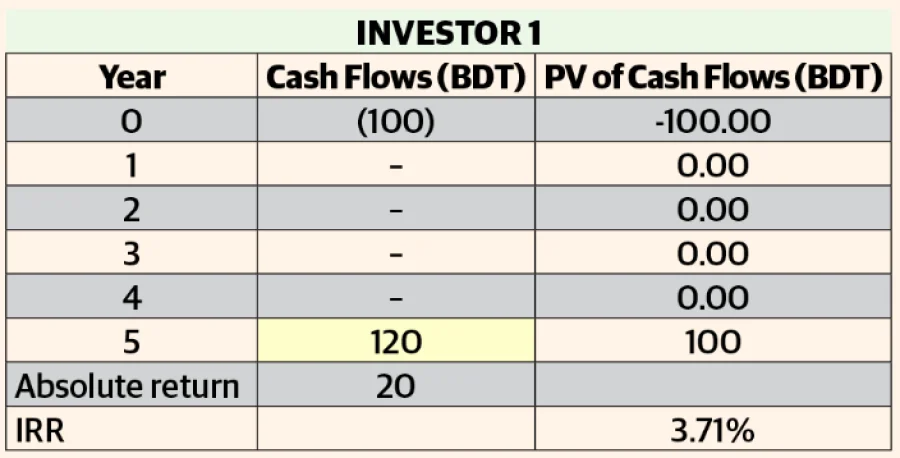
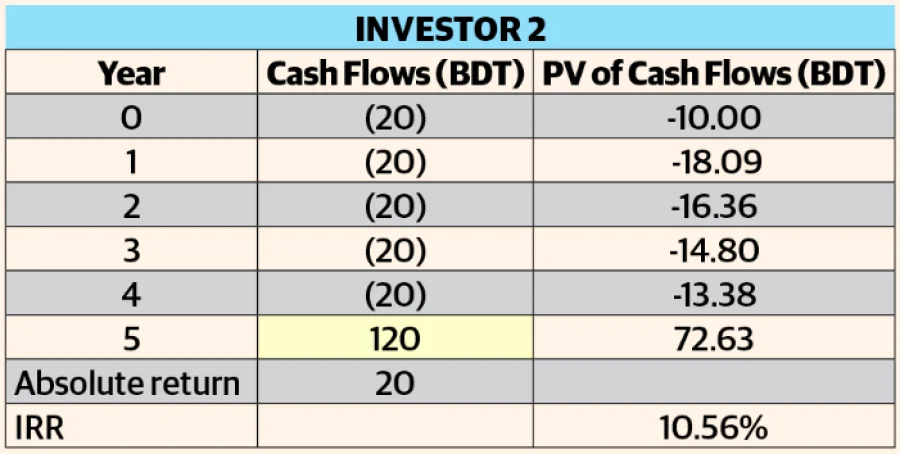
| Here, the absolute return for both the investors is Tk20, however, the returns of the funds are different due to differences in the timing of the cash flow injections. The return (IRR) is calculated by finding the rate that equates the present value of the cash inflows to the present value of the cash outflow. In doing so, the IRR shows us the money-weighted return of two investments with the same premium (BDT20) but different cash flows. In this example, equating the cash flows shows us that the IRR for the second investment is higher, making it the more desirable one. |
Mistake 2: Not considering relative performance
What if, during this 5-year period, the DSEX return was 20%?
Did either fund manager do a good job if the opportunity cost of investing in their funds was to miss out on a superior DSEX return?
Judging an investment only by its return ignores the performance of the market and the performance of comparable investments.
Setting a performance benchmark- often done by following an index that has a similar strategy to the fund in question- helps both the investor and the fund manager judge the fund’s performance in relation to the market and provides context to the returns.
Funds that have outperformed the market generally reflect well on the fund manager’s abilities.
However, rarely in Bangladesh, are investment performances compared to relevant benchmarks.
Mistake 3: Considering realized gain as performance measure
Another current practice open to scrutiny involves considering only realized gains as investment gains.
A major issue arising from this is that it delays the recognition of gains and losses in evaluating performance.
This misrepresentative practice opens the door to another issue: manipulation.
Fund managers can easily manipulate their performance evaluations if unrealized returns are left unaccounted for.
To illustrate, imagine a fund which has an unrealized gain of 30%. A fund manager who is leaving their current post might decide to immediately sell the assets, without any regards for future performance of the assets, in order to have the fund gains reflected on his evaluation record.
Conversely, imagine a fund that has been experiencing continuous losses.
The fund manager refuses to sell the assets in fear of having these losses stain their performance records.
If a new fund manager sells these loss-creating assets, they would have to unfairly bear the stain of having the losses reported on their record.
How do we revise our current practices?
We need to start by acknowledging the drawbacks of our current practices and agree that measuring return performance requires a proper system to be in place.
Individuals who will be responsible for evaluating performance will also need relevant training and expertise.
Developed economies have made huge advances in designing and developing systems for performance measurement of fund managers and we can easily learn a lot from them and adopt some of their learnings.
Faiza Kamal is an intern at EDGE Research & Consulting Limited. Asif Khan, CFA is chairman of EDGE AMC Limited
