



The eminent Austrian economist, Joseph Schumpeter, had defined entrepreneurs as “individuals who exploit market opportunity through technical and/or organizational innovation”.
To Frank H Knight, another famous economist known for his work on risk and uncertainty, entrepreneurship is mostly about taking risk.
When HYV rice was introduced in Bangladesh in the 1960s, there was concern whether the small peasants of Bangladesh, living on the margins of subsistence, would adopt this new variety of rice.
To the surprise of many, Bangladeshi farmers, including the small ones, were rather quick in adopting the new technology, the so-called seed-fertilizer-water technology (HYV rice needed irrigation and fertilizer; hence the name).
These intrepid small farmers were among the early entrepreneurs of Bangladesh.
The farmers started with new varieties of rice and gradually diversified.
First came other crops, such as potatoes.
Then came non-crop agricultural activities, such as aquaculture and poultry.
In doing so the farmers were responding to market opportunities with technical or organizational innovations, however modest these might have been.
They were taking risks too - price risks, demand risks and technical risks.
Schumpeter and Knight would clearly have been impressed.
As irrigation coverage and fertilizer use increased in support of HYV rice cultivation, and policy reforms expanded space for private sector distribution of irrigation equipment and fertilizer, a new class of traders emerged in the rural areas.
As many farmers could not afford the cost of irrigation pumps, a rental market developed for such equipment, along with repair and maintenance services (see chart).
In many cases, farmers who had the required capital carried out such activities in parallel to farming.
This also created entrepreneurial opportunities in rural Bangladesh.
Mechanization in agriculture
As mechanization increased in agriculture, initially in the form of mechanized irrigation and then expanding into other types of equipment, a domestic manufacturing industry developed to make some of these equipment and their spare parts, even while imports remained dominant.
Meanwhile, as farmers diversified into non-rice crops such as potatoes and vegetables, and non-crop agriculture such as fisheries and poultry, a value-chain developed around these activities with the entry of new players besides the traditional village traders.
These included cold storages for potato and hatcheries for aquaculture.
Yet another new breed of entrepreneurs emerged in rural Bangladesh.
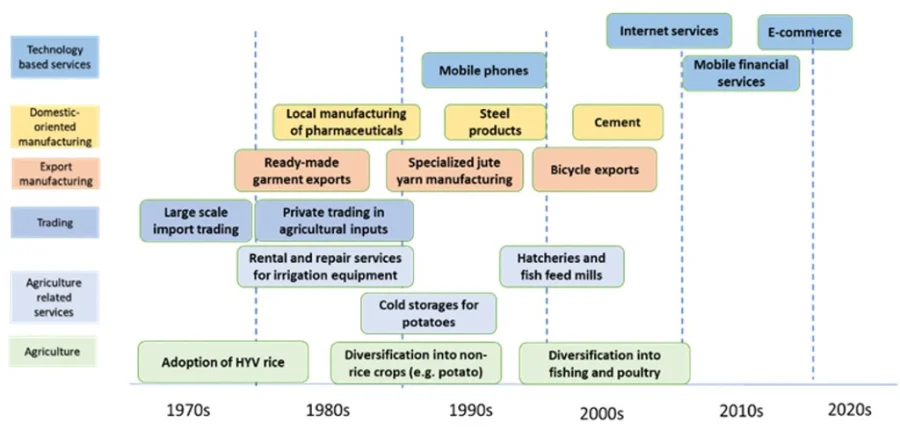
Finally, as rural incomes increased due to agricultural growth, remittance inflows and wage earnings of rural women employed in the garment industry, demand increased for a wide variety of rural non-farm products, as well as products made in the urban areas.
The significant expansion in the rural road network, starting in the late 1980s, helped expand the supply of such urban goods to rural markets while also facilitating the sale of rural products, both agricultural and non-agricultural, to urban areas.
All these activities led to the emergence of an entrepreneurial class in rural Bangladesh.
Many were based in the rural areas and may have been farmers before.
Others engaged in such activities as supplements to their farming activities. In some cases, the entrepreneurs came from urban areas, but their business was at last partly in the villages.
In other cases, villagers may have migrated to the cities but then leveraged their rural knowledge and connections to conduct business in the rural areas.
Meanwhile, things were brewing in the urban areas.
Independence, and the resulting exodus of non-Bengali businessmen who had dominated the business scene in pre-independence Bangladesh, created opportunities for Bangladeshis. In those early days, opportunities were limited in manufacturing following the nationalization of industries in early 1972.
Private investment in industry was allowed but subject to a ceiling.
Also, given the political and economic uncertainty in the early years after independence, investors were reluctant to make long-term investment in industrial activities even on a small scale.
Entrepreneurial energies were thus directed towards trading, including importing.
Foreign exchange shortages led to rationing of imports through import licenses.
Those who got such licenses enjoyed a scarcity premium.
Money was also to be made by selling products made by the public sector enterprises.
The origins of some of the large conglomerates of Bangladesh can indeed be traced to such business ventures of the 1970s.
Rise of industries
An export-oriented garment industry made its debut in the late 1970s and took off in a big way in the 1980s.
The 1980s also saw the beginnings of ceramic tableware exports and an acceleration of jute yarn exports.
The 1990s heralded the entry of Bangladeshi bicycles in global, primarily European, markets.
Meanwhile, rising incomes and certain policy actions stimulated the growth of domestic market-oriented industries.
The path-breaking Drug Policy of 1982 gave a big boost to the domestic pharmaceutical industry which now serves most of the local market.
The 1980s also saw the beginning of the ship-breaking industry which facilitated the growth of a domestic steel industry by providing raw material for it.
But the big boost came later, in the 1990s and in the new millennium, as rising incomes, combined with public investment in construction related activities, created huge demand for construction material.
This boosted the growth, first of the steel industry, followed by the cement and tile-making (ceramic) industries.
In recent years, rising incomes and certain protection policies of the government have facilitated the growth of an electronics industry, some of whose products are now also being exported.
Finally, the spread of mobile phones, expansion of internet use, and the growth in mobile financial transactions, have catalyzed the growth of digital businesses.
Paradoxically, Covid-19 has given a boost to many such activities by increasing the demand for online purchases.
Diversity
The rich variety of entrepreneurial activities described above suggests both diversity as well as commonalities in the entrepreneurial journeys of economic actors in Bangladesh.
Breakthroughs in the export market, not just by garments but slowly by other products too, is an indicator of competitive niches.
Both entrepreneurs and workers have shown an ability to learn fast, grabbing opportunities as swiftly as they appear, irrespective of whether these originated domestically or came from global markets.
Entrepreneurship has blossomed in both the economic and social spheres.
NGOs have not only created effective delivery mechanisms for social services, but many have become vehicles of entrepreneurial activity.
People have seen problems, thought about creative solutions, mobilized required resources, delivered the solutions, reassessed them in the light of experience and redesigned approaches when needed.
There are a few important things to note from the entrepreneurial stories mentioned above.
First, the unleashing of the entrepreneurial spirit in Bangladesh has been across-the-board, from the small farmers to the large conglomerates, from agriculture to manufacturing, from domestic market-oriented activities to export ventures.
Second, there are linkages between these activities. As HYV rice production increased, it created entrepreneurial opportunities in the import and distribution of fertilizer and irrigation equipment and fertilizer.
The spread of irrigation equipment, in turn, created business opportunities in the repair of such equipment and the provision of required spare parts.
As potato production increased, it stimulated investment in cold storages.
As aquaculture took off, entrepreneurs responded by setting up hatcheries and fish feed industries.
As rural incomes increased due to all these agricultural activities, it stimulated demand for non-farm products thus catalyzing an entrepreneurial response in rural non-farm activity.
It also created the ground for agro-processing industries.
A similar story can be told of linkages within urban activities.
The growth of garment industries led to expansion into backward linkage industries such as textiles.
The rise of construction activity stimulated the growth of the steel and cement industries.
And the growth in mobile phone subscriptions made possible the phenomenal growth in the mobile financial transactions industry.
Developed countries are usually expected to have a steady stream of entrepreneurs, adept at identifying and prioritizing investment opportunities, and translating these into actual investments.
The major constraint in such countries is the availability of finance, which in turn depends on the supply of savings.
Traditional growth theories, informed by developed country experience, assumed that so long as savings and profitable investment opportunities existed, there would be no shortage of entrepreneurs to exploit such opportunities.
Investment will thus automatically follow.
For the developing world, by contrast, the main challenge was presumed to lie in the supply of entrepreneurship.
It was believed that such countries will lack a steady stream of entrepreneurs capable of identifying investment opportunities.
This view was contested by the famous economist Albert Hirschman.
In his classic book, The Strategy of Economic Development, Hirschman suggested that developing countries often have a ‘reserve army of entrepreneurs’ which remains latent, waiting for the right opportunity to make its entry.
It appears from the experience of the last fifty years that Bangladesh indeed possesses such a reservoir of entrepreneurial talent, which had long been waiting to be unleashed.
An independent Bangladesh provided a space for such a spirit to burst forth, further nurtured by policy actions of the government, and stimulated by fortuitous developments in the global economy and the infusion of new technology.
Entrepreneurship has been unleashed in waves in Bangladesh, each building on the momentum of the preceding ones.
Therein lies the secret of Bangladesh’s remarkable development journey since independence, and the formula for its resilience in the face of many odds.
The author is an economist, previously with an international development agency
