




Just as Covid-19 leaves the survivors emaciated, so is the pandemic leaving public finances significantly weakened. With economic activities being halted initially, government revenues were falling short of what had been budgeted. Meanwhile, governments are spending additional sums to support the health sector as well as workers and businesses more broadly. As result, budget deficits are widening, and public debts are rising.
Bangladesh is no exception. According to the IMF, the budget deficit for 2020 was likely to be 6.8% of GDP, compared with the 3% it projected a year ago. The debt-to-GDP ratio for 2020 was expected to be 40%, from last October’s projection of 35%.
Hsowever, according to the IMF, the impact of the pandemic on public finances was expected to be less severe in Bangladesh than in many of its South and Southeast Asian neighbours.
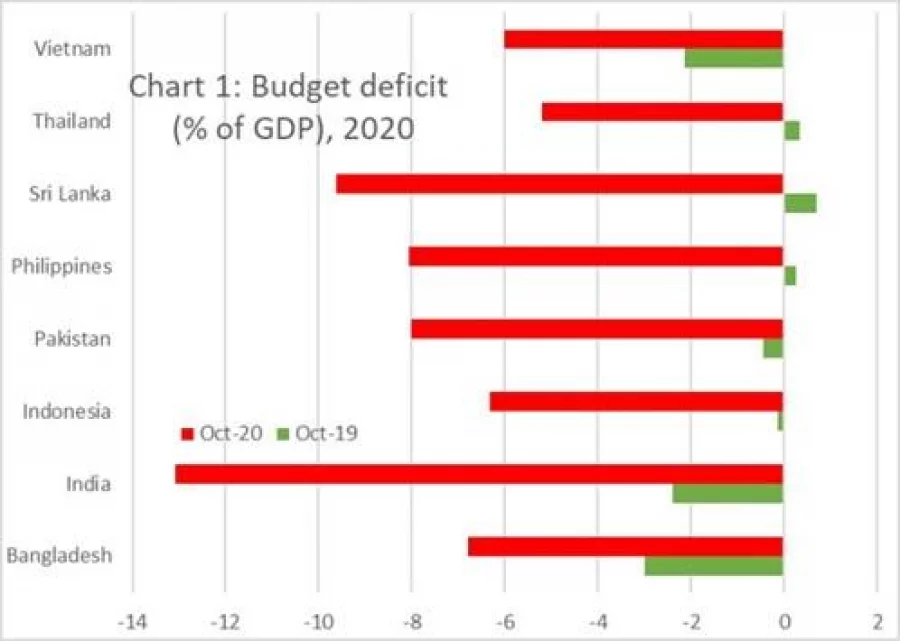
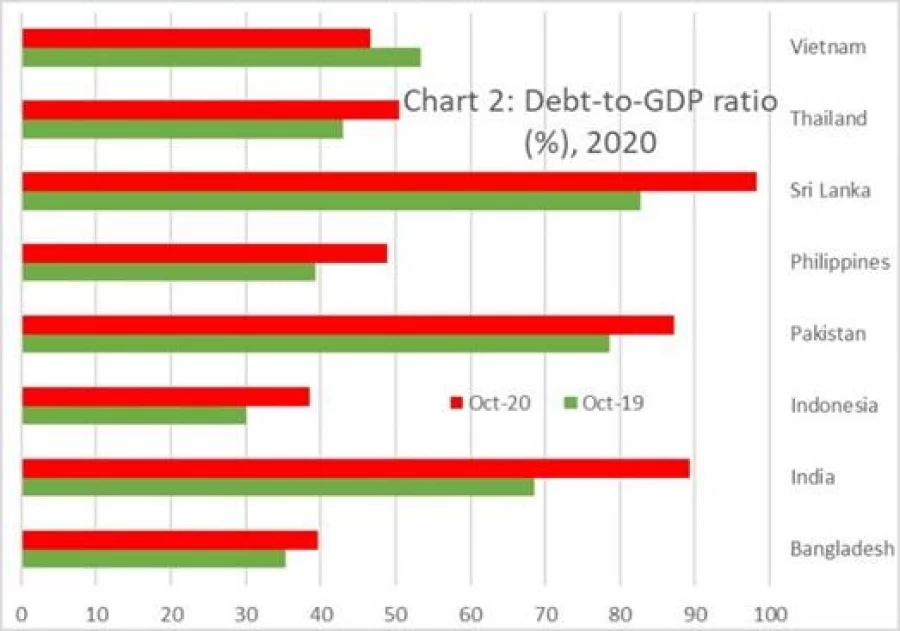
That said, the IMF was expecting a worse fiscal outlook than what Bangladesh government budgeted for in June -- the official figures show a budget deficit of 6% of GDP in 2020-21 fiscal year. This reflected IMF’s assessment that economic recovery was going to be much weaker than a return to the 8% growth underpinning the budget.
What does the scenario analysis we have been considering over a number of posts imply for debt dynamics?

Recall that some back-of-the envelop calculations based on the above scenario implies:
- There might be a revenue shortfall of about Tk500 billion (or $6bn) a year in 2020-21 and 2021-22;
- Shelving development expenditure might be one way to manage the revenue shortfall;
- alternatively, the government might borrow from the IMF (and other multilateral institutions) or China to finance a larger budget deficit.
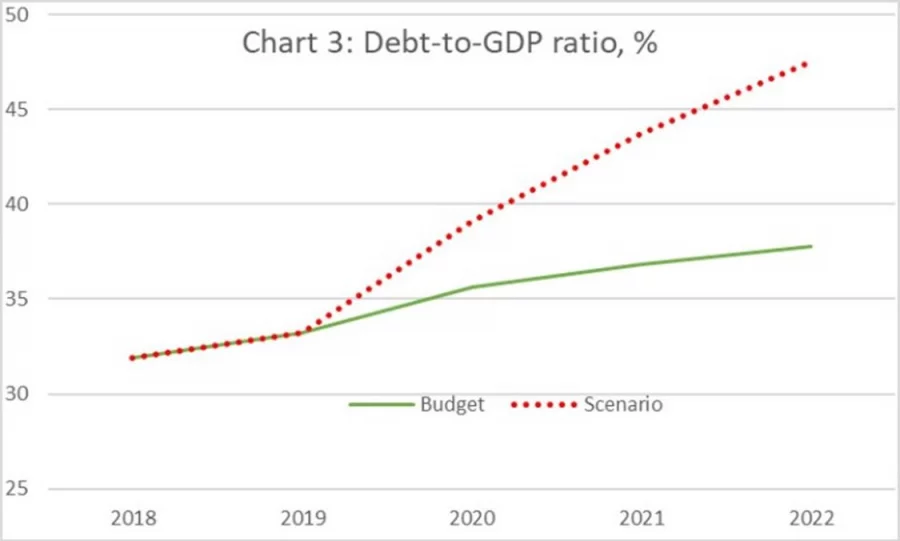
Of course, if the government were to take the borrowing option, the debt-to-GDP ratio would rise even further. The exact trajectory of the ratio in the alternative scenario would, however, depend on two other factors: Economic growth, which determines the government’s ability to meet its obligations; and the real interest rate, which determines how the existing stock of debt rises over time. All else being equal, slower economic growth would reduce the government’s ability to pay down existing debt, and raise the debt-to-GDP ratio.
Assuming no change to the real interest rate, a weaker economic recovery such as the scenario being analyzed would raise public debt by about 10% of GDP by 2021-22 (Chart 3).
The good news is that relative to GDP, Bangladesh will be still far less indebted than, say, India, Pakistan or Sri Lanka.
The bad news is that the scenario analysis may not be capturing the full picture.
Firstly, the unchanged real interest rate is a big assumption. The budget assumes a nominal interest rate of 1.4-1.5% for the externally held debt. This assumption may well be valid for our purposes if the government were to borrow from the IMF and other multilateral institutions.
Unfortunately, terms and conditions of other countries’ debt agreements with China are quite opaque, and it is hard to assess what might be a sensible nominal interest rate assumption for a loan from China.
More importantly, one needs to have a view about future exchange rate movement if the government were to borrow nearly six billion dollars a year -- for context, at the end of 2017-18, total stock of externally held public debt was about $40 billion.
And any view about the exchange rate is intricately linked with monetary policy and THE inflation outlook. Fortunately, the current inflation environment is quite benign, and there is no immediate pressure on the exchange rate.
Unfortunately, sentiments could turn on the proverbial dime, let alone six million grand! Greater transparency would, of course, help anchor exchange rate expectations -- providing yet another argument for preferring the IMF and multilateral development banks over China.
Further, if the economic rebound had proved to be as anaemic as the scenario being considered, it is quite likely that the government would be under pressure to spend.
Households might need to be supported through either cash payments or public relief operations that provide food and other necessities. Businesses might need bridging loans or other forms of assistance.
In the more extreme, but all too plausible, scenario where Bangladesh’s low cost manufacturing dependent growth model becomes unsustainable, the government might need to consider policies to “build back better.” The IMF’s own analysis suggests public investment on infrastructure might provide a good foundation for recovery.
Their projections for Bangladesh were more optimistic than elsewhere in the region. Yet more arguments for approaching the Fund then?
Well …
These “Washington institutions” would provide concessional loans, but insist on “conditionalities” that would expose underreported expenditure, contingent liabilities, undisclosed obligations, and other fiscal shenanigans. The same cannot be said about Beijing. And therein might lie the rub.
Since the middle of last century, before there was a Bangladesh, across the spectrum ranging from the Marxists to Islamists with various shades of nationalists in between, the so-called neoliberal West has been viewed with suspicion and unease by our political classes, for whom the red star over China has always shone bright -- after all, there is a reason why the People’s Republic was chosen in the battlefield by the country’s founders.
The current finance minister is reputed to have strong commercial links with China.
This year, his instincts and political expediency might push him to travel northeast in search of $6bn. But we all might be better served if he travelled northwest.
Jyoti Rahman is an applied macroeconomist. This article appeared on his blog jrahman.wordpress.com and has been reprinted here with special permission.
