



On August 7, just two days after the toppling of tyrant Sheikh Hasina government -- when the country’s overall law and order situation was still very fragile with a large number of policemen not yet rejoining their duties, I received a message on my phone from a longtime friend from the Philippines enquiring about our safety.
“How are you and the family? I hope you are well and safe. I have been praying for Bangladesh,” reads the message sent by Edita Burgos, whom I fondly call Tita (aunt) -- whose long-lost middle son Jonas is about my age.
As I assured her that we were safe and looking forward to see the rise of a new democratic Bangladesh, Edita pressed further, with a deep sense of anxiousness: “I wonder if you have heard about Adilur Rahman Khan. He heads Odhikar, a human rights organization in Bangladesh. He is a friend. Been also praying for him and his organization.”
I knew it for many years that they’ve (Edita and Adilur) come a long way championing the cause of human rights -- specially raising their voices against the heinous crime of enforced disappearances in some countries of Asia. I could well understand where Edita was coming from, her concerns for Adilur.
It was only natural for someone like Edita, a champion in her own right and mother of an “enforced disappearance” victim, to be anxious about Adilur Rahman Khan (now an important member of the Yunus-led interim government), whose organization has long been tracking the cases of enforced disappearances in Bangladesh.
Edita Burgos was a teacher who wanted to be a nun when she met the man who would become a free speech icon in the Philippines -- Jose Burgos Jr (popularly known as Joe Burgos). Joe, whom I used to call Tita (which also means uncle), was a good personal friend and a mentor to me who died rather prematurely at 62 years of age in 2003.
Named one of the world's "50 Press Freedom Heroes of the Century" by the International Press Institute (IPI) in 2000, Joe was the leading symbol of the "alternative press" or what they used to call in the Philippines "mosquito press" which exposed the truth about the Marcos dictatorship with his publication the WE Forum.
Jonas Burgos was abducted on April 28, 2007, four years after his father’s demise, from near a Quezon City mall
President Marcos called them “mosquito press” because he thought, just like the mosquitos, they could be a major annoyance but not too deadly. Joe was jailed by the late dictator Ferdinand Marcos along with his leading columnists and staff members after a raid on his newspaper office in December 1982, but went back to active publishing just a month after being released from prison.
Joe and I spent days together organizing networks of Asian farm journalists back in the late 1990s and had great times together at his farmhouse, far off from Metro Manila, angling Tilapia at his fish farm, sipping fresh brewed San Miguel and Tortang Talong (a Filipino eggplant omelet dish) that he would cook especially for me.
The couple’s (Joe and Edita) middle son Jonas Burgos, who showed all the signs of kindness, empathy, and charity from a very tender age, was abducted on April 28, 2007, four years after his father’s demise, from near a Quezon City mall. He was 37, and had a daughter and wife. He was red-tagged and banished for all these years not to be found till date.
Even as a child, Jonas would take his food from the dining table to give this to a neighbour. Sensitive to the difficulties of ambulant vendors, Jonas would exchange his father’s slippers with the worn-out slippers of a poor -- taho (Filipino vendors selling snacks made from sweetened tofu with sago pearls). As a college student, Jonas -- an agriculture student in the Benguet State University -- would share his harvest with his fellow students and the poor families living near the University campus.
Edita, who headed the Philippines Home Economics Association for many years and has written a number of books, referred to a homily that says: “When a rich person gives to the poor he is called a saint. But when a poor person gives to the poor, he is called a communist.” Edita, who has been an active member of various national and international rights bodies fighting for the cause of stopping enforced disappearance being used as a toll to suppress dissenters, applauded Bangladesh’s recent accession to the UN convention protecting people from being disappeared.
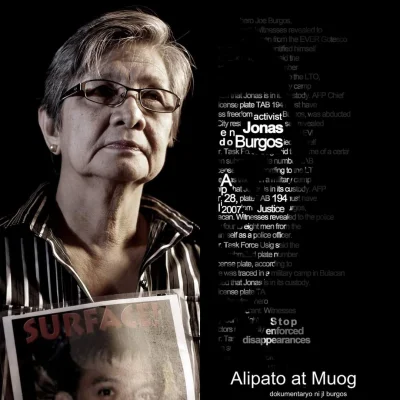
Edita says though the Supreme Court has resolved that the Philippine Army was responsible for the abduction of her son, the state apparatus never did feel compelled to return Jonas to his family all these years. “Such is the justice system we are faced with.”
Now, closer to home, just the other day (August 26), dozens were killed in the Musakhel district of Pakistan’s Balochistan province with the Balochistan Liberation Army (BLA) -- the most active militant group in the province -- claiming responsibility for the attack, the second of its kind this year. While the world has reckoned the death tally with angst, how many of us living around the world are today actually aware that how hundreds of Baloch families saw their near and dear ones becoming victims of enforced disappearance?
My good friend, Karachi-based journalist Zofeen T Ebrahim, offered a figure in her piece published in the Guardian on August 31. It referred to a rough estimation of more than 5,000 Baloch who have been abducted since the early 2000s. “These are very rough figures and could be more as even gathering data has become dangerous. Our volunteers have been warned to stop this exercise,” says Mahrang Baloch, the leader of the Baloch Yakjehti Committee (BYC), which believes in peaceful protests unlike the BLA. Balochistan’s history of resistance against the Pakistan government goes back to 1948 and has continued ever since.
Pakistan’s military, paramilitary, and intelligence forces have responded by kidnapping, torturing, and killing Baloch men, writes Zofeen.
After the August 5 change-over through a student-people’s revolution in Bangladesh, the dark episode of many enforced disappearances has come into the fore. It becomes crystal clear now that, for too long a period, the now toppled Sheikh Hasina’s government misused the state machinery in silencing many dissenting voices in most criminal means and made people banished, disappeared, who have spent years in notoriously secret prisons, operated without the lawful sanctions of the state.
If the human rights organization Odhikar’s tally is something to go by, at least 708 people became victims of enforced disappearances during Hasina's rule. Over the years, families got back only a handful of these victims of enforced disappearances and learned about the deaths of some others but a large majority of them still remained traceless. Only a few people came out of secret torture cells after the August 5 changeover but there is still no official statement about the fate of the others. Families of the dozens of still-disappeared people met several times with the government high-ups demanding either release or trace of them but to no avail so far.
There have been two welcome moves recently: First, on August 27, the interim government established a commission of enquiry to investigate incidents of enforced disappearance that occurred during the previous regime. Second, on the eve of the International Day of the Victims of Enforced Disappearances (August 30), the interim government of Bangladesh acceded to the international convention of protection against enforced disappearance on August 29, 2024.
If the human rights organization Odhikar’s tally is something to go by, at least 708 people became victims of enforced disappearances during Hasina's rule
With this good spirit we need to demand from the government and all its concerned law enforcement apparatuses that they should come up with information and whereabouts of so many other people who have long been forcibly disappeared.
At the same time, the government needs to ensure that all the forces’ people, who were responsible for the disappearances, killings, and tortures in secret cells are arrested sooner than later. Otherwise, there’s always a risk of them managing to escape from the country, thereby dodging the punishments that they badly deserve.
Taking a cue from the famous “injustice” quote by Martin Luther King Jr, we can say that enforced disappearance anywhere is a threat to freedom everywhere -- be it in the Philippines, in Pakistan, or in Bangladesh.
When people are made banished for their dissenting views or made to live a horrendous life behind the bars of torture cells, others living in open air can’t breathe freedom in its true sense. We need to free this world from the curse of forced disappearances and what better way is there for us than to start the move from home.
Reaz Ahmad is Executive Editor, Dhaka Tribune.
