




Take it or leave it, that is the general position of “Hobson’s choice.” The saying originates from a 17th century English horse trader who, it is believed, rented horses to customers on his own terms. The customer had to rent the horse offered to them or none at all. And if you are in the market with no other seller you have to take whatever is given to you and make the best of it. Take it or leave it. Another way to define the situation is to eat what you have in front of you or wait until the next breakfast. Who knows when or if at all there will be a next breakfast.
After months of speculation and a staring contest of the two major contestants, the inevitable is happening, with neither side relenting. Looks like we will have the general elections as expected with the government holding its ground not to yield to the main opposition’s demand for a neutral government. And it also looks like the major opposition is bent on not taking any part of it -- unless they have it their way.
Will the twain ever meet?
The government has already announced the election schedule, and the party in power -- along with those who want to make hay while the sun shines -- have started to board the election boat with great gusto. On the other hand, the main opposition is stubbornly holding on to its demand, and up to the writing of this piece we have seen a total of three days of hartals, six days of blockades, and counting.
Judging from what we see, we can say that the government is betting on an election on its own terms, while the opposition is betting on its relentless campaign to thwart the elections and the government’s ultimate failure to hold them. So far, the opposition-government staring contest is ongoing and probably will stop when the elections are finally held.
The staring contest
So, who will finally win this staring contest? The government or the opposition? Let us look at the reality so far: For the last one year or so, the main opposition’s conditions to participate in the elections has been a caretaker government, which the government shot down as unconstitutional since the provision for caretaker has been eliminated after the 15th amendment of the Constitution. Therefore, creating a caretaker government will be unconstitutional. Thereafter, the opposition demand was amended to a call for having a neutral government to hold the elections. And, of course, the government would have none of that either. The elections will be held only in its own terms, under the government currently in power. The case for a neutral government was closed, as far as the incumbent government was concerned.
But it was not so for the opposition. It has only one condition for participating, a completely neutral government, or else no election. For a long time, it was rhetoric on the opposition’s side without any visible street protest as we had seen in the previous election cycles. The opposition demand and rhetoric got new wind in its sail early this year when the US announced a new visa policy for would-be visitors from Bangladesh that would preclude those who, in its determination, “undermine democratic election process.” This visa policy was later joined by a call by US State Department officials urging Bangladesh to establish a participatory, fair, and transparent election process.
Fair enough.
The US can always choose who to give a visa to enter its land and who to deny. The US can also urge Bangladesh, as a development partner, to have a free and fair election process, so long as this call is not interpreted by some as twisting the arm of Bangladesh to adhere to a subtle demand to yield to the opposition’s call. However, if we believe in the official disclaimer from US officials, including its high-profile ambassador in Bangladesh, neither the new visa policy nor its call for a fair and transparent election process favours any particular political party. It is a generic call emanating from US belief in democratic principles, in people’s rights, and the right of a people to choose their representatives freely and in a transparent manner.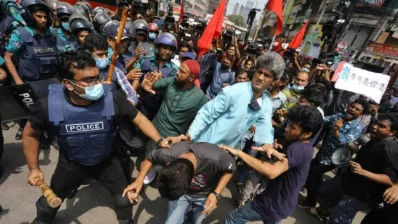
Unfortunately, the over-enthusiastic interpretation of the US visa policy, as well as a plethora of visits to Bangladesh by several mid-level state department officials coupled with calls for a free and transparent election process, led to further complication and the hardening of both sides on how to hold the general elections.
The government was paranoid of foreign intervention in domestic politics which has also been partly fed by some “foreign friends” who are not “friendly” with the US, and also to bolster the defense against a compromise with the main opposition. On the other hand, the opposition’s sail got wind because of a mistaken belief that their demand has been able to bring out the ire of the US and that this could force the hands of the ruling party and the government.
None of this panned out.
Facing reality
The government paranoia and the opposition euphoria soon gave way to the realities of an election, for which the government has announced the schedule. And while the opposition has come out with its own decades-old plan of resistance through hartals and blockades, the government has shown no sign of cancelling its Hobson’s choice of an election. From what we have seen so far, there is a long queue for election seekers not only from the ruling party -- old guards and wannabees -- the rag-tag parties which once had joined voice with the main opposition are also joining the bandwagon of the great election game.
Elections to choose representatives are a fundamental right of the people. In Bangladesh, elections are held at several levels of governance -- from Union Parishad to upazila, to cities to national legislature. Even though the kind of governance expected from each level is much less than desired, people’s participation in each level makes each election worthwhile and meaningful.
This participation is facilitated not only by the government by ensuring safety and security of the voters, and the sanctity of the elections through fairness and transparency. It is also facilitated by the political parties by participation and ensuring safety of the voters and the voting process themselves. Non-participation for fear of rigging or non-fulfilment of demands is a denial of people’s right for franchise.
We have seen the results of the election boycott in the previous two major elections. Over half of the legislators got a walkover in the parliamentary elections of 2014 because of a boycott. The next elections also saw a sweep by the ruling party. Perhaps they were manipulated, but they were also made possible because of a boycott of the elections. The opposition’s presence was lukewarm.
I do not know if there will be a change of minds in the main opposition since time is ticking away. But consider this: The main opposition party is something that still counts as a counter force in the country’s politics. It may not be able to form the next government, but it is still a voice that people can hear. It cannot change the government by blockades, hartals, and hopes of a foreign intervention. But it can make a difference with a different voice in the parliament should it choose to join the elections, even under Hobson’s choice.
Ziauddin Choudhury has worked in the higher civil service of Bangladesh early in his career, and later for the World Bank in the US.
