




On June 2, 1971, I became an orphan.
Another innocent and sacred life was sacrificed at the altar of our much sought freedom from the injustice and tyranny of Pakistani hyenas that were let loose on us. The Yahya/Bhutto axis were never inclined to hand over power to the majority of the elected representatives of their country, which was till then our country too.
They knew, if the Awami League came to power, the apartheid and neocolonialism which were under the cuffs of the West Pakistani ruling class would be exposed and the rule of the so-called elite minority over the majority of Pakistan's population would come to an end. They understood furthermore that from then on, if democratic governments could continue to remain in power, the Punjabi dominated ruling class of Pakistan and the Pakistani military would never again dictate the fate of the country.
That did not suit them. The so-called aristocrats of Pakistan led mostly by Punjabis took it as their birthright that Pakistan's future will be shaped by their wishes and whims.
Until the end of February,1971 all Bengalis hoped that at long last, after 24 years of discrimination, Pakistan will see the light of democracy and Sheikh Mujibur Rahman (by then already Bangabandhu) will become the legitimate prime minister of Pakistan and we will get our proper share in all spheres of life.
Though Bengalis constituted about 55% of Pakistan's population, our share in government jobs including in the military was well below 25%, and in some of the sectors close to 10%. With some reservations, we were hoping for the best and a festive mood was prevailing all around.
The much awaited national assembly session was scheduled for March 3. Everyone in Pakistan was waiting with anticipation. On March 1, came a bolt from the blue. The assembly session was postponed by Yahya at the insistence of Bhutto. The volcano erupted.
In East Pakistan,everyone came out on the road to protest. Militant protestors, mostly students, youth, and Awami League activists started to appear on the roads to stage demonstrations against Yahya and his military junta. Every day we were getting information of police and military firings on angry mobs at different parts of East Pakistan.
Bangabandhu warned the authorities to refrain from resorting to arms and instructed his followers to stay calm, united, and follow his instructions. He announced that on March 7, 1971 he would address his people to declare further course of action.
Come March 7, and an epic address was delivered by this poet of politics. That speech has been declared as one of the greatest political speeches in the history of the World by UNESCO.
Hundreds of thousands of Bengalis gathered at Suhrawardy Udyan (the then Race Course) to listen to their leader declare total non-cooperation with the Pakistani regime. He stopped little short of declaring total independence, making Yahya unable to declare him a secessionist.
He demanded a peaceful transfer of power to the elected representatives of the people and instructed people to not cooperate with the Pakistani authorities. He instructed his people to prepare for emancipation of their rightful demand of power and to fight for independence, if their demand was not met.
He requested the Pakistani armed personnel to not come out of the barracks and confront the public. He assured that nobody would harm them if they complied with his request.
Bangabandhu also categorically mentioned that everyone living in the geographical boundaries of East Pakistan will be treated equally without any discrimination.
I was a student of BUET (then EPUET) and was present in the Race Course to listen to this extempore epic first hand. Some of our friends were a little disappointed that our leader did not declare outright independence. But mind you, he was by then a matured politician and we were only chivalrous youth.
The Pakistani leadership understood that their time was up. Sweet words like, brotherhood, Islamic fraternity, gradual development to prosperity, etc, could no longer subjugate the Bengalis. So, they decided to intimidate their weaker subjects with arms and bullets (Pakistani rulers always thought their military to be one of the best in the world and the Bengalis to be a weak non martial nation).
On one hand they kept an eye-wash type reconciliation meeting with Bangabandhu and Awami League ongoing. On the other hand they started to prepare for a planned genocide on the Bengalis. It goes without mention that their targets were Bengalis as a national group and Hindus as a religious group. From amongst Bengalis they chose Awami League supporters in particular.
The preparation included transfer of as many armed personnel from West to East Pakistan as possible and also arms and ammunition transfer in the same direction. It also included mobilization of Biharis (non Bengali refugees from mostly Bihar and UP) which included other commonly Urdu or non-Bangla speaking Pakistanis who lived in East Pakistan, but with a strong allegiance to Pakistan.
There were some families who stayed away from politics and concentrated in their business only. But there is no denying that many of them willingly identified themselves with Pakistani authorities, were frontline fighters for Pakistan as their cronies like Rajakars and opted for Pakistan when given the choice.
Pakistan, as one might expect and as we now know, later abandoned and failed them. Only a handful were taken in as game tactics and after a certain time they were flatly refused.
The point I'm trying to make is, this group of Pakistani citizens, settled in the then East Pakistan, were being organized to face the ensuing fight with the Bengalis in which they willingly participated from their stronghold areas. As I mentioned earlier, there were peace loving neutral people amongst them as well, but not many.
The month of March was very tense. Every day we were hearing reports of police, army, and Bihari firings on demonstrating Bengalis. There were reports of Bengali retaliations as well. There were casualties on both sides.
After the March 7 speech of Bangabandhu, all institutions were closed. Only the government offices that provided essential services were open. Pakistani power was confined to cantonments, police, other authoritative premises dominated by West Pakistanis, and areas of residence of Biharis and other non-Bengalis.
On March 8, I left Dhaka and reached Chittagong early the next day by changing and using different modes of transportation. I found in Chittagong that everyone was getting prepared in their own way.
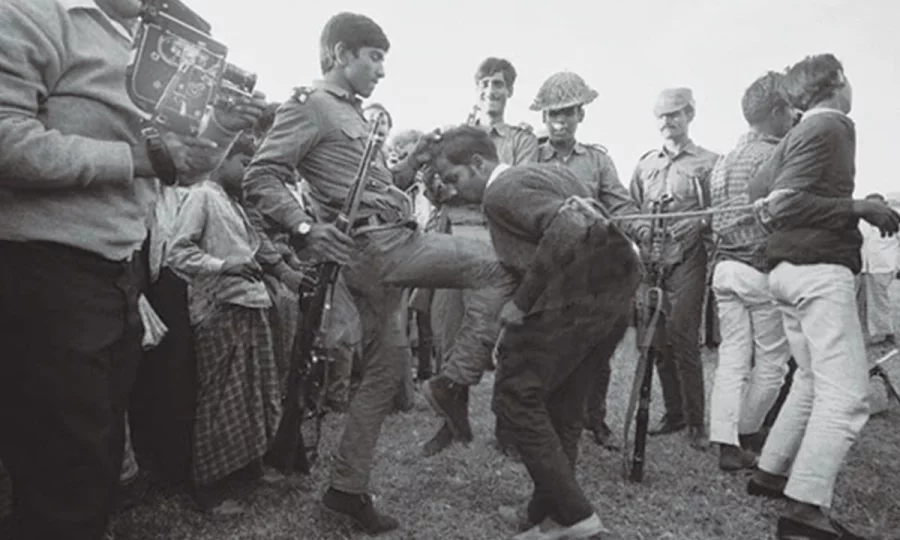
On the night of March 25, Pakistan unleashed their full might on unarmed civilians with their so-called best army of the world. It was Operation Searchlight. The genocide had begun.
Bangabandhu was arrested and soon transferred to West Pakistan, but not before he could smuggle out his proclamation of independence of Bangladesh, which was transmitted to different parts of the country.On March 26, it was broadcasted on air from Chattogram Radio by Awami League leader Abdul Hannan and later by few others and finally on March 27 by Major Ziaur Rahman. This broadcast assured the Bengali nation that the Bengali Armed Forces were on our side. The war for independence started.
We have the dates like: April 4 -- Teliapara, Mukti Bahini formation; April 10 -- proclamation of provisional government; April 17 -- Mujibnagar Day; November 21 -- formation of Bangladesh Armed Forces from Mukti Bahini; December 6 -- recognition of Bangladesh government by Bhutan and India; December 14 -- Shaheed Intellectual Day; December 16 -- Victory Day; each to tell its history and show its glory.
We found reasons to grieve and rejoice.
Coming back to my family story of grief, let me introduce ourselves.
My father, Hironya Kumar Dutta, hailed from Nalchhiti of greater Barisal, had settled in Chittagong since our childhood as the Manager of M/S Mirza Aboo Company. In those days it was perhaps the second most important and strong industrial and business house of Bengali origin after the AK Khan conglomerate.
My dad was the virtual CEO of the company looking after all aspects of their business and was well known in Chittagong business circles, especially in the steel and hardware sector as Dutta Babu. He never wore anything except dhotis and shirts. He was never associated with any politics, but often engaged in social activities.
I, being the eldest of six siblings, had five younger sisters. With my academic background of SSC/HSC I could get entry into any institution of higher learning in Pakistan (in fact I was offered an inter-wing scholarship to study Engineering in Lahore) or maybe even abroad. My mom was not really interested and so I stayed back and started studying in BUET -- which was then EPUET.
After March 27, it was evident that Pakistani army would conquer its own country and Bengalis would be subjected to untold torture and sufferings. Our family left the city to a village named Dhalghat near Patiya to take shelter in a family friend's home.
It was not easy. A couple having a son of barely 18/19 years and five daughters coming of age … We were not locals. But luckily my dad had few proven friends in that area and we spent days in agony with their families. Some youth were departing and joining the freedom struggle. News of atrocities by the Pakistani army and their cronies were coming every day.
Some info on the Mukhti Bahini being formed and inflicting damage on the Pakistanis also trickled in -- ushering in some hope of ultimate victory. The enemy started gaining grounds, and with the support of Rajakars (comprising of Biharis and pro Pakistan Bengalis), started attacking village after village to show their might, to scare people off, to torture people and rape women, to loot, and to resort to arson. In short, they carried out a genocide.
Somehow Mirza Aboo Ahmed, the owner of my father's organization came to know about his favourite Dutta Babu's plight and sent two of his confidantes to smuggle us to Nanupur in Fatikchhari, his village home. We had to cross Chittagong city, which was infested with army personnel, and had to cross several check posts enroute. Still the delegation was successful and we found good shelter and good food after two months.
Little did we know that our happiness would be so short-lived. Nanupur was a transit point of Bengali refugees, who could no longer stay in their homes and had to flee to India. Most of them were obviously Hindus -- being the prime target of the Pakistani stormtroopers, apart from Awami League activists. In their eyes being a Hindu was enough reason for being their enemy and for being terminated.
M Aboo Ahmed's son, Mansur Bhai, was then an MPA from Awami League. He along with two of his brothers, were already in the leadership of the Mukhti Bahini somewhere in the borders of Indian Tripura and Chittagong Hill Tracts.
This infuriated the Pakistani authorities. Just two days after we reached Nanupur, a contingent of the Pakistani army, assisted by Rajakars and some local associates, attacked the area early in the morning.
I was rounded up along with Dad and my uncle. My mom was staying with the ladies of Mirza family with my sisters in the andarmahal (inner chambers of the house) and thank God I managed to escape.
They assembled a few hundred male Bengalis whom they gathered in a nearby field and were looking for the MPA, his father, and his siblings. Finally they could get only Akbar, the youngest of the brothers and promptly sent him to Chittagong to higher authorities. Mr Mirza Aboo had already gone under cover. They realized that they were not in a position to get Mr Ahmed on that occasion.
Someone among their local cronies pointed at my father and said that he was Dutta Babu and the main force behind the Mirza family. Dad was segregated from us and tortured all through the day in one corner of the field.
Later in the afternoon they segregated the Hindus and Muslims amongst those held. Muslims were given a lecture on the integrity of Pakistan and let go. The Hindus, including myself and my uncle, had the beating of our lives before we were allowed to run away. My dad was kept with them.
By that time the chairman of that union, came to know of the army attack and despite knowing the risks came running to save his constituents. His parents were rounded up and alas, he was also arrested and tortured.
By dusk, after seeing no further possibility of success, the Pakistani forces left for Chittagong after brutally killing my dad and the chairman. Two more shaheeds were added to the list of those who had to lay their lives for our freedom.
The next morning, I buried my father's sacred body with respect, love, and tears, with the help of some locals and the Mirza family. It's an officially recognized Boddhyabhumi.
The next day, again with Mirza family's help, our and MA Hannan's (Awami League leader, who read the proclamation of independence on Chittagong Radio first on March 26) families set forth on a difficult journey -- on foot -- to India through difficult Chittagong Hill Tract terrain.
We made it and my struggles started as I took on the responsibility for my family -- trying to establish myself, my sisters, and my mom. With the support of many, we overcame all difficulties and at the end of the day, after more than four decades, I can finally say that we are on par with the average Bangladeshi.
I want to conclude by reiterating our demand for an apology from Pakistan for the genocide committed on Bengalis in 1971. One should remember this demand is never time barred. Rwanda could achieve it. Belgium apologized for its connivance in the murder of Patrice Lumumba 40 years after it happened. Armenians are still demanding recognition of the Armenian genocide which has happened 100 years ago.
They have achieved partial success. We should keep our fight ongoing. I am sure we shall overcome all odds.
Joy Bangla!
Pradip Kumar Dutta is currently engaged in the campaign for a global recognition of the 1971 genocide.
