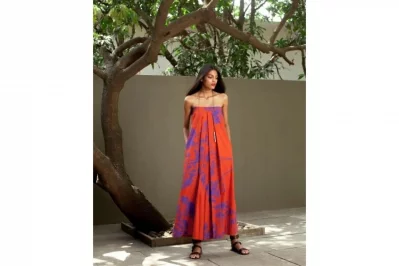
Launched in the year 2012 by Payal Khandwala and Vikram Ramchandani, payalkhandwala, the label, was conceived out of Payal’s love for easy, minimal separates. With a background in Fine Arts, Payal Khandwala stood out for her unique perspective on colours, fabrics and proportions. Her collections portray her refined taste, reflecting the designer’s love for rich palettes and traditional hand-woven fabrics.
This month, Payal Khandwala spoke to Avenue T about the inspiration behind her Spring/Summer 2020 collection, and her approach to retaining traditional crafts.
You’ve spoken about the excitement of the challenge of trying to free contemporary ethnic wear from obvious cultural trappings without losing out on the essence of traditional craft. How do you, as a designer, approach this challenge?
I try my best to rethink my approach to traditional crafts. To me repackaging a craft, or a silhouette from the past is simply not enough. What drives me, is using our crafts to create a reference for the future. To this end, I focus on reinventing shapes, drapes, coordinates, palettes, in some cases even the way the textile is woven, to present an alternative that looks and feels more relevant, but without its obvious context. The challenge is to retain the legacy of the artisans but making the product more modern and less predictable.
Your Spring/Summer 2020 collection was just the thing we needed for a year in relative isolation -- the simple silhouettes provided a sense of comfort and ease in these uncomfortable times, and the beautiful colour story was a much-needed mood lift. Can we look forward to another collection this year, and if so, could you give us an idea of what to expect?
Thank you! Our new release is launching right now, with a new brand identity and direction. So, I’m especially pleased and excited about it. It’s inspired by Mario Botta’s San Giovanni Battista in Switzerland. You’ll see lots of staggered stripes and an illusion of checks, created by using a variety of transparencies and textures, all of which are hand-woven in a deep, rich palette, to mimic the play of light and space.
You’ve been extremely vocal about the need to cut down on the number of annual collections and fashion weeks in order for fashion to become sustainable. With that in mind, and also given that the arrival of a Covid-19 vaccine is still uncertain, what is the plan for 2021?
These steps are integral, but in addition to that suggesting a way of clothing that is less reliant on trends and fashion is even more important. We must look at clothes that are made slowly, that are timeless and last. From the consumers' point of view, it is important to ask what the purpose is behind products, and to question our need for overconsumption.
Dialling down the wastage and being mindful is the only key to being responsible. Our clothes have always been versatile, and certainly timeless, because we focus more on personal style than we do fashion. So our product won’t change, our communication will now be more in line with that, so that our releases will have more freedom, might be smaller in editions, limited in some cases and even more considered to align with how we always felt about this business.
Has this enforced downtime in the industry if you will, influenced your design choices at all?
Perhaps only in the way that now, I’m trying not to retrofit how and what I design based on timelines that are external. I’m trying as much as I can, to make this process more personal, less frantic and less dictated by cycles that are created by market forces.
In a utopian world, this would be easy, but given that I still need distribution and stockists, I hope to at least find a middle ground that works for everyone. This downtime will affect the way I design perhaps, but not what I design. Our values when we design haven’t changed, we’ve always believed and made a product that has value over time, that is practical and well-priced, we’re not inventory heavy, we never go on sale, so in that sense, we’re minimal across the board.
You recently launched a virtual platform to allow your clients to shop from the safety of their homes. How has the experience been? What were the challenges?
We had already launched our virtual platform a few months before the pandemic hit, so that helped give us a head start. But the challenge, of course, was logistics in a time where different parts of the world were in different stages of lockdown, timelines were hit, both for production and delivery. Amongst all these hurdles, I’d have to say to maintain an experience online, that felt more personalized and less automated, in a world that felt more distant, was difficult, to say the least.
Assuming that the industry takes to heart the lessons of the pandemic, what does the future of fashion look like?
I hope that the business of fashion becomes less frenzied, more thoughtful, and less wasteful. I hope that both manufacturers and consumers become more responsible in the choices they make and exercise them with more integrity and with less focus on profit. And in the end, I hope that people don’t have a short-term memory because we all know bad habits are hard to break.