



With her shy smile and demure giggle, Navina Aziza at first glance strikes one as the type to be the wallflower at a party. But get her started on the topic of the hearing impaired, and she’s firing on all cylinders. The young sign language interpreter is passionate about not just creating awareness about the hearing impaired, but also facilitating a space for them to express themselves and achieve greater independence. For Navina, this isn’t just a passion project she stumbled on to; it is deeply personal.
In the beginning, there was silence
As the daughter of a hearing-impaired couple, Navina’s first language – her mother tongue, if you will – was a sign-based language invented by her mother to communicate with her sisters.A child specialist that Navina’s parents consulted advised them to expose her to more speaking people so that their baby girl, who was mercifully not hearing or speech-impaired, could learn to speak. As she grew older and her fluency with signs improved, her father taught her the standardized Bangladeshi Sign Language (BSL). After completing her O’Levels around 2008, Navina joined the newly-established Society of the Deaf and Sign Language Users (SDSL) where she formalized her training in BSL and became a sign-language interpreter.
Words can’t bring me down
The words “normal” and “regular” mean different things to different people.  For Navina, they denote a binary, in which there were “normal/regular” people, who could speak, and the hearing/speech impaired. She magnanimously attributes instances of childhood bullying to a lack of awareness, and keeps a brave face when she recalls the teasing and taunting she got from her peers. “My mother stopped coming to pick me up from school when she realized my classmates were making fun of me, calling me ‘boba’ (mute) because of her, and that was very hard for me to deal with,” she admits. It was particularly difficult for Navina because she is an only child. “Sometimes my school teachers wouldn’t know that my parents were hearing impaired, and when they did find out,they were not equipped to deal with it. I had one teacher who, instead of finding a way to communicate with them, said my parents didn’t need to come and collect my report card, as long as I got a passing grade. I still get goosebumps when I think about it, but it also made me more determined to do something about it and bring greater awareness about the needs and difficulties of the hearing impaired.”
Going mainstream
Once she became an interpreter, Navina’s earliest gigs included going to social programs, usually linked to awareness for people with disabilities, and interpreting the sessions for those in the audience that were hearing or speech impaired. Striving for greater inclusion, the SDSL turned their attention to television around 2010 landing two slots on BTV, where they interpreted the 2pm and 6pm news updates. Private channels were reluctant to pick up this service, citing cost issues. Finally, after many entreaties and false leads, Desh TV finally agreed to give them one news slot.
“Because of the lack of interest, and funding available, most people don’t opt for this as a job of choice” Navina says ruefully. “For me, it was a personal thing, so I persevered. I did the gigs, I got further training, and picked up ASL, built the networks, so that whenever there was a program that needed a sign language interpreter, I’d be among the people they called.”
Miles to go
Determined to bring about greater awareness for the hearing impaired, and hopefully to effect some change, Navina enrolled into the Department of Media and Communication at the Independent University, Bangladesh (IUB), and made her advocacy in favour of the hearing/speech impaired the cornerstone of all her projects and presentations. One assignment she fondly recalls is a project designed to impart health and hygiene information for the hearing impaired in rural or ultra-poor settings, using simple sign language and other visual cues.What had in her youth been stigma for her, became her brand and USP. It wasn’t always easy.
“I could change my profile picture on Facebook and get 100 likes. But if I were to make an awareness post about disability, I would get very few likes, if at all. It’s not just awareness, there’s a serious lack of interest in this issue”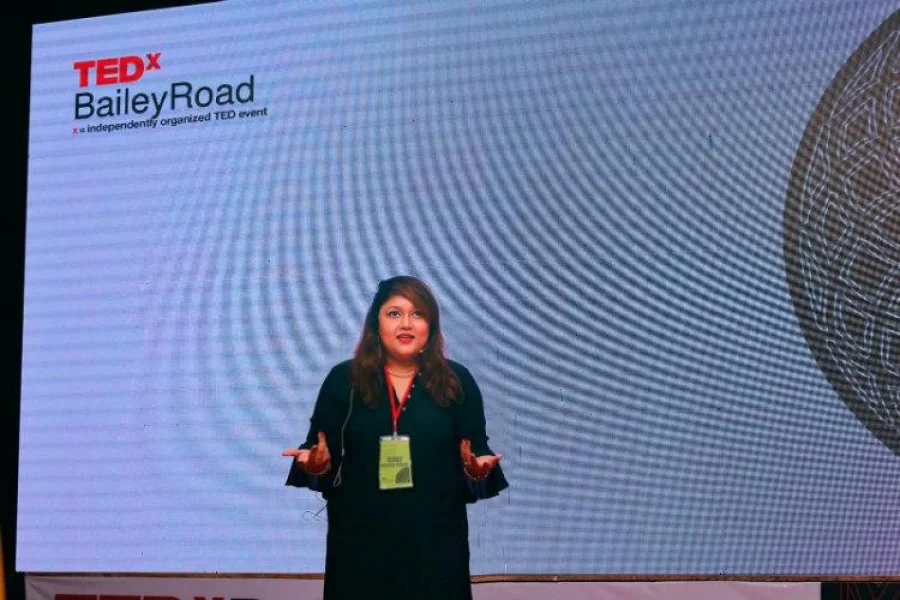
A huge boost came for her in April this year, when she was invited to speak at the TEDx Bailey Road series about her journey as an interpreter, and the need for greater inclusion for the disabled in public spheres. “It was beyond my dreams, I never thought I’d ever get to attend one, let alone give a TEDx Talk. I was so happy with the responses, and being able to take my parents there, and have people clap for them was huge! I hope I can get a larger conversation going, and then we can really begin the necessary steps for greater inclusion.”
Her big hope is to raise enough awareness that greater learning and job opportunities are created for the hearing/speaking disabled. Navina, whose day job is as Executive, Cars Operations and Growth at Pathao, intends to someday be able to establish a rec centre for people with special needs, which is designed with those needs in mind, so that they can learn new creative and vocational skills.
Did you know?
• Sign language has “accents” that depend on the fluidity of the speaker’s gestures, as well as the rapidity of the hand movements.
• When people are signing in Bangladesh, they tend to mix BSL and ASL together, much in the same way that we speak “Benglish”.
• We’re not the only ones with an Urban Dictionary. Sign language users also invent and pick up new “slanguage” through various memes and cultural influences.
