



 Contemporary art on display Mehedi Hasan/Dhaka TribuneKamruzzaman Shadhin is a visual artist working in the mediums of installation, video, and performance art. His work mostly focuses on environmental and social issues. His art projects are often created through public participation and are exhibited in public spaces where the main audiences are the general public and surrounding communities.
He noted that one of greatest problems in the Bangladeshi art scene is the huge gap between the audience and the artist. This gap, he said, contributes to making art obscure and inaccessible to the general public. He said the reason he chose installation art is because it creates a strong connection between the message the artist is trying to convey and the audience.
Hamiduzzaman Khan, a renowned sculptor, spoke about the time he joined the Faculty of Fine Arts, University of Dhaka. Back then, there were no courses for sculpture art in Bangladesh. His initial expertise was in sketching and painting. He was subsequently inspired to sculpt after a medical visit to London. He started sculpting in 1969.
Contemporary art on display Mehedi Hasan/Dhaka TribuneKamruzzaman Shadhin is a visual artist working in the mediums of installation, video, and performance art. His work mostly focuses on environmental and social issues. His art projects are often created through public participation and are exhibited in public spaces where the main audiences are the general public and surrounding communities.
He noted that one of greatest problems in the Bangladeshi art scene is the huge gap between the audience and the artist. This gap, he said, contributes to making art obscure and inaccessible to the general public. He said the reason he chose installation art is because it creates a strong connection between the message the artist is trying to convey and the audience.
Hamiduzzaman Khan, a renowned sculptor, spoke about the time he joined the Faculty of Fine Arts, University of Dhaka. Back then, there were no courses for sculpture art in Bangladesh. His initial expertise was in sketching and painting. He was subsequently inspired to sculpt after a medical visit to London. He started sculpting in 1969.Installation art, a rather new medium in Bangladeshi contemporary art, was the focus of a panel comprising some of the country’s leading installation artists at the 4th edition of the Dhaka Art Summit, on Tuesday.
Leading Bangladeshi artists discussed their practice and the influence, historical journey, and evolution of installation art in Bangladesh. Panelists included Hamiduzzaman Khan, Kalidas Karmakar, and Kamruzzaman Shadhin, moderated by art critic Mustafa Zaman.
Kalidas Karmakar played a pioneering role on the Dhaka art scene by traversing a wide range of mediums and forms including performance. He was among the first in Bangladesh to incorporate found objects in his art.
He said he considered himself lucky to have been able to stand witness to the evolution of art and art styles in Bangladesh.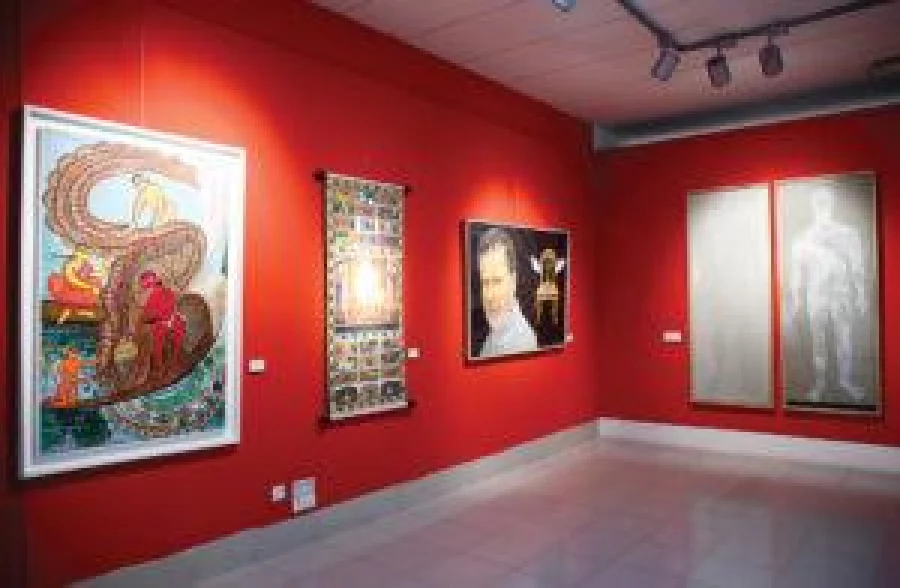 Contemporary art on display Mehedi Hasan/Dhaka TribuneKamruzzaman Shadhin is a visual artist working in the mediums of installation, video, and performance art. His work mostly focuses on environmental and social issues. His art projects are often created through public participation and are exhibited in public spaces where the main audiences are the general public and surrounding communities.
He noted that one of greatest problems in the Bangladeshi art scene is the huge gap between the audience and the artist. This gap, he said, contributes to making art obscure and inaccessible to the general public. He said the reason he chose installation art is because it creates a strong connection between the message the artist is trying to convey and the audience.
Hamiduzzaman Khan, a renowned sculptor, spoke about the time he joined the Faculty of Fine Arts, University of Dhaka. Back then, there were no courses for sculpture art in Bangladesh. His initial expertise was in sketching and painting. He was subsequently inspired to sculpt after a medical visit to London. He started sculpting in 1969.
Contemporary art on display Mehedi Hasan/Dhaka TribuneKamruzzaman Shadhin is a visual artist working in the mediums of installation, video, and performance art. His work mostly focuses on environmental and social issues. His art projects are often created through public participation and are exhibited in public spaces where the main audiences are the general public and surrounding communities.
He noted that one of greatest problems in the Bangladeshi art scene is the huge gap between the audience and the artist. This gap, he said, contributes to making art obscure and inaccessible to the general public. He said the reason he chose installation art is because it creates a strong connection between the message the artist is trying to convey and the audience.
Hamiduzzaman Khan, a renowned sculptor, spoke about the time he joined the Faculty of Fine Arts, University of Dhaka. Back then, there were no courses for sculpture art in Bangladesh. His initial expertise was in sketching and painting. He was subsequently inspired to sculpt after a medical visit to London. He started sculpting in 1969.
Contemporary art on display Mehedi Hasan/Dhaka TribuneKamruzzaman Shadhin is a visual artist working in the mediums of installation, video, and performance art. His work mostly focuses on environmental and social issues. His art projects are often created through public participation and are exhibited in public spaces where the main audiences are the general public and surrounding communities.
He noted that one of greatest problems in the Bangladeshi art scene is the huge gap between the audience and the artist. This gap, he said, contributes to making art obscure and inaccessible to the general public. He said the reason he chose installation art is because it creates a strong connection between the message the artist is trying to convey and the audience.
Hamiduzzaman Khan, a renowned sculptor, spoke about the time he joined the Faculty of Fine Arts, University of Dhaka. Back then, there were no courses for sculpture art in Bangladesh. His initial expertise was in sketching and painting. He was subsequently inspired to sculpt after a medical visit to London. He started sculpting in 1969.