


Hastings Technology Metals (ASX: HAS) (OTCPK: HSRMD) is giving us all one of those teachable moments about the rare earths industry. The HAS shares are down 17% today as they reveal the updated costings for the Yangibana mine. There's no doubt that there's a considerable deposit of rare earth containing material here. When we consider traditional sources and mining techniques - for bastnaesite, xenotime, monazite and so on - it all looks entirely feasible and so on. There's a considerable risk coming up on the inside track from ionic clays and OD6 and the like and we do think that poses a technological risk. But, consider Hastings and Yangibana by comparison with Lynas, or MP Materials, and it seems like a decent enough project.
So, why is there this fall in the share price as they release updated costings and plans? The answer being, we think, that there's not a huge amount of excitement here. Instead there's a considerable capital commitment to be made: “Total project capital cost is now estimated at $948m, with the Stage 1 component being $470m (a 40% increase to the estimate from 2020/21)”. $500 million is a lot of money. Especially for a company which currently has a market capitalisation of perhaps $200 million. Sure, some of that could/will be debt finance, there could even be some grants under strategic plans for rare earths and so on. But it's also $500 million to get to producing a simple rare earth concentrate. Which is the easy part of the rare earths business.
Going further, the billion $ plant still only gets to a mixed carbonate. That still has to go off to another (and usually billion $) plant for separation into the individual rare earths. There's a huge capital commitment necessary here that is. And the rare earths business is still really pretty small. It's some handful of billions of $ a year. Even at current elevated prices it's nowhere near $50 billion a year, probably closer to $5 billion a year.
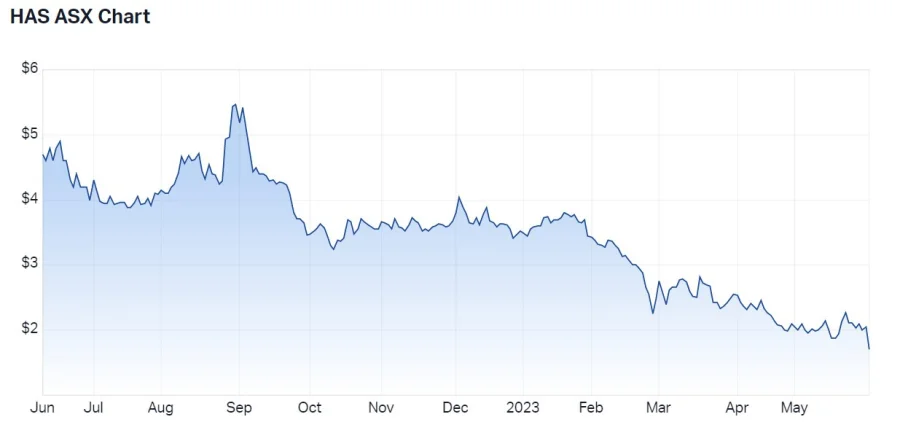
Hastings Technology Metals share price from ASX
High capital requirements into a small global market - that means that the real determinant of success will be how many other people try to do the same thing. For once any such plant is built that's all sunk costs. So, once built such plants tend to keep producing whatever market pricing. It's terribly easy for such markets to become wildly over-supplied - at the cost of both market prices and even the possibility of anyone making a margin.
Yes, yes, we know, the world needs magnets. But rare earth prices are at least 40% off recent highs already. We can see innumerable projects being developed out there. A billion $ on these risks? We're not sure that will be found, to be honest.
