


Marks & Spencer (LON: MKS) (OTCQX: MAKSF) annual results are out and the market has marked them as good by driving the share price up some 8% just after the open. The nominal results are indeed good - good enough perhaps, good-ish. But we've all got to relearn a lesson from the 1970s here. Inflation changes things. What can seem good in nominal, pre-inflation adjustment, numbers becomes rather different when seen in real, post inflation adjustment, numbers. Now, of course reality is important. It's actual piles of cash that matter in the end. But when thinking about performance over time we do need to at least stop and think a bit about what's happening after the effects of inflation.
To economists one of the most dangerous effects of inflation is that it obscures price signals. Yes, the econdweebs do think this important for prices are not just random numbers attached to things but vital information. So, if all prices are changing by that random inflationary amount those signals get obscured. This is the problem with these M&S results. The nominal numbers look pretty good for a business of this size. They're not going to massively outgrow the market, for example, for they're large enough that to some extent they are the market.
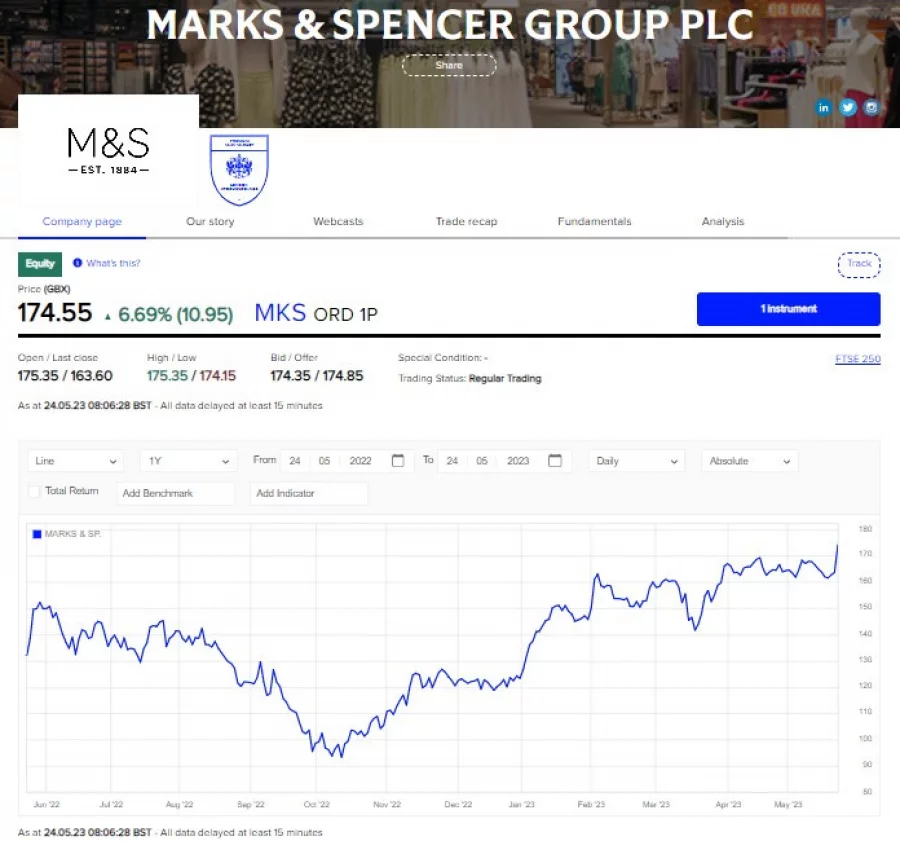
Marks & Spencer share price from London Stock Exchange
The results, in nominal terms, are indeed good: “Profit before tax & adjusting items of £482.0m (2021/22: £522.9m, including £59.8m UK business rates relief) Statutory profit before tax of £475.7m (2021/22: £391.7m) Clothing & Home sales up 11.5% to £3.72bn; Store sales up 14.9%, online up 4.8%; Strong growth in Click & Collect Clothing & Home adjusted operating profit £323.8m (2021/22: £330.7m, including £35.2m rates relief) Food sales up 8.7% to £7.22bn. Strong growth across core categories, hospitality and franchise Food adjusted operating profit £248.0m (2021/22: £277.8m, including £24.6m rates relief)”
Well, OK, but now think on this a little bit. UK inflation over the time period was perhaps some 10%. That means that clothing and home sales were, post-inflation, just about flat. Store sales were ahead of inflation - but online significantly behind it. Food inflation was higher than general inflation - at 19% in fact. So in real terms food sales dropped by perhaps some 5%%. Which is a much less pleasing set of numbers.
The problem we've all got here is that there is no one set of “right” numbers here. Yes, cash is cash so we must pay attention to those nominal numbers. But if we want to compare performance over time then inflation becomes something we should at least consider adjusting for. M&S food sales, on this basis, fell last year, as did online. Whether that's wholly and absolutely the right measure is another thing - but it's certainly a less pleasing set of results, isn't it?
