


WeTrade Group (NASDAQ: WETG) did trade up at $20 a share following its IPO just under a year back. Yesterday it was trading at $0.04 - yes, four cents. That's 99.8% value destruction - or as close to total value destruction as we're likely to see in a corporation still trading. Stockholders might think that this is on the turn as the stock will rise some 185 times at the open today, a 18,500% rise. That is, the likely trading price will be around $7.20 or so at the open. The thing is this will be a change in the nominal price but not in the real one. This is all a plan to retain the NASDAQ listing, not an actual turnaround in the business itself.
WeTrade is in the business of technical services and solutions online inside China. More specifically, it offers such things as AliPay, WeChat, UnionPay and so on to small businesses who aren't of large enough size to work directly. Such intermediary services, agglomeration, can work but they do tend to be low value work. Simply a result of the competition in the field, plus the fact that retailers and the like of size can gain direct access to the platforms.
The result of this has been a not very good business. There are varied announcements of launching a ChatGPT service, of linking up with Erniebot and so on but none have made all that much difference to the stock price. There have been speculative surges in WeTrade stock but those have faded away, usually within the day.
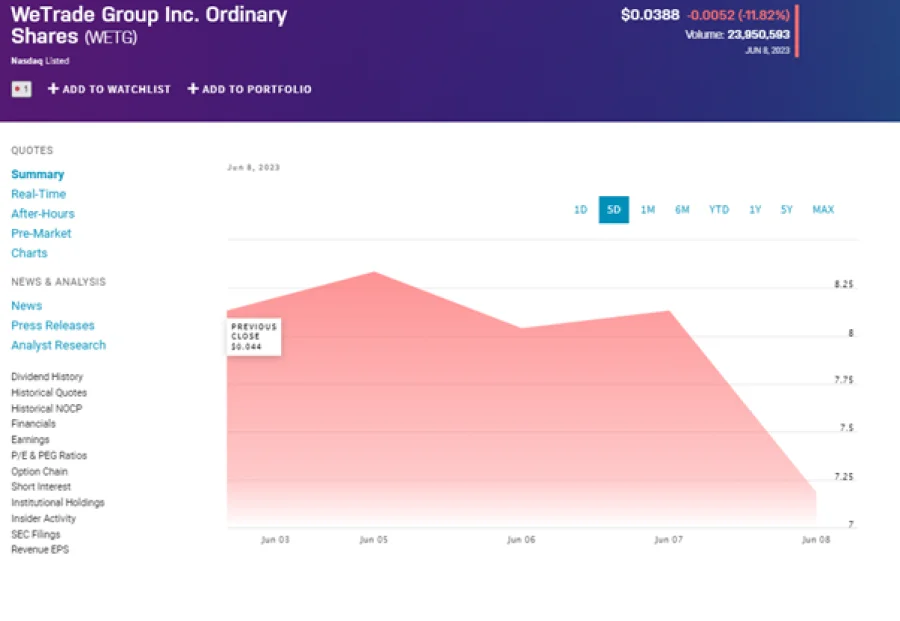
WeTrade stock price from NASDAQ Note that this is post consolidation
The price change in WETG today is entirely different. The American markets think that penny stocks are somehow disreputable. Therefore, to keep a listing on NASDAQ or the NYSE you must meet the $1 minimum bid price. Clearly, a stock price rolling along at four cents doesn't do this. Something therefore must be done and that something is a reverse stock split, a consolidation. Simply declare that what used to be 185 shares are now one share. Which is exactly what WeTrade has done, a one for 185 reverse stock split.
This doesn't change - not directly - the market capitalisation of the company, doesn't change the value of any particular stake in it. It just changes the number of pieces of paper which make up the holding, thereby changing the nominal value of each piece of paper. Job done.
Except, of course, this doesn't change the business at all, not its lack of profits, revenue and so on. It's a purely nominal change done just to keep the stock quotation on a major market. So, not that much of a relief for the long suffering stockholders.
