


Neometals (ASX: NMT) (LON: NMT) shares are up 22% in Australia and 8.6% in London on the back of an announcement about their success, in their joint venture with Primobius, in recycling lithium batteries. This is one of those problems which is going to have to be solved but it's also possible to insist that European Union targets aren't going to be the way that it's solved. Because those targets might well end up p[roducing a process which is non-optimal. The grand insight to have here is that the EU seems to think that we're about to run out of all sorts of minerals. We're not, really, no, we won't. But this incorrect belief then means that the rules are being set so that all these minerals must be recycled. Which could well be - not must be, just could well be - the non-optimal answer.
To give the example of what Neometals is now claiming: “The success of the latest trials support Primobius' goal of being the first to achieve the proposed recycling recovery requirements in the pending EU Battery Regulations. These regulations will mandate recycling of all batteries placed on the EU market. Once legislated, authorised recyclers will be required to recover at least 90% of contained nickel, cobalt, and copper by 2026, increasing to 95% in 2030, 35% for lithium in 2026 increasing to 75% by 2030.” Well, maybe it will be profitable to recycle all the copper, nickel and cobalt in those batteries. Or 90%, or 95%, whatever, plus that 75% of the lithium. Also, maybe it won't be. There are always losses in any process. Further, the last 10% of an operation usually costs as much as the first 90% - marginal costs increase massively as we attempt to reach greater recovery rates. That's just the way these things work.
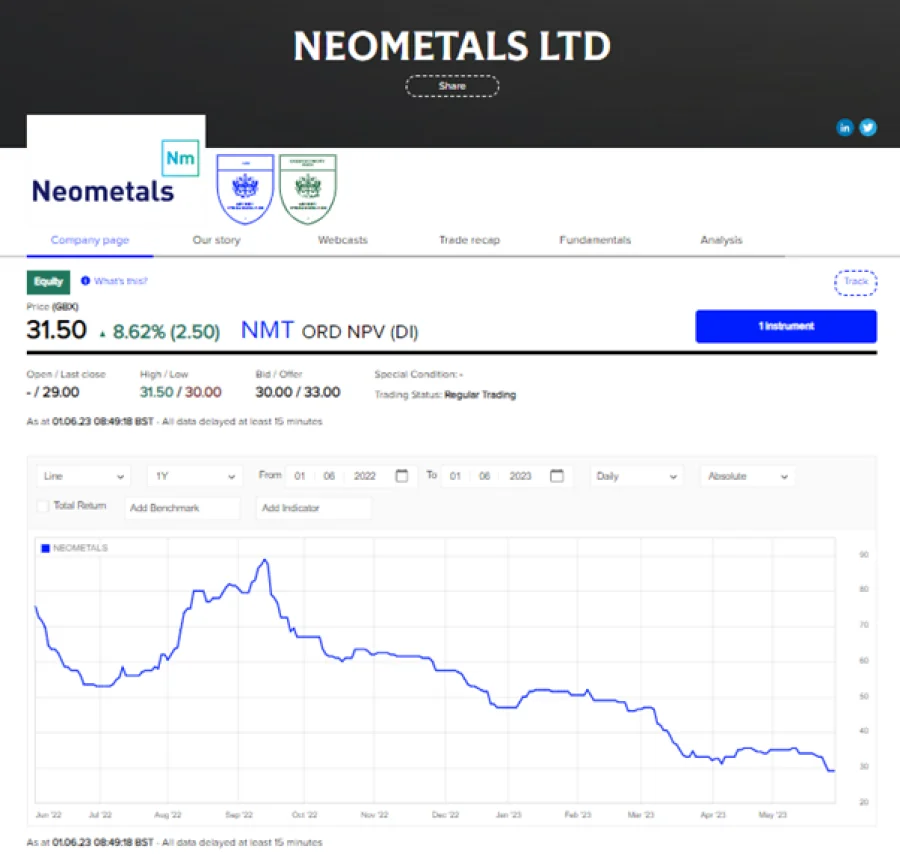
Neometals share price from London Stock Exchange
Here's the problem though. The EU is trying to force the technology. Which is fine, people operating within the EU will be forced to use the forced technology. But something which is forced and non-optimal will not be used outside the EU. Because it's non-optimal. It might be - we stress, might - be better to only recover 70% of the lithium, 89% of the cobalt and 99% of the copper. Say, just as an example. We're not, in fact, going to run out of any of these or any other metal, not on a global scale. So recycling needs to be optimised for cost, not for recovery rates.
The end result of this is that maximising recovery rates might make the process, in the absence of that legal forcing, unprofitable. And who wants to be invested in a company developing an unprofitable process?
