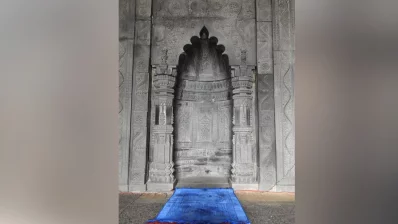
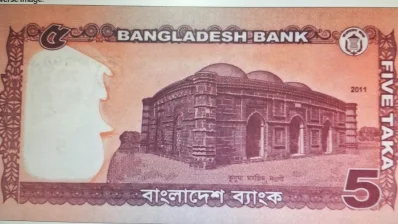
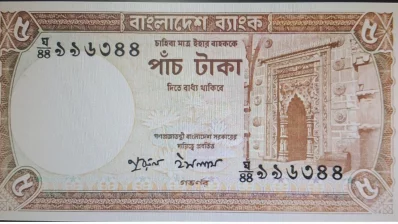
The intricate design of black basalt stone has been etched in my mind since childhood, thanks to the Taka 5 banknote. Its obverse once featured the Mihrab (prayer niche) of the historic Kusumba Mosque—an image first printed on one of Bangladesh’s smallest denominations in the late 1970s. Decades later, in 2011, the full image of this 16th-century architectural masterpiece graced the reverse of the note.
That childhood memory became a vivid reality in the summer of 2024 when I finally reached the mosque in the northwestern district of Naogaon. True to its moniker—the "Black Gem of Bengal"—Kusumba’s dark basalt stones stood as a cool, ancient anchor against the shimmering heat of the Barind Tract.
Built nearly 500 years ago on raised ground, the mosque compound is a serene expanse of spacious courtyard, big trees, and a vast dighi (pond). Constructed of brick and basalt, the rectangular structure features six domes arranged in two rows. These stones were reportedly shipped from Jharkhand’s Rajmahal Hills, a 120-mile range of volcanic peaks.
Located in Kusumba village in Manda Upazila, roughly 35 kilometers west of Naogaon, the site greets visitors with an Archaeology Department billboard detailing its history: “The walls... are covered with black stone inside and out... divided into two aisles and three bays by two black stone pillars.”
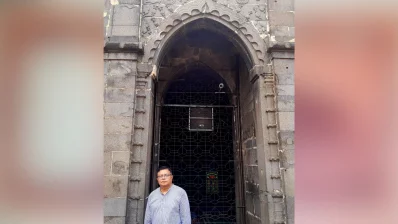
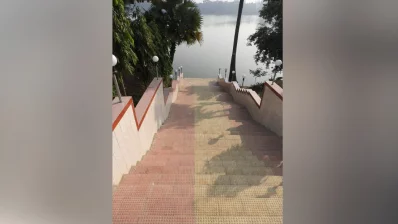
Stepping inside, the ambiance is transformative. The courtyard, backyard trees, and the misty breeze off the pond create an environment perfect for both prayer and reflection. The dighi was dug to provide water for the villagers and for the ablution needs of devotees.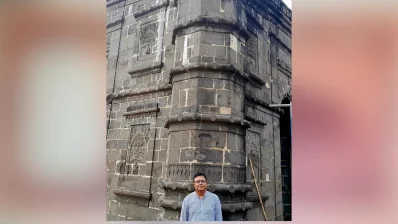
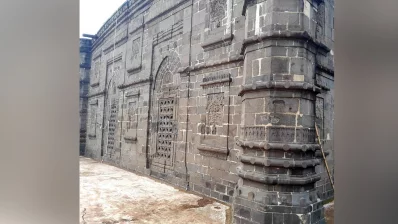
Architecturally, the mosque is stunning. Four octagonal turrets anchor the corners, while three arched entrances lead inside to three Mihrabs adorned with grape bunches and floral motifs. The central Mihrab, encased in black stone, features highly crafted hanging chains and leaf designs. In the northwest corner sits the ‘Badshah-ki-Takht’ (King’s Gallery)—a raised platform where, according to historians, the Qazi (judge) once conducted judicial proceedings.
Inscriptions above the entrance date the mosque to 966 Hijri (1558-1559 AD). It was built by an influential official named Suleiman during the reign of Ghiyasuddin Bahadur Shah, the last of Sher Shah’s Afghan dynasty.
There are various legends about the village’s name. One legend goes like this: Kusum Bibi, the wife of Sultan Alauddin Husain Shah of Gaur, came to live in this area for some time. The village was named Kusumba after her. Later, a mosque was built in the name of Kusum Bibi.
The legends apart, the architectural complexity of the mosque is truly fascinating and worth exploring. One of the May days in 2024 that I visited the place, the area was buzzing with hundreds of visitors. A traditional Baishakhi Mela (New Year fair) was underway nearby, drawing even larger crowds than usual. Locals noted that while the mosque comfortably fits 80 people inside, up to 700 gather in the courtyard for Friday prayers.
What makes Kusumba truly unique among Sultanate-era mosques is its reliance on meticulous relief work over traditional terracotta. Its beauty lies in the high-precision carving of water pots, serpentine vines, and intricate rosettes into flat stone surfaces. To see such laborious, three-dimensional artistry executed five centuries ago in this remote village is nothing short of breathtaking.