Brac Onnesha, a nanosatellite created by the students of Brac University, started orbiting around Earth on Friday afternoon.
With this nanosatellite, Bangladesh has officially started its journey in space exploration and research.
The nanosatellite was sent to its own orbit at 3:10pm on Friday, and started its journey as an independent satellite.
A cube measuring 10cm along its edge, the satellite is at 400km altitude and will rotate around Earth at the speed of 7km per second. It will complete a full rotation around Earth in 90 minutes, and will pass over Bangladesh four to six times every day.
The nanosatellite is expected to stay in its orbit for six months.
Earlier on June 4, the nanosatellite was launched to space by Japan Aerospace Exploration Agency (JAXA) from Nasa's Kennedy Space Center in Florida, US at 3:07am Bangladesh standard time.
The satellite was carried to the International Space Station by Falcon 9 rocket launcher of SpaceX.
The
ground control station of the nanosatellite is at the rooftop of one of Brac University's buildings.
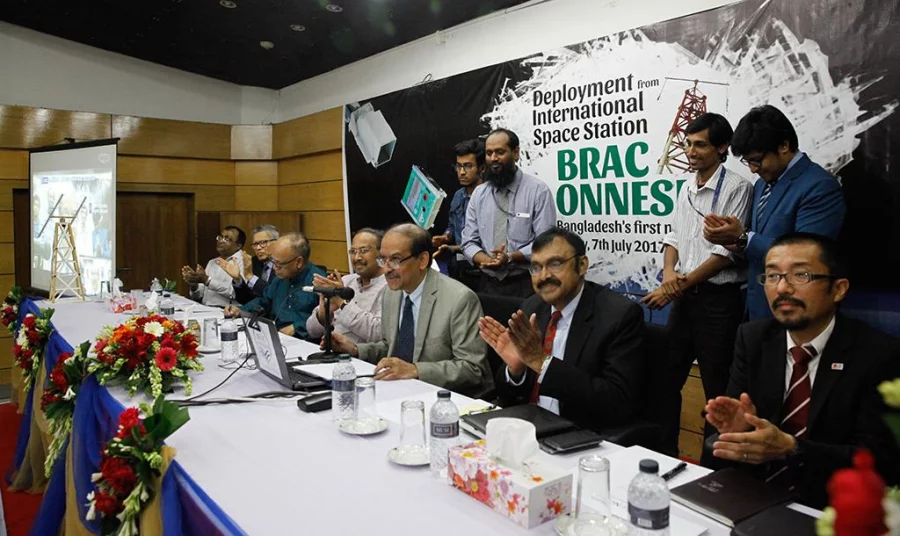
Guests at a ceremony organised by Brac University in Dhaka applaud the moment when Bangladeshi nanosatellite Brac Onnesha officially starts its journey around Earth on July 7, 2017
Mahmud Hossain Opu/Dhaka TribuneBrac University organised a ceremony at its auditorium to celebrate the historical moment of Bangladesh stepping into space for the first time, connecting to an international video conference by the JAXA in Japan.
Science and Technology Minister Yeafesh Osman, Brac University Vice-Chancellor Prof Syed Saad Andaleeb, Prof Abdul Mannan, chairman of University Grants Commission, and Dr Shahjahan Mahmood, chairman of Bangladesh Telecommunication Regulatory Commission (BRTC), attended the ceremony, among others.
Prof Saad Andaleeb said investment in space economy was growing, especially in China and India, and Bangladesh stepping into this new frontier was a matter a pride.
He further said the university would develop specialised units and courses on space technology.
BTRC Chairman Shahjahan said BTRC would soon sign an MoU with Brac University for collaborating on satellite issues.
Abdulla Hil Kafi, Maisun Ibn Monowar and Raihana Shams Antara, the three Brac University alumni who designed and built the nanosatellite, also joined the ceremony through video conference and said they planned to build another satellite for Bangladesh within the next four years.
The ceremony was also attended by Toshiyuki Noguchi, first secretary of the Japanese Embassy in Dhaka, who was the guest of honour, Dr AA Ziauddin Ahmad, professor of mathematics and natural sciences in Brac University, and Dr Hafizur Rahman, member of SPARRSO, among others.
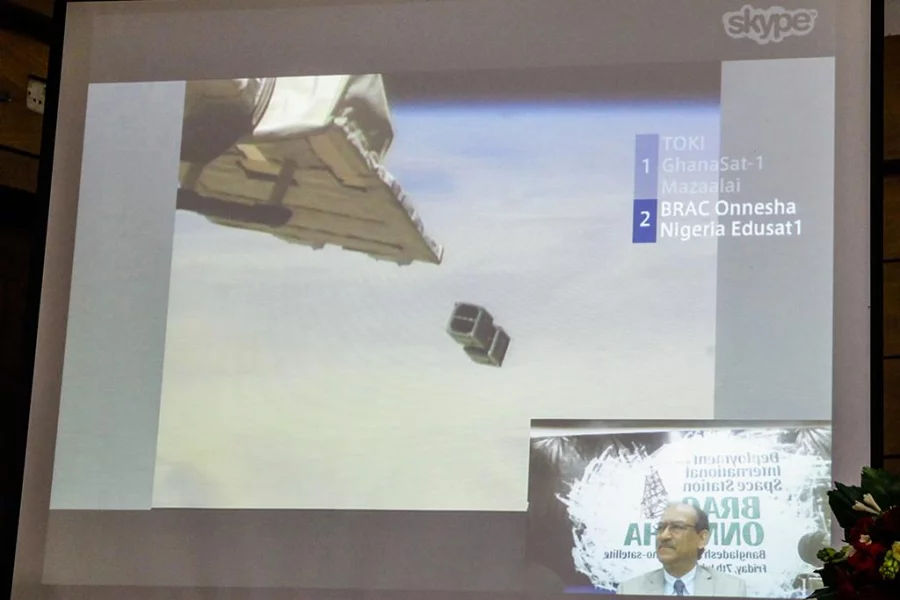
Brac Onnesha, the first ever Bangladeshi nanosatellite that was designed and developed by three Brac University students, leaves the International Space Station along with a Nigerian nanosatellite to enter its orbit on July 7, 2017. The event was streamed live by the Japan Aerospace Exploration Agency via Skype at a ceremony organised by Brac University at its auditorium in Dhaka
Mahmud Hossain Opu/Dhaka Tribune.
Kafi, Maisun and Raihana graduated from the electrical and electronics engineering department of Brac University and are currently enrolled in post-graduation programmes at Kyushu Institute of Technology in Japan.
Brac University signed a deal with Kyushu Institute of Technology in June 2016 to collaborate for the creation of the first ever satellite in Bangladesh.
The project was titled “Joint Global Multi-Nation Birds Satellite” – BIRDS Project in short.
With the help of Kyushu Institute of Technology, Kafi, Maisun and Raihana built the nanosatellite.
The device was officially handed over to Brac University VC Prof Saad Abdaleeb on February 9 this year; Brac University handed it over to the JAXA on the same day.
Dr Khalilur Rahman, associate professor of computer science and technology, is the principal investigator, and Dr Hasanuzzaman Sagor, assistant professor of electrical and electronics engineering, is the co-investigator of the project.




 Guests at a ceremony organised by Brac University in Dhaka applaud the moment when Bangladeshi nanosatellite Brac Onnesha officially starts its journey around Earth on July 7, 2017 Mahmud Hossain Opu/Dhaka TribuneBrac University organised a ceremony at its auditorium to celebrate the historical moment of Bangladesh stepping into space for the first time, connecting to an international video conference by the JAXA in Japan.
Science and Technology Minister Yeafesh Osman, Brac University Vice-Chancellor Prof Syed Saad Andaleeb, Prof Abdul Mannan, chairman of University Grants Commission, and Dr Shahjahan Mahmood, chairman of Bangladesh Telecommunication Regulatory Commission (BRTC), attended the ceremony, among others.
Prof Saad Andaleeb said investment in space economy was growing, especially in China and India, and Bangladesh stepping into this new frontier was a matter a pride.
He further said the university would develop specialised units and courses on space technology.
BTRC Chairman Shahjahan said BTRC would soon sign an MoU with Brac University for collaborating on satellite issues.
Abdulla Hil Kafi, Maisun Ibn Monowar and Raihana Shams Antara, the three Brac University alumni who designed and built the nanosatellite, also joined the ceremony through video conference and said they planned to build another satellite for Bangladesh within the next four years.
The ceremony was also attended by Toshiyuki Noguchi, first secretary of the Japanese Embassy in Dhaka, who was the guest of honour, Dr AA Ziauddin Ahmad, professor of mathematics and natural sciences in Brac University, and Dr Hafizur Rahman, member of SPARRSO, among others.
 Brac Onnesha, the first ever Bangladeshi nanosatellite that was designed and developed by three Brac University students, leaves the International Space Station along with a Nigerian nanosatellite to enter its orbit on July 7, 2017. The event was streamed live by the Japan Aerospace Exploration Agency via Skype at a ceremony organised by Brac University at its auditorium in Dhaka Mahmud Hossain Opu/Dhaka Tribune.
Kafi, Maisun and Raihana graduated from the electrical and electronics engineering department of Brac University and are currently enrolled in post-graduation programmes at Kyushu Institute of Technology in Japan.
Brac University signed a deal with Kyushu Institute of Technology in June 2016 to collaborate for the creation of the first ever satellite in Bangladesh.
The project was titled “Joint Global Multi-Nation Birds Satellite” – BIRDS Project in short.
With the help of Kyushu Institute of Technology, Kafi, Maisun and Raihana built the nanosatellite.
The device was officially handed over to Brac University VC Prof Saad Abdaleeb on February 9 this year; Brac University handed it over to the JAXA on the same day.
Dr Khalilur Rahman, associate professor of computer science and technology, is the principal investigator, and Dr Hasanuzzaman Sagor, assistant professor of electrical and electronics engineering, is the co-investigator of the project.