




Muhammad Mostafigur Rahman, also known as Mustafiz Mamun, has been capturing images for three decades, mainly in the newspaper industry.
Apart from his professional work, he enjoys taking photos for passion. His work often showcases the natural beauty of Bangladesh, with a special focus on the Sundarbans. His photography has earned him several prestigious international awards.
One may wonder, when did this man first become interested in photography?
Recalling his childhood memory he said: “During my childhood, foreign magazines were available in bookstores in our area. These magazines had amazing pictures that fascinated me. I often spent time looking at these photographs before even starting to read the magazine.”
Despite his passion for photography, he had no chance to take pictures back then. "In the village, no one owned a camera, so I spent my childhood merely observing photographs."
Mamun's journey into photography began to shift when he was in the fifth grade. His friend Lipu's father owned a 'Yashica Electro 35' camera, and occasionally, Mamun got the chance to experiment with this rangefinder camera.
However, the turning point in his path to becoming a photographer came when he was in seventh grade. He stumbled upon a 'Pentax MG-1' DSLR camera hidden in his aunt’s cupboard. Equipped with a 50 mm prime lens and an 80-200 mm zoom lens, finding it felt like discovering a treasure. The camera, purchased by his uncle in the 80s, was barely used and had succumbed to fungus damage after long periods of disuse. Yet, Mamun didn’t hesitate; he started taking pictures with it immediately.
At that time, a black-and-white 'River' brand film roll cost Tk10, and developing the film at a studio added another Tk10. Like many renowned photographers, Mamun financed his early photography by using his tiffin money. He soon taught himself how to develop film and continued to use that Pentax camera until his admission to Dhaka University. Eventually, he bought his own camera, a Nikon FM-10 model film DSLR, with money he saved up himself.
While studying at university, Mamun started working for a daily newspaper, juggling both writing and photography. During this period, he was able to undertake formal photography training after completing a course with the Dhaka University Photographic Society. Inspired by this, he decided to take his passion a step further and enrolled in a one-year diploma program at Pathshala South Asian Media Institute, the country's leading institution for media studies.
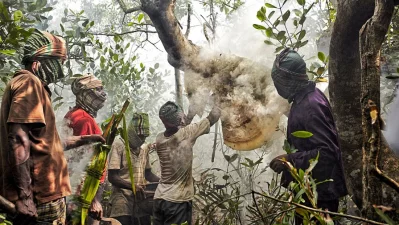
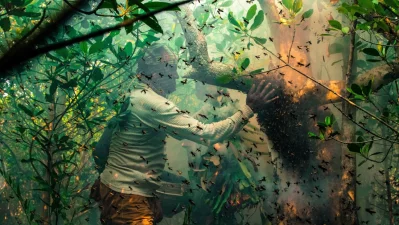
Mamun's career as a photographer is filled with varied experiences, some exhilarating and others quite perilous. In 2015, while capturing the lives of honey hunters in the Sundarbans, he was attacked by bees, narrowly escaping death. Earlier, in 2013, a visit to Lauachhara National Park to photograph Hanuman langurs turned violent when one of the langurs hurled a tree branch at him, piercing his lips and necessitating plastic surgery.
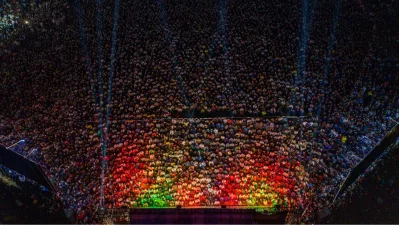
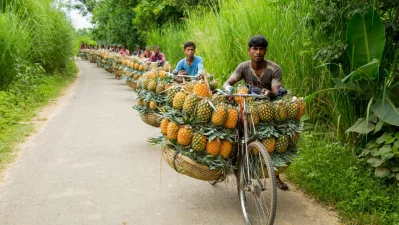
Despite these challenges, Mamun’s work has often been met with acclaim. Sometimes his photographs have become immensely popular, and other times, they have won prestigious awards. His first major recognition came from Reader's Digest Asia's 'Unseen Asia' award, where his photograph of farmers transporting pineapples on bicycles in Madhupur, Tangail was featured across two pages in the December 2013 issue. His success in this competition stemmed from spotting an advertisement in a newspaper, which prompted him to submit his photo via email.
Over the past 11 years, Mamun has amassed more than 50 international awards. Among these, he cherishes the 'Consultative Group to Assist the Poor' (CGAP) Award, a testament to his dedicated work in the Sundarbans, photographing one of the world's most dangerous professions—honey collecting. This particular image not only earned him the CGAP award but also brought him several other international accolades, underscoring his significant contribution to the field of photography.
In Bangladesh, it's rare for photographers to publish books showcasing their own work, but Mamun stands out as an exception. He has already authored four travel books and one dedicated to photography. His book, "Dekhun Bangladesh," takes readers on a journey across all 64 districts of the country, while "Dekhun Sundarbans" explores the intricate details of Bangladesh's renowned mangrove forest. "Dekhun Somudra Saikat" offers comprehensive travel tips for the country’s beaches.
These three books, published by Obosor Prokashoni, are rich in information but lighter on pictures, providing essential insights for exploring Bangladesh's diverse landscapes.
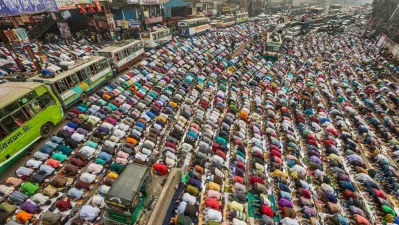
His most recent work, "Bone Berai," delves into the forests of Bangladesh, presenting a unique glimpse into the country's lush biodiversity. Unlike his previous books, "Celebrating Colors of Bangladesh," which was published by the Bangladesh Consulate General of Milan, focuses heavily on photography, capturing the vibrant hues of the country.
Mamun's photography has also taken him onto the international stage.
In January 2023, he held a solo exhibition in Milan, Italy. His work has been featured in joint exhibitions at notable locations such as Reforma Avenue in Mexico City, the University of Colima in Mexico, Seef Mall in Manama, Bahrain, and Mall of Dilmunia.
He has participated in group exhibitions across a myriad of countries including Italy, the United Kingdom, the United States, Japan, Sri Lanka, Turkey, Hong Kong, Taiwan, Spain, and Germany.
Reflecting on his future in photography, Mamun shared his enduring passion and vision: "I aim to take pictures until the last day of my life and showcase the beauty of Bangladesh to the world. Additionally, I aspire to publish a book featuring pictures from different countries around the world."
His commitment to his craft and his country’s beauty remains unwavering, as he continues to capture and share the diverse stories through his lens.
