



 The service is widely praised, with the State Minister for ICT Zunaid Ahmed Palak declaring mobile banking is helping Bangladesh march toward a cashless economy by providing e-wallet facilities.
“We are moving quickly towards a cashless economy and our vision of ‘Digital Bangladesh.’ Thousands of rural households now receive money from their sons and daughters in the cities,” Palak told the Dhaka Tribune.
The state minister also said, “Thousands of RMG workers send back money home using mobile financial services. We are very close to end the cash transactions.”
State Minister Palak said Bangladesh is launching PayPal to ensure smoother transaction with global clientele.
“Years ago, it was very difficult to send money for my son’s education in the village. He lived with his grandmother, for whom it was impossible to maintain a bank account,” Safia Akter, a garments worker at a Chittagong-based factory, told the Dhaka Tribune.
“But with a bKash account, I can send money any time and they can receive it sitting at home.”
However, the accountholders think the transaction charge is high. Many recommend that reducing the rate, which is about 1.85% across all MFS, will encourage more people to use mobile banking services more.
“As a student, paying Tk18.5 on a transaction of Tk1,000 is a little too much for me. I think, the government and Bangladesh Bank should take steps to lower transaction charges,” said Aminul Islam, a student at Dhaka University.
The service is widely praised, with the State Minister for ICT Zunaid Ahmed Palak declaring mobile banking is helping Bangladesh march toward a cashless economy by providing e-wallet facilities.
“We are moving quickly towards a cashless economy and our vision of ‘Digital Bangladesh.’ Thousands of rural households now receive money from their sons and daughters in the cities,” Palak told the Dhaka Tribune.
The state minister also said, “Thousands of RMG workers send back money home using mobile financial services. We are very close to end the cash transactions.”
State Minister Palak said Bangladesh is launching PayPal to ensure smoother transaction with global clientele.
“Years ago, it was very difficult to send money for my son’s education in the village. He lived with his grandmother, for whom it was impossible to maintain a bank account,” Safia Akter, a garments worker at a Chittagong-based factory, told the Dhaka Tribune.
“But with a bKash account, I can send money any time and they can receive it sitting at home.”
However, the accountholders think the transaction charge is high. Many recommend that reducing the rate, which is about 1.85% across all MFS, will encourage more people to use mobile banking services more.
“As a student, paying Tk18.5 on a transaction of Tk1,000 is a little too much for me. I think, the government and Bangladesh Bank should take steps to lower transaction charges,” said Aminul Islam, a student at Dhaka University.Md Sumon (30), a RMG executive, living in Dhaka, received a phone call from his village in Bagerhat Friday morning. His mother fell sick and urgently needed money for treatment.
As it was a government holiday and the banks were closed, Sumon transferred the money through bKash – the largest mobile financial service (MFS) in Bangladesh.
“The situation was tense, my mother’s treatment was stalled. But bKash saved the day for me with their prompt service,” Sumon told the Dhaka Tribune.
Countless others like Sumon have benefited from the MFS providers. Millions of Bangladeshis do not have bank accounts, for them, mobile banking is the way to go. The reality is too many people from lower income groups and rural areas are still outside conventional banking system.
These digital financial services have rapidly expanded, bringing the unbanked and lower income people under a structural financial system.
In 2011, the Bangladesh Bank (BB) introduced MFS as a part of a financial inclusion plan aiming to bring unbanked people to the national financial network. The target customers for MFS are mainly people with limited to no access to banking services.
Currently, they provide several services including inward remittance, cash-in transaction, cash-out transaction, person-to-person (P2P), salary disbursement, utility bill payment, merchant payment, government payment, purchasing from brands or outlets.
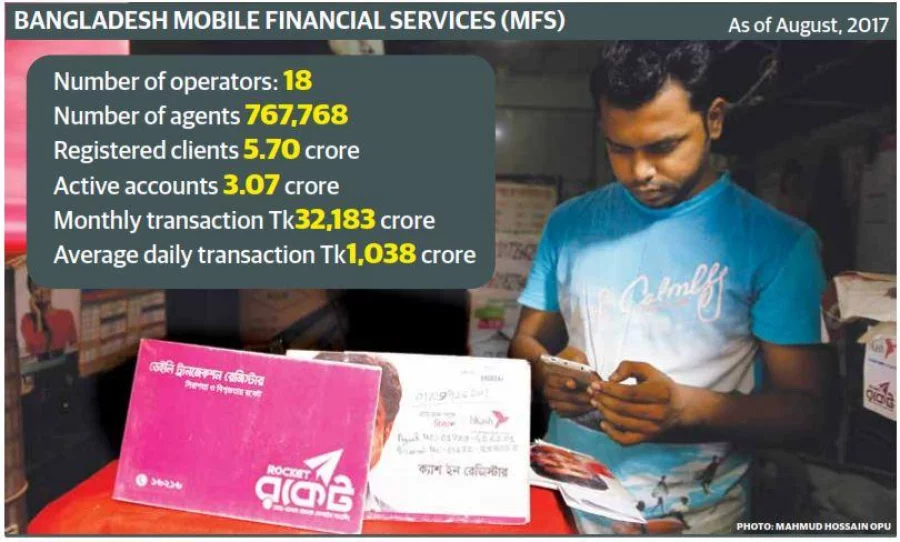
Mobile banking has rapidly grown in popularity in Bangladesh. At present, 19 banks have the permission to operate MFS and all but one of them provide these services. Brac Bank’s bKash and Dutch-Bangla Bank’s Rocket are the most popular services.
Former Bangladesh Bank governor Atiur Rahman, who introduced mobile banking to Bangladesh, claimed, “No other country has more mobile banking customers than Bangladesh.”
He told the Dhaka Tribune: “Consumers can receive information about their accounts and conduct transactions with their financial institutions using their mobile phones. They can pay and receive money with these simple mobile payments.” The service is widely praised, with the State Minister for ICT Zunaid Ahmed Palak declaring mobile banking is helping Bangladesh march toward a cashless economy by providing e-wallet facilities.
“We are moving quickly towards a cashless economy and our vision of ‘Digital Bangladesh.’ Thousands of rural households now receive money from their sons and daughters in the cities,” Palak told the Dhaka Tribune.
The state minister also said, “Thousands of RMG workers send back money home using mobile financial services. We are very close to end the cash transactions.”
State Minister Palak said Bangladesh is launching PayPal to ensure smoother transaction with global clientele.
“Years ago, it was very difficult to send money for my son’s education in the village. He lived with his grandmother, for whom it was impossible to maintain a bank account,” Safia Akter, a garments worker at a Chittagong-based factory, told the Dhaka Tribune.
“But with a bKash account, I can send money any time and they can receive it sitting at home.”
However, the accountholders think the transaction charge is high. Many recommend that reducing the rate, which is about 1.85% across all MFS, will encourage more people to use mobile banking services more.
“As a student, paying Tk18.5 on a transaction of Tk1,000 is a little too much for me. I think, the government and Bangladesh Bank should take steps to lower transaction charges,” said Aminul Islam, a student at Dhaka University.
The service is widely praised, with the State Minister for ICT Zunaid Ahmed Palak declaring mobile banking is helping Bangladesh march toward a cashless economy by providing e-wallet facilities.
“We are moving quickly towards a cashless economy and our vision of ‘Digital Bangladesh.’ Thousands of rural households now receive money from their sons and daughters in the cities,” Palak told the Dhaka Tribune.
The state minister also said, “Thousands of RMG workers send back money home using mobile financial services. We are very close to end the cash transactions.”
State Minister Palak said Bangladesh is launching PayPal to ensure smoother transaction with global clientele.
“Years ago, it was very difficult to send money for my son’s education in the village. He lived with his grandmother, for whom it was impossible to maintain a bank account,” Safia Akter, a garments worker at a Chittagong-based factory, told the Dhaka Tribune.
“But with a bKash account, I can send money any time and they can receive it sitting at home.”
However, the accountholders think the transaction charge is high. Many recommend that reducing the rate, which is about 1.85% across all MFS, will encourage more people to use mobile banking services more.
“As a student, paying Tk18.5 on a transaction of Tk1,000 is a little too much for me. I think, the government and Bangladesh Bank should take steps to lower transaction charges,” said Aminul Islam, a student at Dhaka University.
The service is widely praised, with the State Minister for ICT Zunaid Ahmed Palak declaring mobile banking is helping Bangladesh march toward a cashless economy by providing e-wallet facilities.
“We are moving quickly towards a cashless economy and our vision of ‘Digital Bangladesh.’ Thousands of rural households now receive money from their sons and daughters in the cities,” Palak told the Dhaka Tribune.
The state minister also said, “Thousands of RMG workers send back money home using mobile financial services. We are very close to end the cash transactions.”
State Minister Palak said Bangladesh is launching PayPal to ensure smoother transaction with global clientele.
“Years ago, it was very difficult to send money for my son’s education in the village. He lived with his grandmother, for whom it was impossible to maintain a bank account,” Safia Akter, a garments worker at a Chittagong-based factory, told the Dhaka Tribune.
“But with a bKash account, I can send money any time and they can receive it sitting at home.”
However, the accountholders think the transaction charge is high. Many recommend that reducing the rate, which is about 1.85% across all MFS, will encourage more people to use mobile banking services more.
“As a student, paying Tk18.5 on a transaction of Tk1,000 is a little too much for me. I think, the government and Bangladesh Bank should take steps to lower transaction charges,” said Aminul Islam, a student at Dhaka University.