When the topic of the Bangladesh-India border comes up, the first thing that comes to our mind is the stream of border killings, followed by cattle smuggling, drug smuggling, and so on. It is natural to forget the bilateral treaties between our two countries which have led to an innovative endeavour that brings our people closer together – border haats.
Border haats, weekly markets set up on the border of Bangladesh and India, have changed lives and set new precedents.
[arve url="https://www.google.com/maps/d/u/0/embed?mid=12Fgxi2v7v8_sOUGHOi0mdn9rPIg"/]
At the foot of a hill
Away from the barb wires and border patrols and the bustle of border outposts, the Dalora-Balat haat in Sunamganj bordering Meghalaya is nestled away in the shadow of the Garo hills.
A large tin-shed compound with iron fences over three acres surrounded by a verdant void, the Dalora-Balat Haat remains desolate six days a week. But on every Tuesday, it takes on new life.
Bangladeshis and Indians throng towards the compound in an orderly fashion – perhaps in trepidation or elation – under the supervision of the border patrol agencies of two countries.
People come with carts laden with goods. They converge on the haat, located on the zero line in the No Man’s Land. While entry in the same marked territory in any other part of the 4,100km border results in the Border Security Force seizing the interlopers, or worse shooting them, here, there is peace. A peace brought upon by trade among humble citizenry who are looking to make an honest day’s living, driven by the notion that each has what the other wants – a mutually assured zippy, institutionalised, natural gathering.

The mesmerising view of the Dalora-Balat haat haat in Sunamganj bordering Meghalaya is nestled away in the shadow of the Garo hills
Abu Siddique/Dhaka TribuneIt is an opportunity to get Indian goods at little to no cost. Here, Taka and Rupee speak for the needs of the many.
Two gates lead to the haat – one from Bangladesh, the other from India. Entry is not easy, one needs authorisation from their respective governments. Only 25 vendors are permitted from each country for each day of haat.
Inside the Dalora-Balat Haat, the vendors split in two groups according to their nationalities and set up shops in six sheds for each country. Although only 50 registered vendors are allowed to set up shops, almost the same number of people squat outside the sheds clutching their wares, seeking a cut of the lucrative border market.
The border authorities issue entry passes to 1,500 people from each country.
Although the border haat is ideally designed to cater to people who live in a 5km radius around the border, people from 10-20km away make the journey for this day.
It is a place where Taka and Rupee change hands nonchalantly. In many cases, traders go back to a more dated form of exchange – barter. The sense of amicability resonates among traders, customers and guards alike.
History of the border haat
In October 2010, the governments of Bangladesh and India signed a Memorandum of Understanding for border trade and border haats. It stated that traders in select communities in Bangladesh and India can trade without paying any duties.
The first border haat began operating in July 2011. The Baliamari-Kalaichar Border Haat was set up to trade necessary produce among the locals residing in the border area. But the unexpected success of the venture led to the launch of a second haat in May 2012. This haat was set up between the Dalora in Sunamganj and Balat in Meghalaya.
The third haat was set up in Purba-Srinagar in the Feni-Tripura border. The latest haat is located between the Tarapur-Kamalasagar border in Brahmanbaria and Tripura.
According to the Press Information Bureau of India, Rs168 million or Tk21 crore worth of cash trade was carried out at the four haats till June 2016.
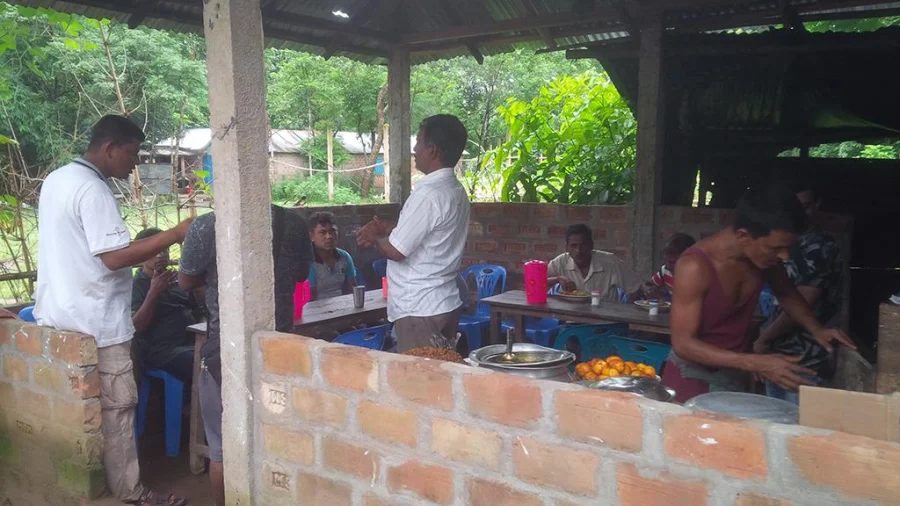
Vendors and haat-goers are able to enjoy quick meals at make-shift food corners inside the border haats
Abu Siddique/Dhaka TribuneOf fruits and vegetables
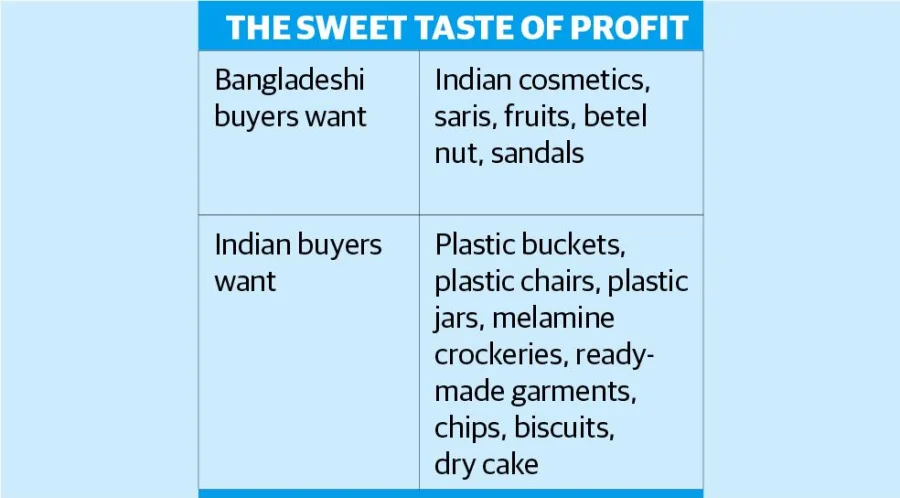
There is a great demand for Bangladeshi vegetables and Indian fruits at the border haats.
On July 25, Monsur Ali, a Bangladeshi, went to Dalora-Balat Haat with ocra and arum on July 25, accompanied by several other farmers – each carrying different vegetables for sale.
He told the Dhaka Tribune: “Meghalaya is mostly hilly country; hence they have difficulty growing many vegetables. So, we take our vegetables to the haat to sell and make better profits.”
Of course, the trade goes both ways. Pears, a delight that unfortunately has difficulty growing in Bangladesh, grows aplenty in India.
Govinda Das, a Bangladeshi, purchased around 70kgs of pears from Indian farmers and was setting out happily when he spared a moment for the Dhaka Tribune.
“I bought these at Tk21 per kilo, I will be selling them here [in Bangladesh] at Tk30-40 easy.”
At least three Bangladeshi vendors regularly attend the haat to sell their homemade sweetmeat – Rosogolla and sweet curd, because of their incredible popularity among the Indians.
As the sweetmeat vendors set up shop, a BSF trooper approached them and bought 55 Rosogollas from them at Tk5 each.
Kawser Mia, one of the vendors, said he has been trading at the border haat for the past two years.
“I can make a Tk1,500 profit if I can sell around Tk5,000 of sweets. Sometimes the profit is equal to three-to-four days of sales at once.”
Another vendor Mohibur Rahman runs a shop of food items and melamine products in the haat. He can sell around Tk70,000 on each day of haat.
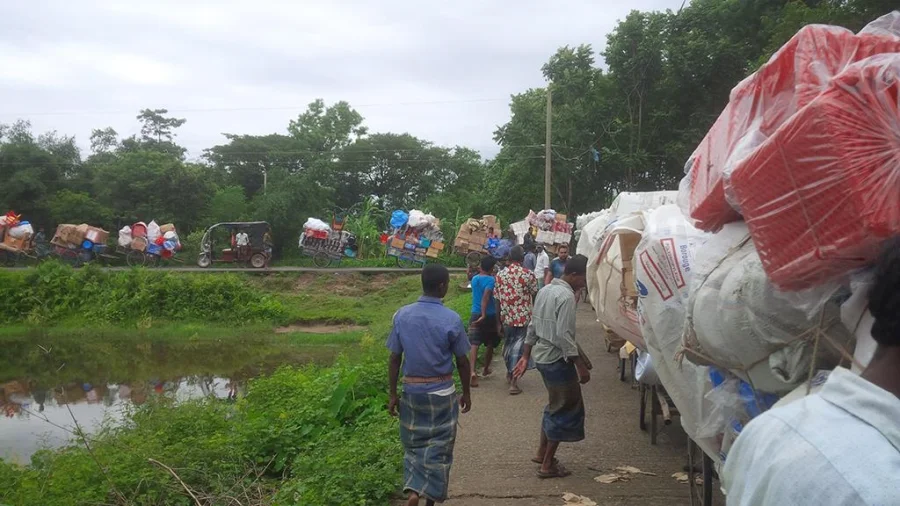
Vendors are carrying their goods to the nearest border haat
Abu Siddique/Dhaka TribuneThe faithful and the faithless
The border haat operates on good faith among its regular attendees. Because of dual currency and barter exchange being a norm, a deep layer of trust is established.
Sirajul Islam, a trader, told the Dhaka Tribune: “I have been running my shop since the haat started. When we grew closer, I could buy a few things on credit. But one day, a trader from India took goods worth Tk3.45 lakh from me and never returned.”
Smuggler’s blight
Md Shafiqul Islam, an additional secretary at the Ministry of Commerce, told the Dhaka Tribune that border haat trade volume is mostly in India's favour.
He said: "There is a huge demand for Indian products – especially cosmetics and fruits. The demand for Bangladeshi products is rather low, which has off-set the trade balance in India's favour."
The additional secretary said the governments are selecting locations for four more haats in – Sunamganj, Moulvibazar, Haluaghat in Mymensingh and Sherpur.
He also said: "Roumari in Kurigram was notorious for smuggling. Since we set up the Dalora-Haat, it has discouraged smuggling because of legal trade."




 The mesmerising view of the Dalora-Balat haat haat in Sunamganj bordering Meghalaya is nestled away in the shadow of the Garo hills Abu Siddique/Dhaka TribuneIt is an opportunity to get Indian goods at little to no cost. Here, Taka and Rupee speak for the needs of the many.
Two gates lead to the haat – one from Bangladesh, the other from India. Entry is not easy, one needs authorisation from their respective governments. Only 25 vendors are permitted from each country for each day of haat.
Inside the Dalora-Balat Haat, the vendors split in two groups according to their nationalities and set up shops in six sheds for each country. Although only 50 registered vendors are allowed to set up shops, almost the same number of people squat outside the sheds clutching their wares, seeking a cut of the lucrative border market.
The border authorities issue entry passes to 1,500 people from each country.
Although the border haat is ideally designed to cater to people who live in a 5km radius around the border, people from 10-20km away make the journey for this day.
It is a place where Taka and Rupee change hands nonchalantly. In many cases, traders go back to a more dated form of exchange – barter. The sense of amicability resonates among traders, customers and guards alike.
 Vendors and haat-goers are able to enjoy quick meals at make-shift food corners inside the border haats Abu Siddique/Dhaka Tribune
 Vendors are carrying their goods to the nearest border haat Abu Siddique/Dhaka Tribune
