



Bangladesh Bank has again raised the policy or repo rate, a key monetary policy tool, to tame inflation.
This is the fifth hike this year and the 12th since May 2022.
The central bank on Tuesday increased the policy rate by 50 basis points to 10%, which will be effective from October 27, the central bank said in a circular issued on the day.
This decision came just a day after (21 October) the central bank published its “Inflation Dynamics in Bangladesh” report for July–September 2024 quarter (Q1’FY25).
The report said that domestic products were the primary drivers of inflation in Bangladesh, accounting for 74% of the overall inflation in September 2024 quarter, whereas the contribution of domestic items to inflation was 61% in the June 2024 quarter.
Inflation dynamics in Q1’FY25
In September 2024, the contribution of domestic items to inflation was rising at a time when the contribution of import-concentrated items to inflation decreased from 39% to 26% in June 2024.
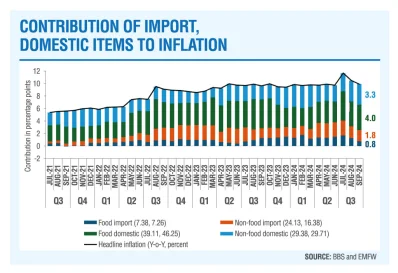
However, the report also said the contribution of perishable goods to inflation rose from 18% in the June quarter to 23% in the September quarter.
The year-on-year consumer price index (CPI) inflation surged to 10.7% in the first quarter (July-September) of FY25.
July recorded a 12-year high inflation rate of 11.7%, and inflation remained elevated at 9.9% in September, compared to 9.6% in the same month last year.
The report also stated that persistent inflation was driven by high commodity and energy prices, along with currency depreciation.
Food inflation peaked at 14.1% in July, the highest in 13 years, before falling to 11.4% in August and 10.4% in September.
Non-food inflation increased modestly, averaging 9.6% in Q1 of FY25, up from the previous quarter.
According to the report, rental costs for housing began to contribute significantly from August 2024, accounting for approximately 26% of inflation in September 2024. Additionally, health and personal care expenses continued to exert significant inflationary pressure on non-food items, contributing around 17%.
Additionally, wage growth remained sluggish, with real income continuing to decline as inflation outpaced wage increases since April 2022. However, there was a slight uptick in wage growth in September 2024, particularly in the Dhaka and Rangpur divisions, offering a modest glimmer of hope for improving purchasing power.
Policy rate now in double digits
To tackle ongoing high inflation, the central bank is trying to use policy or repo rate as a key monetary policy tool.
The latest hike comes in less than a month (effective September 25 last) after Bangladesh Bank increased the repo rate to 9.50% from the previous 9%.
As a result, the interest rate of the money that the banks borrow from the central bank will increase.
Additionally, there will be a rise in the interest rate on bank loans and deposits.
Bankers said that due to the rate hike, the interest rate for any commercial bank facing a liquidity crisis will rise.
Also, loan interest rates for customers will increase.
Consequently, higher loan rates are expected to reduce consumer spending, which should help decrease inflation gradually.
Additionally, the Standing Lending Facility (SLF) has also increased by 50 basis points, reaching 11.5%.
The Standing Deposit Facility (SDF) has also been hiked by 50 basis points, reaching 8.5%.
The SLR is the facility through which the central bank grants overnight credits (emergency funds) to eligible banks, while the SDF allows banks to deposit their excess liquidity.
Earlier in September, Bangladesh Bank Governor Ahsan H Mansur hinted that the central bank would raise the policy rate twice within the next month to curb inflation.
A contractionary monetary policy will be followed until inflation comes under control. The policy rate will be hiked once this week and again next month, Mansur said during a briefing.
“I am optimistic that inflation will stabilize by March or April. While we cannot predict the exact level, we will continue tightening policies to reduce inflation. The stable exchange rate and rising remittances should help keep inflation in check,” he added.
