



Capital base of the country’s banking sector strengthened in the second quarter of this year as a number of banks have been enjoying deferral facility on keeping their provisioning against defaulted loans.
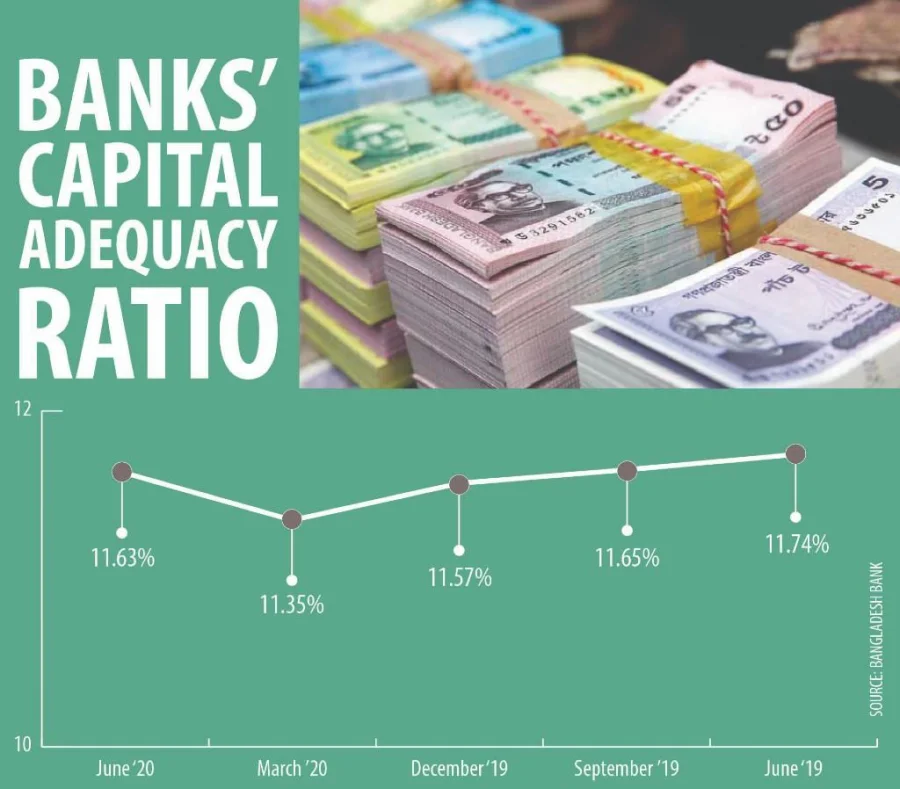
As of June this year, banks’ capital adequacy ratio (CAR) stood at 11.63%, up from 11.35% three months back, according to the latest data of the Bangladesh Bank (BB).
Some state-owned banks were given deferral facilities by the (BB) in case of provisioning against their default loans which resulted in their healthy capitals, says a high official of the BB.
However, the country’s banking sector failed to maintain CAR as per the deadline set by the BB for implementation of Basel– 111 by December, last year.
Basel– III is an international standard that requires financial institutions to maintain enough cash reserves to cover risks incurred by operations, the BB official has explained.
He says the BB set the December, 2019 deadline for banks to increase the capital adequacy ratio to 12.50%.
The country’s state-run commercial banks have maintained a very low capital adequacy ratio as the CAR of those banks went down to 6.93% till June, this year, according to the BB data.
Overall capital adequacy ratio (CAR) in the overall banking sector is not bad at all but the state- run banks and some new banks capital adequacy ratios are not good owing to their high amount of non-performing loans, says Zahid Hussain, former lead economist of the World Bank Bangladesh office.
Only 10 banks out of 60 in the country hold 63% of all non-performing loans (NPLs) in Bangladesh, says a recent report of the BB.
State-run specialized Bangladesh Krishi Bank and Rajshahi Krishi Unnayan Bank have been maintaining negative capital adequacy ratio. Their average CAR went down to -36.54% in June, this year.
However, the country’s private commercial banks have been maintaining a relative standard capital adequacy ratio. The average CAR of those banks stood at 13.31% at the end of June this year, which was higher than the required standard.
In addition, foreign commercial banks also have been maintaining high standard capital adequacy ratio. The average CAR of those banks stood at 24.35% at the end of June, this year.
The country’s banking sector has failed to achieve the global standard for CAR owing to 10 banks, including six state-run banks. They jointly faced a total capital shortfall of Tk21,317.22 crore as of June.
The banks are: Agrani Bank, Rupali Bank, Basic Bank, Janata Bank, Bangladesh Krishi Bank, Rajshahi Krishi Unnayan Bank, Bangladesh Commerce Bank, Community Bank Bangladesh, ICB Islamic Bank and Padma Bank.
Low capital adequacy ratio is the direct consequence of the banks’ default loans as the banks had to keep their provisioning against default loans, says former Finance Adviser to a Caretaker government AB Mirza Azizul Islam.
He also has said foreign investors usually monitor the ratio of required capital and default loans of banks before investing in any country. Low capital adequacy ratio discourages them from investing in any economy.
Banking sector in Bangladesh has maintained the lowest capital adequacy ratio (CAR) than other South Asian countries-India, Pakistan and Sri Lanka– says the Bangladesh Bank’s Financial Stability Report, 2019.
Last year, the banking industry in Bangladesh maintained 11.6% CAR, while neighboring India maintained 15.1% CAR; Pakistan maintained 17.0% CAR and Sri Lanka maintained 16.5% CAR, according to the report.
