



The government has set an ambitious target to rein in consumer inflation to 7.5% in the upcoming FY27.
However, macroeconomists view this milestone with deep skepticism. Given the current economic landscape—characterized by serial upward adjustments in fuel and electricity tariffs, global commodity market volatility, and entrenched supply chain inefficiencies—achieving this target remains a steep mountain to climb.
Meanwhile, the country's fixed-income earners, lower-management professionals, and middle-class families are already buckling under the weight of prolonged price surges.
With real wages failing to keep pace with escalating overheads, households are increasingly forced to deplete their lifelong savings, cut back on essential nutrition, and defer critical medical care just to stay afloat.
The latest data from the Bangladesh Bureau of Statistics (BBS) confirms that the inflationary spiral is intensifying rather than stabilizing.
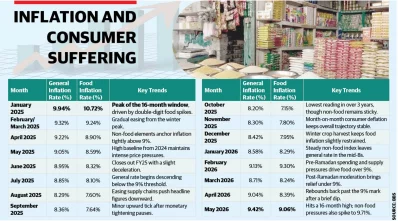
In May, overall consumer inflation climbed to 9.42%, marking the highest point in 16 months since it touched 9.99% in January 2025.
A geographic breakdown reveals that rural areas are bearing a disproportionate share of the economic pain compared to urban centers, with rural inflation at 9.48% (non-food inflation hovering near 10%), and urban inflation at 9.25%
This rural-urban disparity underscores that price pressures are no longer just a big-city phenomenon; the rising costs of agricultural inputs, transport, and basic services are hitting the country’s rural heartland even harder.
The structural erosion of the middle class is clearly reflected in the daily struggles of fixed-income households across the capital.
For instance, a mid-level professional in Dhaka earning a fixed monthly salary of Tk45,000 must manage a four-member household against highly unyielding fixed costs.
With a remaining daily budget of just Tk500 for the entire family, balancing the sharp price increases for daily staples like lentils, cooking oil, broiler chicken, eggs, and seasonal vegetables becomes mathematically impossible.
When unexpected medical emergencies arise, these families have no choice but to liquidate their modest savings. Consequently, former baseline consumer staples—such as fish, fresh fruit, and dairy products—are rapidly turning into occasional luxuries.
Catalysts behind inflationary spiral
Macroeconomic analysts point out that the current inflation crisis is being driven by a combination of several interconnected factors.
Rising global crude oil prices, compounded by persistent geopolitical tensions in the Middle East, have significantly increased the country's import bill.
The government executed two consecutive rounds of domestic fuel price hikes in April and May, raising the prices of diesel, kerosene, petrol, and octane by Tk15 to Tk20 per liter.
Recent upward revisions in bulk and retail electricity tariffs have increased production overheads across manufacturing units, commercial enterprises, and cold storage facilities.
The steady decline in the value of the Taka against the US dollar has made imported raw materials more expensive, an effect further aggravated by domestic supply line inefficiencies and market manipulation by middlemen.
In a modern economy, energy acts as a baseline cost aggregator. As fuel and power are foundational inputs for both production and logistics, any tariff increase triggers a cascading price effect across all sectors.
Farmers are facing higher costs for diesel-powered irrigation pumps, transport operators are raising freight charges to move goods to urban wholesale markets, and factories are adjusting their wholesale prices to cover higher utility bills.
Economists warn that the full impact of the recent electricity price hikes will become visibly apparent across retail markets in June and July, likely triggering a fresh wave of price increases for essential food commodities.
The true impact of this inflationary trend is illustrated by the steady decline in real purchasing power.
When headline inflation consistently outpaces wage growth, citizens effectively experience a net pay cut.
- Average national wage growth (May): 8.21%
- National inflation (May): 9.42%
Because consumer prices are rising faster than nominal wages, the actual purchasing capacity of fixed incomes is shrinking.
To bridge this financial deficit, a growing number of middle-class families are taking on high-interest informal debt or drastically scaling back their household consumption.
The syndicate problem
One of the primary public mandates for the current administration was dismantling the opaque market syndicates that artificially inflate the prices of essential commodities.
While the state has launched targeted interventions—including the expansion of the Family Card network, direct financial aid via Farmer’s Cards, increased strategic food reserves, and localized market monitoring drives—these measures have yet to deliver consistent relief at the retail level.
Trade analysts note that while mobile courts regularly penalize small, front-line retail vendors, regulatory bodies have yet to establish effective, data-driven oversight over major importers, dominant wholesale hubs (arats), and large corporate agro-processors.
This lack of structural oversight allows artificial supply squeezes and speculative pricing to persist unchecked.
