



With increasing competition in the global market, the country's policymakers and businessmen are now looking for new alternative sectors to boost exports.
In this search, another potential golden sector has emerged—the agro-processing industry, which is gradually becoming Bangladesh's new export frontier.
Experts say that the real benefits of the increase in production in the agricultural sector after 2010 are now being seen—in the form of the rise of the processing industry.
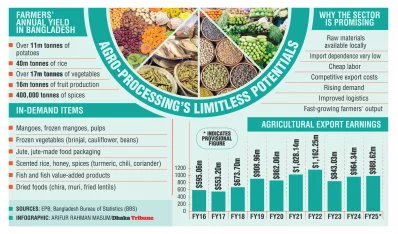
People from all over the city and village are getting involved in the production of raw materials, and entrepreneurs are sending those raw materials abroad after adding value.
Foreign currency is now entering Bangladesh through the hands of farmers who never thought that their chillies, ginger, elephant grass (Hogla) leaves, jute sheets, mangoes or mango powder would go abroad and bring dollars.
Packaged food market doubled in decade
Products that we are familiar with every day—chanachur, biscuits, noodles, spices, drinks, juices, cakes, breadfruit—have now turned into a large-scale industry. The current market size is $4.8 billion, which is a strong domestic market in economic terms.
Analysts believe that this market will reach $6 billion by 2030 due to people's income, urban population, and changes in lifestyle.
In FY24, the combined export revenue of agricultural products and processed foods exceeded $1.5 billion.
Of this, processed food alone was exported at $342 million, while fish, vegetables, spices, tea, and other agricultural products combined generated $1.08 billion.
Eighty percent of the raw materials used in the processed food industry come from farmers. In other words, if farmers do not produce, the export industry will not survive.
Farmers’ production now part of international value chain
The agricultural market in Bangladesh, which is currently $4.8 billion, is predicted to exceed $6 billion by 2030.
The agricultural products produced in this country that are now in high demand in the world market are:
- Mangoes, frozen mangoes, pulps
- Frozen vegetables (brinjal, cauliflower, beans)
- Jute and jute-made food packaging
- Scented rice, honey, spices (turmeric, chili, coriander)
- Fish and fish value-added products
- Dried foods (chira, muri, fried lentils)
Farmers play a major role in all stages of their production—collection—transportation—processing.
Currently, agricultural products are exported from Bangladesh to a total of 148 countries, including Kuwait, Qatar, Saudi Arabia, Germany, Belgium, the Netherlands, and the United Kingdom.
Statistics from the Export Promotion Bureau (EPB) say that Bangladesh's export list includes jute and jute products, fragrant rice, various types of vegetables, fruits (such as frozen potatoes, taro, pointed gourd, taro root, gourd, papaya, beans, bitter gourd, spiny gourd, sweet pumpkin, mango, jackfruit, litchi, guava, etc.), tea, flowers, various spices, tobacco, drinks, and dry foods.
However, as large as this number looks, in reality there is not that much diversity. Data shows that 60% of total exports go to just five countries (Saudi Arabia, Emirates, Oman, Qatar, Malaysia).
About 50% of exports are in just five types of products.
Khandaker Golam Moazzem, research director of the Centre for Policy Dialogue (CPD), said: “We are succeeding in exports, but we have not yet been able to fully open the doors to mainstream markets—especially those of the developed world. Investment is needed in international standards, certification, and quality control.”
According to him, after LDC transition, tariff concessions will decrease, making competition more difficult. Therefore, we must focus on branding, market expansion, and technology development now.
The greatest strength in Bangladesh's agriculture is the abundance of raw materials.
Field after field is being cultivated annually:
- Over 11 million tonnes of potatoes
- 40 million tonnes of rice
- 17 million tonnes of vegetables
- 16 million tonnes of fruit production
- 400,000 tonnes of spices
Faridpur, Jessore, Madaripur, Rangpur, Bogra, Rajshahi—these regions are now major hubs for raw materials.
Agricultural exports cross $1bn-mark
Bangladesh’s agricultural product exports have crossed $1 billion for the first time. Among them:
- Agricultural exports
- Processed food
- Flowers and honey
- Juice, cakes, biscuits, spices, and dry foods
- Frozen vegetables
In the first six months of the current FY26, agricultural and food exports have increased by 9.31%, which shows a positive light despite the overall slowdown in the entire export sector.
There are currently more than 1,000 processed food factories in Bangladesh. Of these, more than 250 companies are involved in exports.
Kamruzzaman Kamal, director of Pran-RFL Group, said: “We now send products to 148 countries. Procuring raw materials directly from local farmers is our strength.” Enthusiasm is being seen not only among big companies but also among small entrepreneurs. In rural areas, homemade pickles, spices, dry fruits, dried fruits, dried cakes are now being commercially packaged and sold in many countries.
Spice production increases due to increased exports
The demand for spice products in the country has increased significantly compared to before. At the same time, Bangladesh's spice exports are also increasing in the international market.
As a result, farmers are now interested in spice cultivation and are getting fair prices.
Md Parvez Saiful Islam, chief operating officer of Square Food and Beverage, said: "We are currently supplying quality branded spices to the market.”
He mentioned that not only single spices, but also the demand for mixed spices for various foods including biryani and meat is increasing manifold. Due to this convenience of not having to buy separate spices—the market for mixed spices is expanding and competition in this sector is also increasing. The volume of exports is also increasing every year.
"However, if some obstacles are removed, it is possible to increase spice exports several times. It is especially important to reduce the use of pesticides and increase radiation facilities. If these quality production systems are ensured, the acceptance of Bangladeshi spices in the international market will increase further."
“We are currently exporting spices to 40 countries. Expatriate Bangladeshis are in a large part of this market. Every year, spice sales increase around various festivals. Production capacity is also being increased in the Pabna factory as demand increases.”
Agriculture seen as potential sector
Declining export income, increasing import costs, and fluctuations in expatriate income—there is a need to diversify the export sector to cope with these pressures.
And the most promising sector for this diversification is agro-processing and agricultural product exports.
Looking into the key reasons:
- Raw materials are available locally
- Import dependence is very low
- Labor is cheap
- Export costs are competitive.
- Demand is increasing
- Logistics improvements
- Farmers' output growing rapidly
How it works
A farmer in a remote village may not think that his Nakagonda red chilies will reach Europe by ship. But this is the reality today.
- Production: Farmers produce vegetables, spices, fruits, or grains. When the price of something drops, they dry it—which is then added to the value and exported.
- Procurement: Local warehouses or company procurement teams buy the products directly from the farmer's home. This also saves the farmer's transportation costs.
- Processing: Companies—washing, cutting, grading, freezing, and packaging. By doing this, they convert the international value.
- Export: Reaches the world market from Chittagong/Mongla/Payra ports or airports.
The farmer, who knows the full value, benefits the most because his production is the main raw material.
In areas where contract farming has been introduced, farmers produce agricultural products for export. For example:
- Narsingdi: high-value chillies
- Rajshahi: exportable mangoes (GI tag)
- Netrakona: dried pulses and local rice
- Jessore: frozen vegetables
- Panchagarh: tea
Competition in global market
Competitive countries (India, Vietnam, Thailand, Turkey) have been leading in exporting agricultural products for a long time.
But the diversity of Bangladesh's labor, raw materials, and flavors is giving these countries a distinct advantage.
Despite abundant production during the season, raw materials do not reach the industry due to lack of proper storage and fast transportation of vegetables, fruits, pulses and spices.
Although there are about 2.7 million tonnes of cold storage in the country, it is limited in uneven distribution, cold transport and temperature control.
Exports are also hampered due to the lack of international standard ISO, HACCP and EU certifications.
Limitations in obtaining international certificates (HACCP, ISO), high tariffs on packaging materials and equipment, and lack of long-term loans are preventing entrepreneurs from making major investments.
Opportunities
Demand for Bangladeshi food in Europe is growing at a rate of 12%. The Asian regional food market in the United States is worth $15 billion.
Demand for Bangladeshi fruit-based and ready-to-cook products is increasing in the Middle East, Europe, China, Japan, and South Korea.
According to experts, exports can double or triple in just 5 years with the right policies, infrastructure, and financing. In the short term, tariff exemption on cold-chain and packaging equipment, easy availability of long-term loans, and fast certification facilities are important.
Exporters say focusing on frozen fruits and vegetables, spices, dry food, ready-to-cook mixes, juices and preserved products first will make it easier to realize the potential of the sector.
