




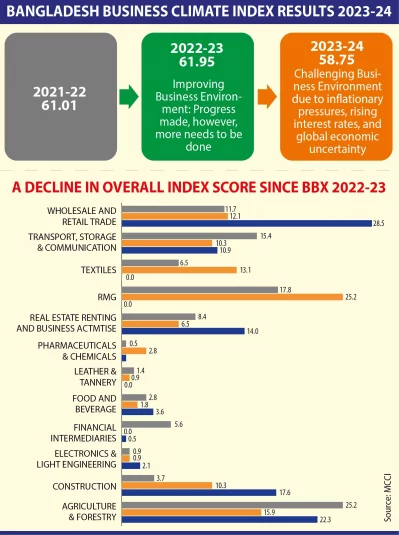
Since the Covid-19 pandemic, Bangladesh's business environment has shown signs of strain. The latest Bangladesh Business Climate Index (BBX) report reveals a drop in the national score from 61.01 in 2021, 61.95 in 2022 to 58.75 in 2023, indicating significant challenges for businesses across the country.
The report, launched by the Metropolitan Chamber of Commerce and Industry (MCCI) and Policy Exchange, Bangladesh (PEB), highlights several key concerns.
The decline in the BBX is mainly due to power outages, difficulties accessing transport and logistics services, increasing production costs, complex tax systems, and challenges accessing finance.
This information was highlighted in the BBX 2023-24 report, launched by the Metropolitan Chamber of Commerce and Industry (MCCI) and Policy Exchange, Bangladesh (PEB) on Thursday.
The report's analysis revealed that Rajshahi topped the list with a score of 61.48, while Barisal was at the bottom with a score of 54.73. Dhaka outperformed Chittagong with scores of 59.61 and 56.73, respectively, for 2023-24.
The report also noted that small businesses continue to face difficulties in accessing finance due to the concentration of large and medium enterprises in Dhaka and Chittagong.
Salman Fazlur Rahman, the private industry and investment adviser to the prime minister, attended the event as the chief guest. He praised the organizers for launching this valuable report and highlighted that a trend could be identified with three BBX reports now available, which the Bangladesh Investment Development Authority (BIDA) could analyze to inform their actions.
Salman Fazlur Rahman also highlighted the need to increase the tax base, decrease the tax rates, and further improve the country’s infrastructure.
He believed that by targeting a business and investment-friendly landscape, Bangladesh could increase its domestic and foreign investments and remain firm on its growth trajectory.
MCCI President Kamran T Rahman in his speech said that the BBX 2023-2024 evaluates the country’s comprehensive business environment, ecosystem, uncertainties, disruptions in the global supply chain, and the escalating situation arising from the Russia-Ukraine conflict and Israel-Palestine conflict. He believed the study would help investors and policymakers with industry-specific action programs.
As the special guest, Lokman Hossain Miah, executive chairman (Senior Secretary) of Bangladesh Investment Development Authority (BIDA), attended the event.
During his intervention, he stated BIDA has always remained committed to improving Bangladesh’s investment landscape and open to suggestions from the business community. He appreciated the organizers for launching this report and believed it would help BIDA chart its next course of actions.
Earlier, Masrur Reaz, chairman of Policy Exchange Bangladesh presented the keynote presentation.
He mentioned that during 2023-2024, the BBX score has dropped to 58.75 from last year’s 61.95, showing that significant efforts are needed to address business environment challenges.
“There were improvements in three pillars coupled with drops in seven pillars. Rajshahi was the best-performing region while Barisal came last. To unlock the country’s potential, he emphasized improving infrastructure and logistics, strengthening financial systems, enhancing legal and regulatory frameworks, bolstering institutional governance, etc,” he also added.
Latest BBX
BBX creates an empirical overview of the business-related challenges in Bangladesh and a comparative picture of the regulatory landscape across all 8 Divisions across Bangladesh.
BBX 2023-2024 is the third iteration of Bangladesh’s first home-grown index that gauges the country’s business climate. It uses 11 pillars, including the latest ‘Environmental Regulation and Standards’ pillar.
The 11 pillars are- starting a business, access to land, availability of regulatory information, infrastructure, labour regulation, dispute resolution, trade, paying taxes, technology adoption, access to finance, environmental regulations, and standards.
These pillars contain a total of 39 sub-indicators that are used to calculate the index.
Those scores were calculated using absolute scores for each pillar for each Division, with each pillar carrying equal weight.
Data showed that among the 11 indicators mentioned, Bangladesh performed the worst in the credit availability index, scoring only 28.11. Last year's survey indicated that obtaining bank loans for business people had become complicated, and this year's survey maintained the continuation of this issue.
Like in 2022, Bangladesh performed the best in the infrastructure sector in 2023, scoring 71.08 out of 100.
Additionally, the scores for other indices are as follows - business start-up at 62.74, land availability at 53.11, access to information at 68.04, labour regulation at 70.04, dispute resolution at 62.38, trade facilitation at 60.87, tax payment at 54.74, technology adoption at 63.50, and environmental control at 51.59.
Overall BBX score by division
The BBX revealed variations in business climates across different regions of Bangladesh.
This year, divisions such as Rangpur, Rajshahi, and Dhaka have shown stronger business environments in contrast to Barisal and Chittagong, as indicated by the overall index score.
Nevertheless, when examining each division under specific pillars, distinct performance variations are observed. This regional disparity underscores the need for targeted interventions to improve business conditions nationwide.
While Dhaka and Chittagong stand as the leading contributors to the country's GDP, both divisions fall within the score range of 56.73 to 59.61 in the Bangladesh Business Climate Index.
Repost stated that this highlights persistent bottlenecks for businesses, including an uncertain regulatory environment and inadequate institutional support. Notably, Dhaka and Chittagong have shown progress in accessing regulatory information, with over 80% of respondents successfully obtaining crucial online information relevant to their businesses, however, both divisions have experienced a decline in score for most of the pillars.
Factors such as power outages, challenges in accessing transport and logistic services, increasing production costs, complex tax systems, etc. have been cited as primary reasons, among others, for this decline.
Additionally, small businesses continue to encounter difficulties accessing finance due to the concentration of large and medium enterprises in Dhaka and Chittagong.
Despite government infrastructure initiatives like the Dhaka Metro Rail, Hazrat Shahjalal International Airport Terminal 3, a four-lane elevated expressway in Chittagong, and the Bangabandhu Tunnel, businesses in these two major cities continue to face constraints as indicated by the dropping scores across various pillars.
