



Apple just announced their new iPhone lineup this year, and it's awe-inspiring. I was more impressed than I was expecting to be, especially with the direction that Apple's going with their Pro models. With the A17 pro chipset, new camera system and new build materials, the iPhone 15 Pro is now legitimately Pro, but there are a few caveats.
Apple didn't start talking about the iPhone 15 Pro until almost an hour after that when things got really exciting, I think not just in terms of the actual features of the phone but the direction that it's going and what the new a17 Pro Chip is going to mean for other products down the line.

Solid state diffusion
The first thing that the new titanium bonding process didn't get a ton of attention is the new construction process for these phones.
Obviously, we've known about the titanium side rails for a while, but the phone's subframe on the inside is made of aluminum. Now previously the entire structure, including the side rails and the internal frame, was all stainless steel and one of the benefits of moving over to titanium is that it reduces weight. But on the inside, that's a lot of titanium, which would probably be more expensive than Apple would want.
So, Apple has introduced this new thermo mechanical process that joins these two metals with Incredibly high strength. Now that's fascinating because they are describing bonding two different types of metals together without using screws. This is a really cool concept, and I think this technology will make it to other devices. And, if that wasn't enough, this new construction process also makes the phone frame more repairable.
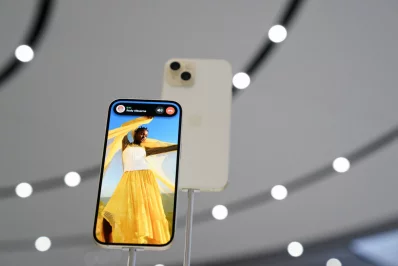
Plus, the back glass can now be removed and replaced with ease. This is a feature that was previously only available on the regular iPhone 14, but now it's finally made its way to the 15 Pro. It's a win-win situation, reducing weight and improving repairability.
Goodbye, mute switch
The next feature Apple implemented was rumoured for a while: the action button; the mute switch is gone, at least on the Pro Models. That's a button, which means that it can be customized to do a whole bunch of different things, and this is a better implementation than it was on the Apple watch. It can be used to start a voice recording, turn on a flashlight, or activate the camera, you name it.
A17 Pro chip
Now, it's time to dive into the insides of the chip because this is where things get crazy. One of the biggest parts of this announcement was the a17 Pro chip, which comes with a brand-new name.
Ever since 2017, with the A11, Apple has used bionic chips. Now, if you're not familiar with the bio ionic term, it comes from the big little core architecture and the neural engine that was introduced in 2017, and it's been the same ever since its two performance cores and four efficiency cores.
Prior to the A11 chip, there was the A10 fusion chip that had two efficient two-performance cores, but you had to switch; you couldn't use them all together. So that's a little backstory, but now Apple has changed the name again for the first time in six years.
This is just a sneak peek of what's to come with the iPhone and M3 Mac. The most significant innovation we've been waiting for is the new three-nanometer lithography, which makes the A17 chip even better than its predecessors.
With up to 10% faster high-performance cores, you can expect a lightning-fast experience.
Although Apple didn't provide any numbers for the efficiency cores, they claim they're faster as well. And the neural engine is now twice as fast, which is fantastic news, but the show's real star is the GPU.
Hardware Ray tracing
That's right, Apple has taken things to the next level by adding Hardware Ray tracing to a smartphone.
You might think this is pointless, but I submit this is just the beginning. Apple putting Hardware Ray tracing in a phone GPU means when the M3 chip comes out with Hardware Ray tracing in a MacBook Air, and that's not all; the M3 Pro, Max, and Ultra GPUs are massive game-changers.
Now, Apple claims a 20-speed improvement, which is already impressive, but when you add in Hardware Ray tracing, the potential is limitless.And the best part is that this technology will become more widespread, with the iPhone 16 having it as a standard feature. It'll start to get to the max by then, and once you've got this ecosystem of devices with Hardware Ray tracing support, you can do all sorts of stuff like Dynamic Reflections things in the user interface.

Apple loves to take Hardware features and turn them into software features. Take the double tap feature on the Apple watch. They're using an improved gyroscope and accelerometer in the S9 chip in conjunction with the heart rate sensor to determine whether you're tapping your fingers, which is pretty cool. Now, imagine what you can do when you give your software team Ray tracing.
Camera system
The camera system is where Apple is making the iPhone 15 Pro come to fruition. USB-C allows you to plug in external storage and record in Pro raw 4K 60fps on two external devices. You can shoot in-log video, which supports the Academy colour Encoding System (ACES), meaning you could use this in legitimate productions. These are real Pro features that Pros will absolutely use, and they're taking a feature they introduced last year as a 2X optical zoom, which is basically cropping in on that sensor. They are kind of expanding upon that by offering different focal lengths, like 35 millimetres, basically just taking that big old sensor and cropping in on it to get to some of the focal lengths that most photographers will use in most cameras.
5x telephoto lens
The iPhone 15 Pro Max has introduced a new and intriguing feature: a 5x telephoto lens, which Apple has achieved through innovative technology.
While Android manufacturers use periscope lenses, which involve an optically stabilized prism to bounce light coming in sideways and then directing it onto a sensor mounted perpendicular to the lens, and that's where we get the term Periscope, Apple's camera uses a tetra prism design.
This design allows light to bounce four times within a glass prism and then travel to the sensor facing the same direction as the lens, using refraction to extend the distance of the light. It remains to be seen how this technology will compare to similar Android phone systems in terms of image quality, but it's certainly fascinating.
They are also introducing yet another technology in addition to the traditional sensor shift we have had since the iPhone 12 Pro Max. This thing features 3D sensor shifts. It's moving in and out rather than moving left and right.
Spatial video recording
We've finally made it to the last feature, and it's a game-changer. With the iPhone 15 Pro's combination of main and ultra-wide lenses, we can now capture 3D videos.
This means we can say goodbye to those bulky headsets and capture stunning spatial videos right from our phones.
Imagine going on a trip and being able to relive those amazing moments in 3D. But it's going to be interesting to see how it works because it uses two very different lenses, and they're not that far apart. Imagine going on a trip and you can take these 3D videos, and then when you go back home, you can show people a 3D spatial video of where you were on your trip; they are going to be blown away.
There are numerous compelling features coming to the iPhone 15 Pro in addition to those we previously discussed, when combined with the new software features they enable, this upgrade is truly impressive.
Md Zahurul Al Mamun is an independent climate researcher and tech enthusiast.
