




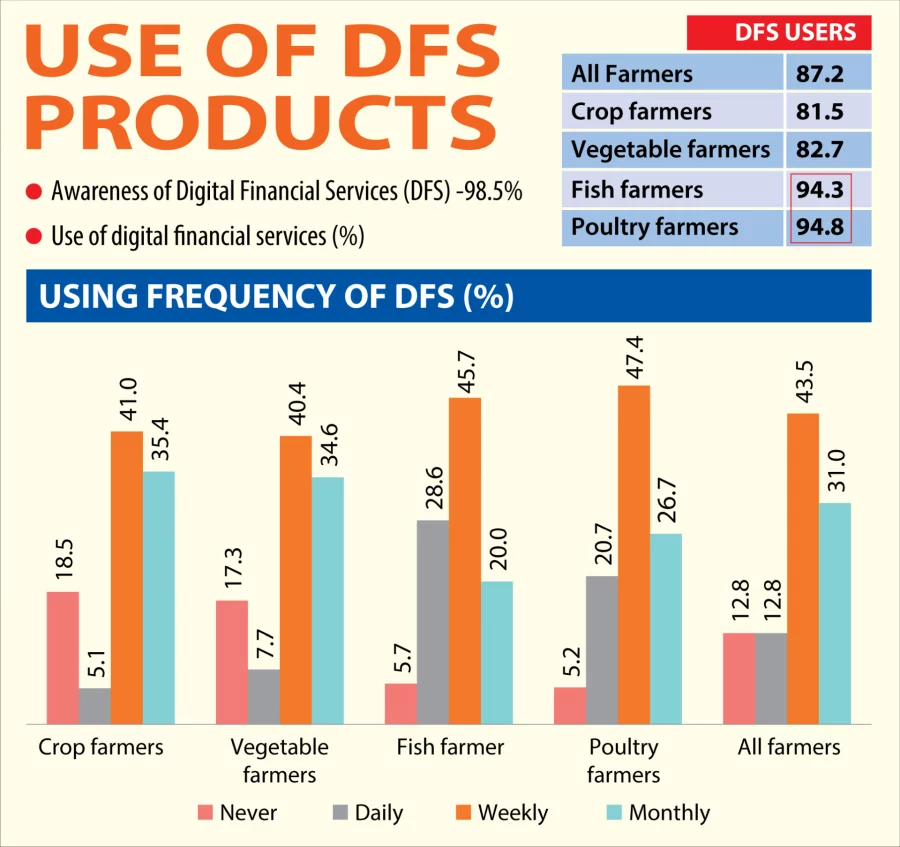
In Bangladesh, poultry and fish farmers are at the forefront of using digital financial services among all agricultural workers.
In a survey conducted by the Policy Research Institute (PRI) with the support of the Bill and Melinda Gates Foundation, they found approximately half of them use this service at least once a week.
Farmers, Indigenous, and Haor residents all suggested lowering Mobile Financial Service (MFS) transaction prices, according to all three surveys.
On June 8, a National Consultation on "Digital Financial Services (DFS) and Financial Inclusion at the Local Level in Bangladesh" revealed all of this.
Ahsan H Mansur, executive director of the PRI said although everyone is talking about reducing the cost of MFS services, it seems that it is not possible right now. In terms of profit, they were at a loss till 2021. This is the first time (2022) that they (bKash) have made some profit.
In fact, the Tk1.8 that this company is taking as a service cost is not for him only, this percentage has to be shared among the four. Now if it is reduced it is difficult for the owners to make a profit,” he also explains.
Mansur also highlighted the significance of financial inclusion in combating poverty in Bangladesh and the potential of digital financial services in bringing the unbanked population into the formal financial system to empower them to take control of their financial decisions and build resilience through managing financial risks effectively.
PRI commissioned three studies last year focusing on DFS use among different marginalized groups in Bangladesh to three universities: Bangladesh Agricultural University, Shahjalal University of Science and Technology, and Hajee Mohammad Danesh Science and Technology University, as part of this project.
"Before these studies, we didn't know the extent of MFS/DFS effects among different groups," Snigdha Ali, Bangladesh country lead, Financial Services for the Poor Team, Bill & Melinda Gates Foundation, stated in her speech. We just had ideas for the apparel industry."
"We need to take this DFS a step further now." And for that, we want to suggest the findings of these studies to government policymakers," she added.
Sadiq Ahmed, vice-chairman of PRI said that the evidence is clear that the full benefits of the digital revolution are yet to be realized and a long way to go.
A key aspect of the digital revolution is the spread of financial inclusion. It is clear that solid progress has been made, but there is still a substantial unfinished agenda.
The research confirms the progress made in enhancing access to mobile phones. It also confirms the spread of mobile financial services through the penetration of leading MFS providers like Bkash, but when it comes to the adoption of DFS, there are important constraints that broadly correlate to the national development challenges, he said.
Concerning the obstacles, this former World Bank senior official stated that access to and availability of smartphones is a key issue, reflecting generally the income and affordability challenge. Another issue is the utilization of internet services.
This highlights the issue of network availability in rural places, as well as the dependability of uninterrupted power service, in addition to income and affordability limits. Another limitation identified was a lack of digital literacy.
This is again linked to the broader development restriction of education and skills.
Before this Akhtaruzzaman Khan, head of the Department of Agricultural Finance and Banking at Bangladesh Agricultural University, presented the first research paper on the “Adoption and Potency of Digital Financial Services among Farmers in Bangladesh,” highlighting the role of digital financial services in empowering farmers and enhancing the agricultural sector.
According to the report, Bkash (82%) is the most popular DFS product among respondents, followed by Nagad (30%) and Rocket (23%).
However, because the payment amount is minimal and transaction fees are cheap, DFS is most typically used for utility bill payments.
According to research, poultry and fish farmers, for example, use DFS primarily to acquire feed, chick/egg/fingerlings, and medicine/insecticide, but they also use DFS on a small scale to receive money for selling products.
However, farmers prefer cash to DFS in order to minimize the risk of transacting huge sums of money.
When asked why chicken (94.8%) and fish (94.3%) farmers are more likely to utilize MFS/DFS, he informed Dhaka Tribune: "Among other farmers, poultry and fish farmers are a little richer, more educated, younger, and more technologically advanced."
Asrafi Bintay Akram, associate professor at the Department of Sociology, Hajee Mohammad Danesh Science and Technology University, presented the second paper of the event, "Access to Digital Financial Services for the Plain Land Indigenous Population in Northern Bangladesh."
In her presentation, Akram shed light on the challenges and opportunities in providing digital financial services to the plainland ethnic minorities of the Santal and Orao communities in the Rangpur and Rajshahi divisions of northern Bangladesh.
The study surveyed 749 individuals from the Santal and Orao communities and found that only 77% of respondents own mobile phones.
The percentage of mobile phone ownership is even less among women (only 31%). Although a vast majority (84%) opened MFS accounts with help from MFS agents, only 42% currently use MFSs. Three-quarters of male respondents (75%) actively use MFSs, compared to only 25% of female respondents.
A major reason for not being able to use MFSs among the respondents is a lack of literacy or formal education. Only 35% of the respondents completed secondary education and the use of MFS is higher among more educated respondents.
27% of the respondents lack knowledge and awareness about MFS. Those who use MFSs, mostly use them for receiving SSNP transfer payments or remittances and utility bill payments.
Repost also said the reasons behind not preferring MFSs include fear of security of money, MFS transaction and cash-out fees, and mobile and internet network disturbances.
In the third presentation, Md Nazrul Islam, professor at the Department of Business Administration, Shahjalal University of Science and Technology presented the findings of the study "Impact of Digital Financial Services on Poverty of Haor People in Bangladesh: Expansion and Deepening Approach," emphasizing the potential of digital financial services in uplifting the lives and livelihoods of the Haor population.
The study found that 65.66% of haor respondents owned bank accounts, and 64.66% of respondents had accounts with NGOs.
Most of the respondents (81.33%) were found to be aware of or have knowledge about MFS/DFS.
Among the respondents with MFS/DFS knowledge, 52.37% owned and used their accounts independently, while 45.65% used their accounts with the help of others, and 1.98% did not have their own accounts and used others' accounts.
The study also highlighted the first usage case of MFS/DFS, with 68.30% of respondents receiving money, 17.04% sending money, and 11.28% receiving social safety net program benefits.
The majority of respondents (69.37%) had MFS/DFS retail agent outlets located within a distance of two kilometres from their homes.
The study also found that only 15.54% of respondents made payments through MFS/DFS in the year 2020-2021, mostly for mobile/ internet bills and purchases from stores.
The study identified several barriers to MFS/DFS usage, including the complexity of transactions (25.39%), unavailability of mobile phones (14.87%), lack of guidance on MFS/DFS usage (13.42%), unavailability of electricity (12.69%), and absence of a photo (10.70%).
Khondoker Shakhawat Ali, emeritus fellow at Unnayan Shamannay and visiting fellow at BIGD, Brac University; Mohammad Saidur Rahman, professor at the Department of Agricultural Economics, Faculty of Agricultural Economics and Rural Sociology, Bangladesh Agricultural University and Lila Rashid, former executive director of Bangladesh Bank also spoke at the event.
