



Private sector credit growth sped up in the last fiscal year 2021-22 as economic activities accelerated after the Covid-19 economic shocks, and burdening import costs amid hiking dollar prices.
According to the latest statistics of the Bangladesh Bank, private sector credit jumped to 13.66%, much higher compared to other months of FY22, and also the highest in the last 43 months.
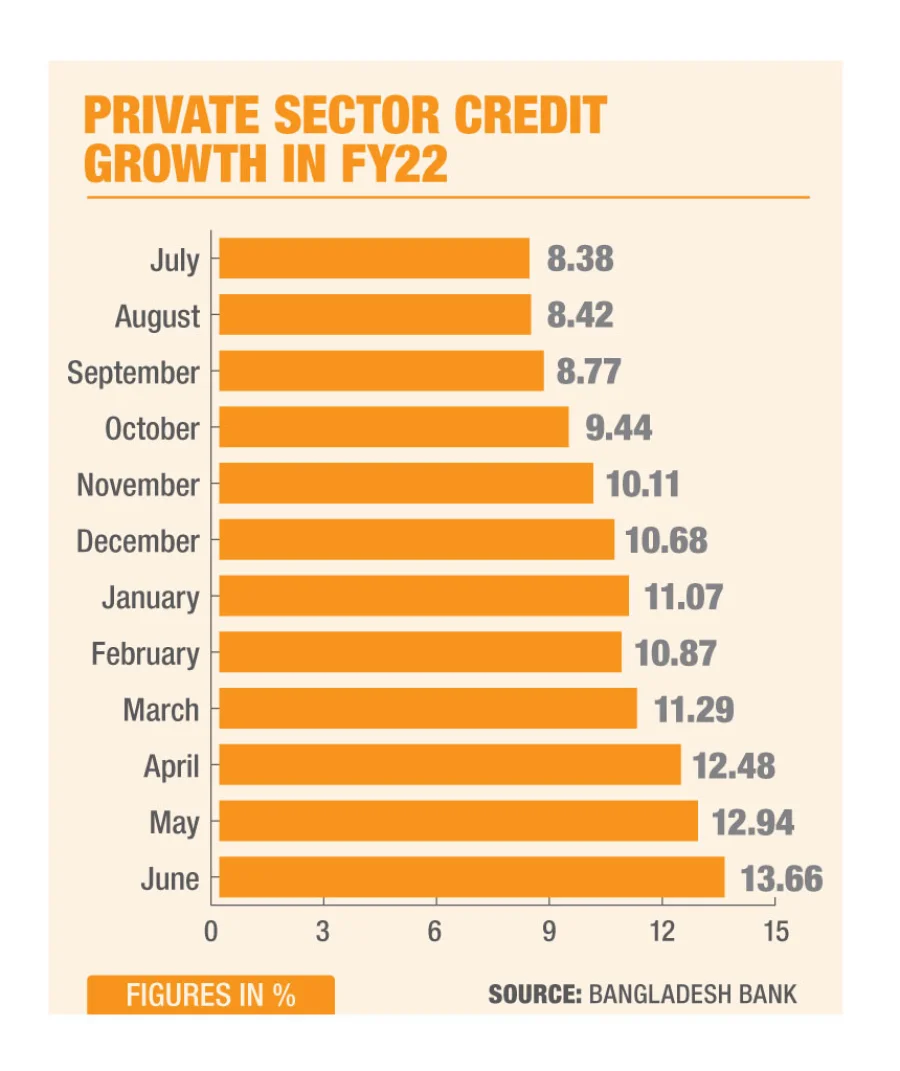
The rate was higher than the previous month's 12.94%.
Private credit growth was also 10.67% higher than FY21.
In the previous fiscal year, an 8.35% credit growth was attained.
However, it was still below the FY22 monetary target of 14.8%.
But there is some solace as the figure was closer to the target of 14.1% set for FY23.
The data comes at a time when Bangladesh Bank is aiming to reduce credit to private business.
Analyzing the central bank data, it has been seen that the banking sector saw a big jump in credit flow to the private sector in June, the last month of FY22.
In July it was 8.38%, August 8.42%, September 8.77%, October 9.44%, November 10.11%, December 10.68%, January 11.07%, February 10.87%, March 11.29%, April 12.48%, May 12.94%, and then a jump to 13.66% in June.
Regarding the rising trend, economists and bankers had differing views.
Economists said that bankers had allegedly put a dent on healthy growth, owing to rising import costs from high dollar price, as well as the extended cash margin for imports of different goods, including non-essential ones.
Ahsan H Mansur, executive director of the Policy Research Institute of Bangladesh (PRI), said that the country achieved the latest credit growth thanks to a vibrant economy following the slowdown from the pandemic.
The overall credit growth in both the private and public sectors should be reduced given that inflation is soaring. Bangladesh Bank should withdraw the interest rate of 9% on loans, he also said.
If the central bank withdraws the lending rate cap, the interest rate on financing for imports will also increase. The private sector will be discouraged from taking loans at a higher cost and reduce imports, and subsequently, associated payments, he explained.
Inflation in Bangladesh hit a nine-year high of 7.56% in June thanks to spiraling prices of food products in the country.
Seeking anonymity, the managing director of a first-generation private bank said that some banks' lending to the private sector increased since the reopening of economic activities in full swing after the pandemic-led restrictions.
Besides, the rising prices of dollars have led to more demand for cash liquidity, he noted.
The central bank, however, has already taken several initiatives to contain money supply to the market by reducing its credit growth to the private sector.
It set a credit growth of 14.1% for this fiscal year.
In addition, the central bank also hiked its policy rate twice within a month for the first time since its introduction in 2003.
The central bank raised it by 25 basis points on May 29 this year and by 50 basis points recently.
The policy rate is what the central bank charges when commercial banks take loans from it for a short term.
An increase in the rate makes loans more costly.
As part of a tightening of money flow, the private sector credit growth ceiling was slashed to 14.1% for FY23 from 14.8% of FY22, according to the monetary policy statement for the current fiscal year.
