




The leather sector’s easy loan facilities and the continuation habit of making a good loan into a non-performing loan (NPL) are now accumulating a mountain of default loans.
However, after a long sleep, the leather, leather goods and footwear exports industry has brought some hope to the just-concluded 2021-22 fiscal year (FY).
According to the latest Bangladesh Bank data, at the end of March this year, the number of defaulted loans in the leather sector stood at Tk1,541 crore, which is 12.57% of the total loans disbursed in this sector.
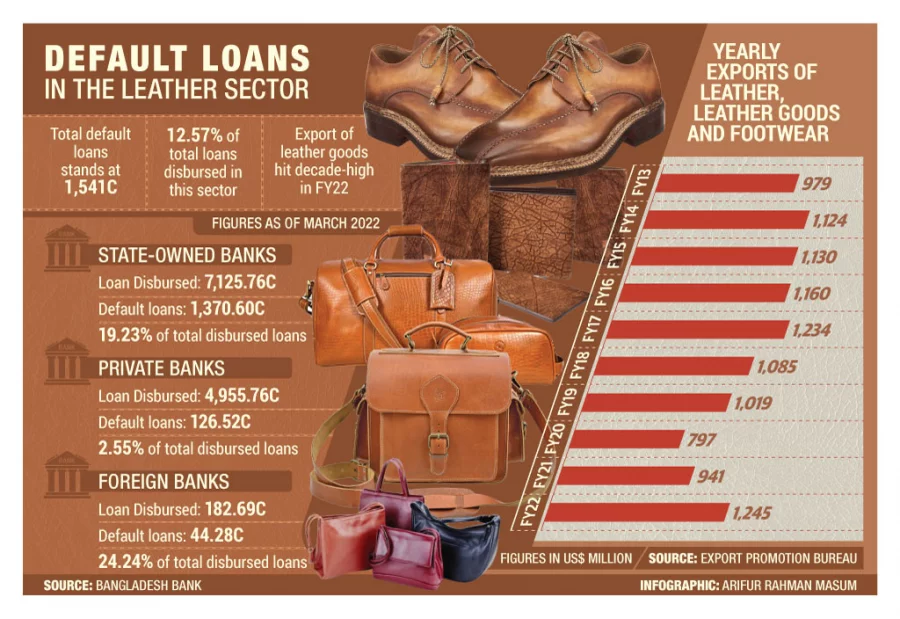
As of March 2022, state-owned banks have disbursed the most in the leather sector. The amount of loan disbursed by them is Tk7,125.76 crore. In the state-owned banks now, NPL stood at Tk1,370.62 crore, which is 19.23% of the disbursed loans.
At the end of December 2021, the defaulted loan was Tk1,158.61 crore, which is 16.43% of the disbursed loan.
The default loans in private banks at the end of March this year stood at Tk126.52 crore, which is 2.55% of the disbursed loans.
At the end of December 2021, the default in private banks was Tk85.63 crore, which is 1.85% of the disbursed loans.
At the end of March 2022, the defaulted loans of foreign banks in this sector stood at Tk44.28 crore, which is 24.24% of the disbursed loans. At the end of December 2021, the amount of defaulted loans in foreign banks was Tk44.27 crore, which is 23.98% of the disbursed loans.
At the end of March 2022, the total debt in the leather sector stood at around Tk12,264 crore. Of this, around Tk7,125 crore was disbursed by the state-owned banks, Tk4,955.76 crore by the private banks and Tk182.69 crore by the foreign banks.
Shaheen Ahmed, president of Bangladesh Tanners Association (BTA) and managing director of Escort Footwear Limited, said: "As far as we know, the banks have so far approved loans of around Tk200-250 crore." This amount of money is very little for buying leather. Because it takes Tk1,000-1,500 crore to buy raw hides of animals at the time of Eid.
The leader of the tannery entrepreneurs said that they were given cash loans for nine months to buy leather. Those who repay the previous year's loan get a new loan.
After transferring the tannery to Savar, a new problem arose in this sector. A huge amount of money has been spent to prepare the factory anew. Many have not been able to repay their previous loans.
That's why we are asking to give a new loan without calculating the old loan. But it was not given. Even in this situation, we are prepared to buy rawhide this year. Hopefully, the skins will be collected as expected this time.
Export of leather goods hits decade high
After a long time, this sector finally gives some good news. According to the Export Promotion Bureau (EPB), leather, leather goods and footwear exports from Bangladesh reached a 10-year-high of $1,245 million in FY2021-22 as importing countries reduced their dependency on China and other producing nations amid the Covid-19 pandemic.
Exports were at their lowest point in the last decade during FY2012-13 when $979 million worth of leather products were shipped abroad. The last time exports came close to the current record was in FY2016-17, when international buyers purchased $1,234 million worth of leather products from the country, as per data from the EPB.
Shaheen Ahamed, chairman of the Bangladesh Tanners Association, said that international buyers increased their selling prices by 20-25% at retail and it had a positive impact on export receipts.
There are around 60 local leather goods companies in Bangladesh, including Apex Footwear, Jennys Shoes and Bay Footwear, that export various items mainly to Japan, the EU and to some extent, the US.
Leather goods are one of the top three highest export earning sectors of the country.
Meanwhile, the government is drawing up a ten-year perspective plan that includes a target to increase the leather sector's export earnings to $10-$12 billion by 2030.
The global leather goods market size is anticipated to reach $624.08 billion by 2028, registering a CAGR of about 5.9% over the forecast period, according to a report by Grand View Research.
Tanners to get Tk443 crore loans
Bangladesh Bank has set 11 state-owned and private banks a target to distribute loans of Tk443 crore to facilitate rawhide trade during the Eid-ul-Azha.
Leather traders, including small business owners, tanneries and organizations involved in processing, can reschedule their defaulted loans after a minimum 2% down payment and get fresh loans to buy rawhide.
However, the banks are turning away from this sector as they have not repaid their loans as per the rules. In 2019, the year before the pandemic, four state-owned banks gave loans of Tk555 crore to buy leather. This time, they want to lend less than half of it. In all, the banks are ready to give loans of Tk245 crore.
However, the question remains as to whether it will be possible to disburse this amount in the end.
Janata Bank is preparing to repay the loan of Tk120 crore this year. Last year, the same amount was supposed to be paid. But in the end, only Tk40 crore was distributed. In 2019, the bank gave Tk205 crore as loans.
Rupali Bank will give loans of Tk30 crore this time. In 2019, they gave Tk155 crore.
Agrani Bank will give Tk70 crore. In the previous year, the bank gave Tk130 crore as loans.
Sonali Bank is preparing to pay Tk25 crore this time. In 2019, they gave Tk70 crore.
On the other hand, private banks have turned away from the sector as most of the loans disbursed in the 1990s have not been repaid.
They are not giving much loan facility to buy leather this time. Only seven private banks show interest in this sector.
Bangladesh Bank Executive Director and Spokesperson Serajul Islam said: “Four state-owned banks and seven private ones will disburse the loans. We sent letters out to the banks with the instruction.”
However, for consumer loans, 180 days past due are classified as NPLs. A loan is in arrears when principal or interest payments are late or missed. A loan is in default when the lender considers the loan agreement to be broken and the debtor is unable to meet the obligations.
