


Producing food packaging as well as printing on food contact materials inevitably involves exposure to specific consumer safety concerns.
These are triggered from various sides, such as from regulatory authorities all over the globe, which aim to protect consumers from potential risks originating from the food packaging – from brand owners, who strive to protect their precious brand from all negative influences also resulting from packaging material alerts – and last but not least from NGOs representing consumer concerns and not to forget, from critical consumers themselves.
Located in the centre of this packaging chain, the printer/converter has to deal with a multitude of aspects and parameters, whilst converting the various material streams (e.g. substrates, inks, adhesives) into the readymade printed packaging, waiting to be filled with food or other content.
It is due to this multitude of parameters, all of which having a pivotal influence on the compliance status/product safety profile of the final food packaging, that expert knowledge as well as open and transparent information are key in order to produce a high quality, fully compliant and fit for its purpose printed food packaging.
Early cases of migration
Long before the public became aware, a number of scientific publications had already revealed the migration potential of substances present in prints.
The transfer of low molecular plasticizers from flexible packaging printed with solvent-based inks into fatty snack foods was published in 1989, and into confectionery, chocolate bars, biscuits, potato crisps and similar in 1993.
Beverage cartons printed with water-based inks were shown to transfer a low molecular surfactant in detectable quantities to mineral water (1998).
Migration of the very low molecular photoinitiator "benzophenone" was measured in shelf-stable, refrigerated, frozen and microwaveable food packed in cardboard printed with UV inks (2000, 2003).
In the US, the 1999 – 2000 National Health and Nutrition Survey detected phthalate metabolites in more than 75% of the US population.
A migration study with UV inks containing "benzophenone" and other low molecular photoinitiators was conducted in 2002.
It became evident that packaging printed with the widely used, so-called standard, UV inks – which were typically based on low molecular photoinitiators – could not be regarded as suitable for food packaging.
Packaging Safety: Media and Consumer Attention
All this knowledge about the migration of low molecular substances from printed layers did not spread.
Instead, it remained largely unnoticed by the decision-makers in the packaging chain until a series of incidents brought the subject of packaging safety in limelight.
The attitude changed with the first big migration scandal in 2005: Findings of isopropyl thioxanthone (ITX, a low molecular photoinitiator used in UV inks) in baby milk and other liquid foodstuffs (the "ITX case") were reported, all over Europe, in the year 2005 and caused several product recalls.
This food scandal alerted the packaging chain about the migration potential of substances from printing inks.
The stakeholders within the packaging chain realized that substance transfer from printed and/or varnished layers, even if not intentionally brought into direct food contact, can happen nevertheless.
The transfer of ITX to food could be described by a set-off in the reel (due to reel-to-reel printing).
As a consequence of the ITX case, the European Commission was prompted to take action and issued the so-called Regulation (EC) 2023/2006 on Good Manufacturing Practice, which addresses processes involving the application of printing inks.
It was the first time that printing inks were explicitly regulated in the European food packaging legislation.
The Rapid Alert System for Food and Feed (RASFF) was put in place to provide food and feed control authorities with an effective tool to exchange information about measures taken responding to serious risks detected in relation to food or feed.
In 2016, 2,993 entries were made by the member states, of which 78 were migration issues.
In early 2009, new findings of the two UV curing photoinitiators "4-methylbenzophenone (4-MBP)" and "benzophenone" above the acceptable thresholds in breakfast cereals packed in polyethylene pouches included in cardboard boxes were entered into the RASFF.
The issue gained huge media coverage, including evening TV news all over Europe.
Food and packaging was recalled on a broad scale, bringing considerable financial losses to the affected companies and a negative image to the food production industry as a whole.
Chemicals Migrate into the food
Migrants are substances which, due to their chemical characteristics and molecular size, move from a printed layer into the packed food.
There are different types of migration:
1) Set-off migration: Migrants can migrate from one layer to another, such as a surface printed layer to the non-printed food-contact surface which is later on brought into contact with food. If these are in direct or close contact like in a reel or a stack after printing, setoff migration can occur in the reel or stack.
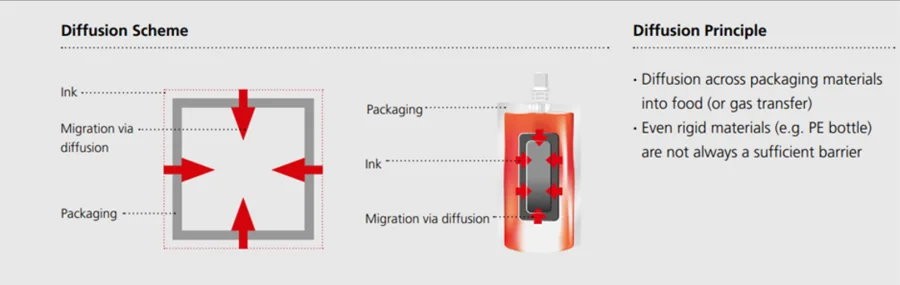
2) Diffusion migration: Small and mobile molecules can easily penetrate into and diffuse across packaging material layers. This can occur even if the printed material has not yet been converted into a food package and filled with food, or later on when the printed package is filled with food and the food starts to "extract" the migrants from the packaging material.
The following figure (below) illustrates set-off migration in a reel or stack, demonstrating that migration can occur even if an aluminum foil (indicated as "barrier") prevents diffusion migration across the packaging material layers. It also shows that set-off migration can take place even if the ink layer as such is not in direct contact with the inner (food contact) PE layer, but another PE layer lies in between.
The figure below illustrates a situation where both diffusion migration and setoff migration take place.
3) Gas-phase migration: Migrants can also migrate from a cardboard (the "releasing reservoir") via the gas phase within the pack, to end up in food which acts as "recipient reservoir" (gas phase migration). This can, for example, occur with migrants such as mineral oils or some UV photo initiators that might not be generally known as being volatile such as organic solvents.

The Figure above illustrates migration via diffusion and via gas phase (air). The ink is printed on an outer wrap which represents a cardboard box. On the left, it is shown that despite an inner wrap, which separates the cardboard box from the food, this PE or paper pouch is not a functional barrier to migration. The situation shown displays the "4-MBP" and the mineral oil migration scenarios of 2009 and 2010. On the right, the inner pouch is made of aluminum, as aluminum of sufficient thickness (>= 6 μm) serves as an absolute barrier preventing migration, and represents an ideal scenario.
The worldwide awareness of migration from food packaging is still increasing and countries are now regulating packaging safety to ensure consumer safety.
The author is head of product safety and regulatory at Siegwerk
