
India has become one of its important sources for maize and wheat import, despite the ongoing Russia-Ukraine conflict.
The consumption of maize has been increasing in Bangladesh over the years thanks to increase in per capita income and health consciousness, experts said.
Export of maize to Bangladesh touched $816.31 million in the first ten months of current fiscal 2021-22 (April-January), already exceeding the $634.85 million achieved during the last financial year.
From an exports realization of $142.8 million in 2019-20, export of maize increased nearly sixfold, taking the total value of shipment to $1,593.73 million in the last three years, despite logistical challenges posed by the Covid-19 pandemic.
Bangladesh has imported maize worth $345.5 million in the current fiscal (April-January), while Nepal has imported maize worth $132.16 million during this period, according to The Statesman, a leading Indian English daily.
With initiatives of the Ministry of Commerce & Industry of India to explore and diversify new markets, Vietnam has emerged as a major destination for the export of maize.
India exported maize worth $244.24 million to Vietnam in the first ten months of the current fiscal (April-January 2021-22).
India’s maize exports at an all-time high of $816.31 million in current fiscal, surpassing $634.85 million in FY21.
Wheat import
Similarly, India has also become a major source of wheat to Bangladesh, as the latter can build a buffer stock of the commodity to contain rising prices against the backdrop of possible longer Russia-Ukraine conflict and low production of the commodity in Brazil and Argentina, sources said.
India is looking to write a new playbook to meet growing global demand for wheat, particularly from South Asian countries, as the Russia-Ukraine war has disrupted supplies of the grain from the region, according to two people aware of the development.
India primarily exports wheat to neighbouring countries, with Bangladesh accounting for the largest share - more than 54% in both volume and value terms in 2020-21, according to the Statesman.
In 2020-21, India entered new wheat markets such as Yemen, Afghanistan, Qatar and Indonesia.
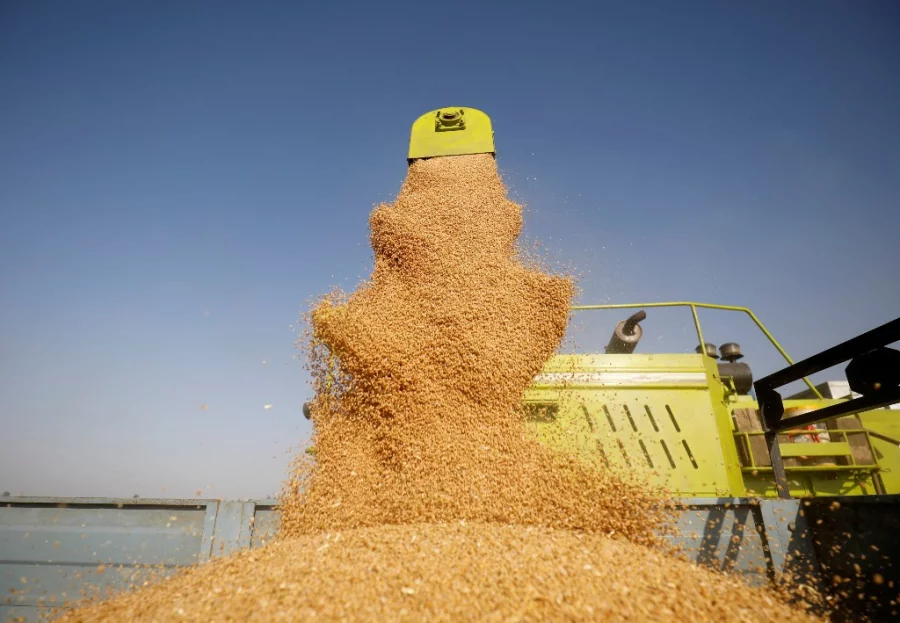 A combine deposits harvested wheat in a tractor trolley at a field on the outskirts of Ahmedabad, India Reuters
The country accounts for barely 1% of global wheat exports.
However, its share increased from 0.14% in 2016 to 0.54% in 2020.
India is the second largest producer of wheat, accounting for 13.53% of world production. It produces around 107.59 million tonnes of wheat annually, of which a major chunk goes for domestic consumption.
The current fiscal has already been strong in terms of cereals exports and if new orders pour in, India could end up exporting historic high levels of wheat this fiscal and in the first half of next year.
Russia and Ukraine account for nearly a quarter of global wheat exports, and with the conflict between the two countries showing no signs of abating anytime soon, India can try and tap a sizable portion of the world wheat trade.
A prolonged war could increase dependency of wheat importing countries on large exporters such as India. A stronger dollar amid rising oil prices could also work in favour of Indian exporters.
According to industry executives, India can easily meet the short-term jump in global wheat demand as it has surplus stocks this year.
The country has more than 100 million tonnes of the staple in its granaries, with domestic output expected to touch a record 316 million tonnes in 2021-22.
India, traditionally, has not been a significant exporter of wheat but over the last two years the country has managed to ship out large quantities of non-basmati rice and wheat.
According to government data, India’s wheat exports during April-October surged 546% year-on-year to $872 million. In terms of volumes, exports jumped 527% on year to 3.2 during the period.
With the anticipated demand, people cited above said, India could end up exporting a record 7-8 million tonnes of wheat in FY22. It had sold 2.09 million tonnes of the food grain in 2020-21.
Among South Asian countries, the Philippines, which happens to buy a lot of Russian wheat, is looking at India to meet its demand.
Although Asia Pacific countries do not directly import large quantities of food from Russia, the only exception is the Philippines, where wheat is the second-largest import from Russia, Moody’s Analytics said in a note.
“There will be a huge hole out there because Russia and Ukraine accounted for nearly one-third of the global wheat exports in 2020. Escalation in tension means this is now an issue about food security and countries will look out for wheat imports, said Biswajit Dhar, professor at Centre for Economic Studies and Planning, School of Social Sciences, JNU.
The way the situation is panning out, the net food-importing countries will be pushed to the wall. For them importing from wherever it is available will be a priority. India is a large wheat exporter and hence will find itself at an advantageous position, Dhar said.
India accounts for barely 1% of global wheat exports, even as it is the second largest producer of wheat, accounting for 13.53% of world production.
It produces around 107.59 million tonne of wheat annually, of which a major chunk goes for domestic consumption