



Countrywide lockdown enforced to limit coronavirus has severely affected workers income as 80.4% rural farmers, day laborers and factory workers experienced decrease in their incomes in February and March, reveals in a survey.
This study titled “Impact of Coronavirus on Livelihoods: Rural and Low-Income Population of Bangladesh” was conducted by LightCastle Partners, a local research firm, among 160 rural farmers and workers to understand their livelihood implications and find ways to tackle the impact of Covid-19.
Among the surveyed people, 56.33% family has 5 to 8 members, 7.59% more than 8 members and 36% one to four members.
Among the surveyed, 37.30% do not have any arable land available for an alternative source of sustenance and among the factory workers who have left Dhaka, 76.47% mentioned that they did not own any lands available for backward or mid-scale farming.
As per the study findings, daily transport workers, rickshaw pullers, van and truck drivers faced the sharpest drop in income by 84.78% in April.
On the other hand, price shocks across all major food value chains have also greatly affected the farmers in earning a fair value for their output, leading to further drops in earnings.
Households involved in vegetable farming, and daily agricultural labor was the hardest hit and experienced at least 65% reduction in income for the same period, said the report.
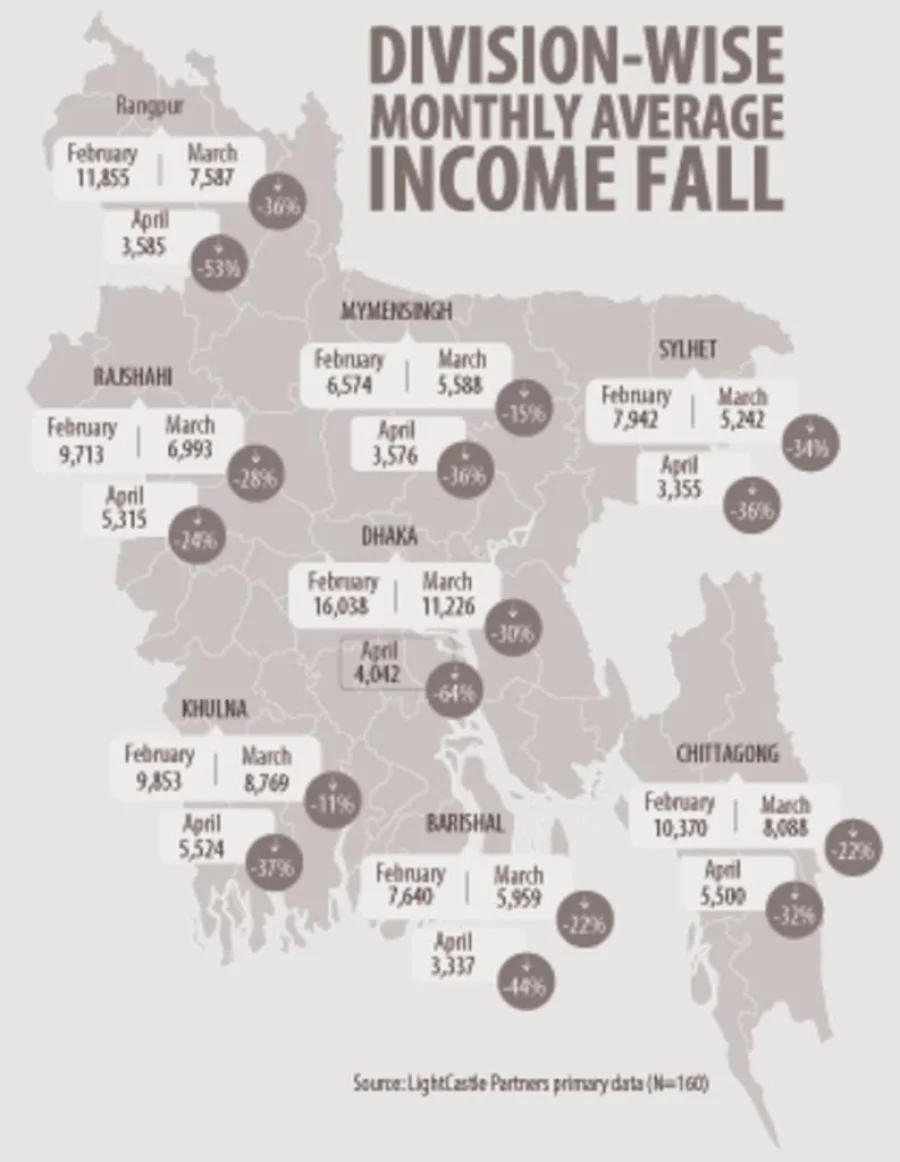
It was confirmed by the rural households that there has been a consistent decrease in income across all the regions and the nation-wide monthly average income of the rural lower-income population came out to beTk10,320, Tk7,234, and Tk4,325 for February, March, and April respectively.
Amongst the eight divisions, the lower-income group from Dhaka, Rangpur, and Barisal experienced the sharpest fall in income of 64%, 53%, and 44% respectively for the month of April compared to March.
However, farmers and rural workers from only three districts--- Sylhet, Khulna and Chittagong said that they have enough income to cover their expenses.
Savings are scarce among rural workers daily wage earners by definition operate on a short run rate of savings and as the coronavirus has spread through the country, 54.72% of farmers and rural workers are running on zero savings.
Among respondent households, vegetable and fish farming have reported the highest proportions of no cash savings. Among those that did have limited savings, 21.8% cannot survive more than a few weeks and daily agricultural workers can rely on their savings the least.
On top of that, support initiatives are yet to be seen. Surprisingly, only 6.96% of farmers and rural workers received no support so far from any institutions; government or otherwise.
As a result, cash (31%), free food, and medicine (45%) were the top asks from these farmers and rural workers as support from the government, private and development sectors.
Household consumption fall
Households involved in factory work including RMG and leather sector, paddy and cereal crops farming, and daily agricultural labor have reduced expenditure by more than 60% compared to the previous month.
On the other hand, some households have reported increased expenditure as they need to purchase more items such as disinfectants and soaps due to the COVID-19 pandemic.
Cash and in-kind support
Agricultural labor and other landless population segment should be identified and provided with in-kind and cash support by the government. Large scale social safety-net programs (SSNPs) including Test Relief (TR), Vulnerable Group Development (VGD), Vulnerable Group Feeding (VGF), etc. should be adopted.
Military forces and credible development organizations like Brac should be included in the planning and execution phase for supporting the adversely impacted rural population segment.
Rural financing schemes
Although the government has already announced a special stimulus package for farmers, deployment of the fund might get delayed due to bureaucratic red-tape. The central bank must ensure rapid deployment of farm loans through commercial banks. Bangladesh bank’s temporary interest freeze should be extended to rural borrowers. Interest rate relief should also be provided to borrowers from microfinance institutions, suggests the survey report.
