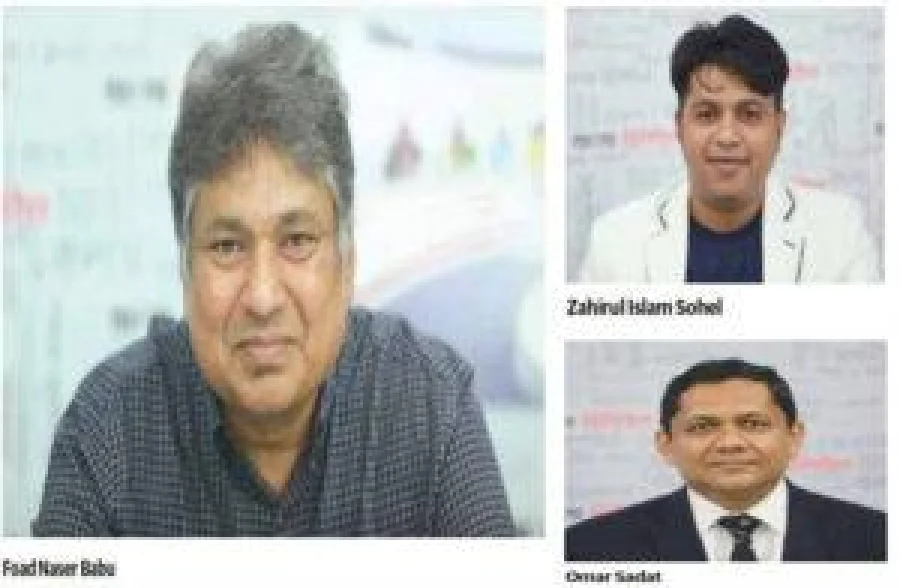
Leader of prominent band Feedback Foad Naser Babu, production company CD Choice owner Jahirul Islam Sohel, Barrister Omar Sadat, Harun Ur Rashid, a journalist of Germany-based international broadcaster Deutsche Welle, singer Asif Akbar and Bangla Tribune Editor and lyricist Zulfiqer Russell participated at the Boithoki.
The programme, moderated by journalist Munni Saha, was telecast live on ATN News and Bangla Tribune’s official Facebook page.
‘Whoever makes profit, tends to split’
Addressing the roundtable, Foad Naser Babu, also the music composer and keyboardist of Feedback, said: “We have been trying for a decade to bring everyone together in this issue, but we failed.”
“Being united has been a big challenge for us as many of us are more inclined to their personal benefits,” he added.
Taking queue, Zahirul Islam Sohel said: “All musicians should get exposure for their works. Unfortunately, we only talk about the songs that become hit. I believe that all artists, including song writers, music composers and singers, need a platform.”
“However, my personal opinion is that we are undermining ourselves by running after revenue and leaving the essence of art behind,” he added.
Barrister Omar Sadat agreed with him, and said: “If all of you come together on a common platform where everyone’s share is unanimously well defined, everyone will benefit. Otherwise, other people will profit while you all fight.”
“As the world is changing, the range of intellectual property is also increasing,” he added.
‘New law for digital media release needed’
Journalist and YouTuber Harun Ur Rashid said that formulation of new laws for songs’ release in online or digital platforms has become necessary.

Backing Sadat’s comments, he added: “I should be aware of my situation when I’m signing a contract. YouTube and other digital means have taken over the previous platforms such as television, radio, cassettes and CDs.
“So, the contract should be signed after knowing and understanding the situation. It is also important that the new law will specify who will get the right to upload a particular content on YouTube,” Harun said.
‘Nothing illegal on my YouTube channel’
Talking about his objection to the Bangla Tribune report at the Boithoki, Asif Akbar said: “My YouTube channel does not have any of the songs mentioned in the report. The remarks of people, whose references were used in the report, are baseless.
“All the comments in the report actually hinted me. This report’s aim was to slander me.”

He added: “However, Qinetic Music oversees YouTube activity in Bangladesh. They have never blocked me, which means there is nothing illegal on my channel.”
Responding to his reaction and allegation, Bangla Tribune Editor and lyricist Zulfiqer Russell said: “A lyricist is the first owner of a song. The second owner is the composer and then comes the singer and others. But do the singers take permission from lyricists or composers when they release the songs on YouTube or allow different mobile phone operators to use them? This was our report’s main subject. It was not targeted at anyone.”
He further added: “I do not know why Asif protested the report which has comments from everyone from the music industry. He suggested a face-to-face conversation, and I just agreed.”
Joining their conversation, Harun Ur Rashid said he also read the report with “much attention.”
He added: “I think this was a well-timed report. While I think it also needed comments from a copyright lawyer, I did not see any link between the report and Asif’s reaction.”
‘This is reprehensible or unfortunate’
Talking about the song ownership, rights and awareness in the music industry, Zulfiqer Russell said: “Nowadays, songs are uploaded on YouTube, but are their owners aware of it? Despite getting paid by producer companies, some artists keep uploading the songs anyway.

“Any money received from the song, even if it is Tk1, it belongs to every owner (singer, lyricist and composer). If the money does not arrive to them, they should be aware of it. But that is not happening.
“Most artists release songs without permission, which is both reprehensible and unfortunate.”
Supporting his remarks, Zahirul Islam Sohel also said that the artists are not united indeed.




 “Being united has been a big challenge for us as many of us are more inclined to their personal benefits,” he added.
Taking queue, Zahirul Islam Sohel said: “All musicians should get exposure for their works. Unfortunately, we only talk about the songs that become hit. I believe that all artists, including song writers, music composers and singers, need a platform.”
“However, my personal opinion is that we are undermining ourselves by running after revenue and leaving the essence of art behind,” he added.
Barrister Omar Sadat agreed with him, and said: “If all of you come together on a common platform where everyone’s share is unanimously well defined, everyone will benefit. Otherwise, other people will profit while you all fight.”
“As the world is changing, the range of intellectual property is also increasing,” he added.
 Backing Sadat’s comments, he added: “I should be aware of my situation when I’m signing a contract. YouTube and other digital means have taken over the previous platforms such as television, radio, cassettes and CDs.
“So, the contract should be signed after knowing and understanding the situation. It is also important that the new law will specify who will get the right to upload a particular content on YouTube,” Harun said.
 He added: “However, Qinetic Music oversees YouTube activity in Bangladesh. They have never blocked me, which means there is nothing illegal on my channel.”
Responding to his reaction and allegation, Bangla Tribune Editor and lyricist Zulfiqer Russell said: “A lyricist is the first owner of a song. The second owner is the composer and then comes the singer and others. But do the singers take permission from lyricists or composers when they release the songs on YouTube or allow different mobile phone operators to use them? This was our report’s main subject. It was not targeted at anyone.”
He further added: “I do not know why Asif protested the report which has comments from everyone from the music industry. He suggested a face-to-face conversation, and I just agreed.”
Joining their conversation, Harun Ur Rashid said he also read the report with “much attention.”
He added: “I think this was a well-timed report. While I think it also needed comments from a copyright lawyer, I did not see any link between the report and Asif’s reaction.”
 “Any money received from the song, even if it is Tk1, it belongs to every owner (singer, lyricist and composer). If the money does not arrive to them, they should be aware of it. But that is not happening.
“Most artists release songs without permission, which is both reprehensible and unfortunate.”
Supporting his remarks, Zahirul Islam Sohel also said that the artists are not united indeed.
