




More than one billion people worldwide are living with mental health disorders, according to new data released by the World Health Organization (WHO) on Tuesday, highlighting the severe human and economic burdens of conditions such as anxiety and depression.
Despite progress in mental health policies and programs in many countries, WHO warns that increased investment and coordinated global action are urgently needed to expand services and safeguard people’s well-being.
Mental health disorders affect individuals across all ages, income levels, and regions, making them a leading cause of long-term disability. Anxiety and depression are the most common conditions, imposing heavy health-care costs on individuals and families and resulting in an estimated global economic loss of US$1 trillion annually due to lost productivity.
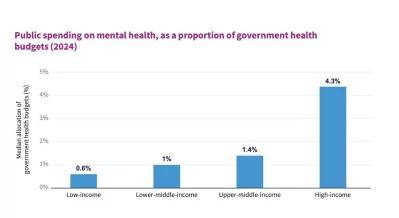
Two major WHO reports—"World Mental Health Today” and the “Mental Health Atlas 2024”—show progress, including the adoption of rights-based policies and improved emergency preparedness, but also reveal critical gaps. Only 2% of health budgets are allocated to mental health globally, a figure unchanged since 2017, with stark disparities between high- and low-income countries. Workforce shortages remain acute, and most countries continue to rely heavily on psychiatric hospitals instead of fully transitioning to community-based care.
The reports also highlight troubling suicide data, showing approximately 727,000 deaths in 2021. Suicide remains a leading cause of death among young people worldwide, and current trends suggest a shortfall from the UN’s goal to reduce suicide rates by one-third by 2030.
WHO Director-General Dr Tedros Adhanom Ghebreyesus called mental health service transformation “one of the most pressing public health challenges,” urging governments to recognize mental health care as a fundamental right rather than a privilege.
Urgent action points, according to WHO, include equitable financing, legal reforms to uphold human rights, investment in the mental health workforce, and the expansion of accessible, community-based, person-centered care. These steps are seen as crucial as nations prepare for the United Nations High-Level Meeting on non-communicable diseases and mental health in New York on September 25, 2025, which aims to reshape global mental health strategies for the next decade.
Mental health in Bangladesh
For Bangladesh, where an estimated 30 million people require mental health services, the findings underscore a pressing public health emergency demanding immediate and sustained action, according to the latest data from October 2022.
Local studies referenced in the WHO report estimate that around 17% of adults and 14% of children suffer from some form of mental disorder in Bangladesh, with depression and anxiety the most common.
Urban areas such as Dhaka and Chittagong are reporting rising cases linked to stress, unemployment, and digital dependency, while rural communities face an additional challenge: the near absence of professional mental health services.
In Bangladesh, mental health spending remains a fraction of the total health budget, with fewer than 300 psychologists and 500 psychiatrists serving a population of more than 170 million. Although the government has adopted a National Mental Health Strategic Plan (2020–2030) and a Mental Health Act to improve policy and legal frameworks, community-based mental health care is still limited, with much of the care concentrated in psychiatric hospitals.
Prof Nahid Mahjabin Morshed, former chairperson of the Department of Psychiatry and head of Child and Adolescent Psychiatry at Bangladesh Medical University, advocated for integrated approaches to mental health development in Bangladesh.
She said, “The budget for mental health is approximately 0.5% of our total health budget. We need to allocate a separate budget specifically for mental health.”
Nahid also suggested increasing the number of psychologists and mental health support medical experts in the country.
She further recommended including mental health services in primary healthcare centres across the country, up to the upazila level.
“Mental health-related education also needs to be introduced in textbooks for children and adolescents,” Nahid emphasized.
Globally, mental disorders represent the second leading cause of long-term disability and impose staggering economic costs, with depression and anxiety alone costing the world economy around US$1 trillion annually. Less than 10% of countries, including Bangladesh, have fully transitioned to community-focused care, and only a small fraction of people with mental illness receives adequate treatment.
The WHO calls on Bangladesh to increase investment in infrastructure, expand the training and deployment of mental health professionals, and integrate services more effectively into primary health care. Such measures are vital to overcoming barriers such as stigma, service gaps, and lack of access, particularly in rural and underserved areas.
This latest global evidence, WHO stresses, should serve as a wake-up call for Bangladesh to view mental health care not as a luxury but as a fundamental right for all citizens.
