




Director General for Asia and the Pacific at the Federal Foreign Office of Germany, Frank Hartmann, has said Germany and Europe are willing and eager to engage more with Bangladesh and get to know the country better.
“To that end, I would like to invite our Bangladeshi counterparts to come visit us in Germany,” he said, reflecting on his recent visit to Bangladesh.
With a packed two-day itinerary, Hartmann and Head of the South Asia Division Steffen Koch engaged with representatives from the government of Bangladesh, civil society organizations, the private sector, diplomatic missions and more, said the German Embassy in Dhaka on Tuesday.
The two senior officials from Germany’s Federal Foreign Office (FFO) visited Bangladesh from June 9 to Thursday.
“This is my first visit to Bangladesh. I had very good talks with political and economic leaders here, as well as civil society organizations. Bangladesh has gone through a difficult political transition in recent years, but it has led to a successful outcome of a new democratically elected government,” Hartmann said.
“Visits like these open doors for deepened collaboration between Germany and Bangladesh,” said German Ambassador to Bangladesh Dr Rüdiger Lotz.
“It was an honour to host Hartmann and Koch and accompany them on their engagements throughout this trip. I hope Bangladesh’s beauty, hospitality and immense potential will inspire our guests from Berlin to visit again,” he said.
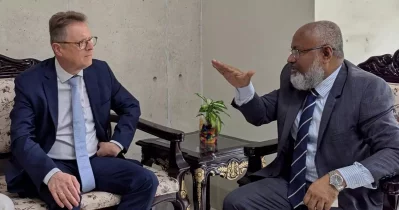
Accompanied by the German ambassador to Bangladesh, the delegation held courtesy meetings with senior officials from the Ministry of Foreign Affairs (MoFA) - State Minister for Foreign Affairs Shama Obaed Islam, acting Foreign Secretary Dr Md Nazrul Islam and Director General for West Europe and EU Mosharaf Hossain.
Both sides acknowledged the long-standing amiable relationship between Bangladesh and Germany, looking forward to continued cooperation.
Hartmann commended Bangladesh on its democratic transition and successful elections. MoFA representatives expressed appreciation for the EU’s deployment of an election observer mission.
Looking to strengthen Bangladesh’s ties with the EU, Bangladesh highlighted its appeal for a Free Trade Agreement.
Hartmann acknowledged Bangladesh’s generosity in welcoming the Rohingya community amid the vulnerable situation in Myanmar.
The state minister urged Germany and the international community at large not to forget about the refugees and facilitate their safe and dignified return to Myanmar.
The day wrapped with a roundtable discussion with representatives of civil society organizations such as the Bangladesh Nari Sramik Kendra, Centre for Policy Dialogue, and Centre for Governance Studies.
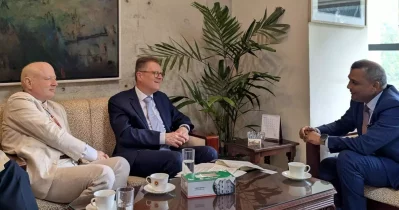
On the second day of the visit, the delegation met with representatives from major German institutions operating in Bangladesh, including the Goethe Institut, GIZ, KfW and the Friedrich Ebert Foundation.
Hartmann and Koch were then welcomed by Commerce Minister Khandakar Abdul Muktadir.
The minister elaborated on recent and upcoming Bangladeshi initiatives such as simplifying the process for aspiring entrepreneurs to start new businesses, devoting more resources to Technical and Vocational Education and Training (TVET), and promoting the leather, jute and light engineering sectors for export in the coming years.
Hartmann welcomed the news and emphasized the need for Bangladesh to effectively utilize the time before its LDC graduation to enact economic reforms, saying trade diversification is crucial for the country at this juncture.
He shared that Germany believes Bangladesh would benefit greatly in terms of economic growth and stability by diversifying beyond textiles.
Hartmann and Koch journeyed to Kashimpur for a tour of DBL Group’s textile manufacturing plants.
DBL walked the delegation through the process of manufacturing clothing from spinning the threads to dyeing the fabric to stitching the final product.
In addition to learning about the manufacturing process, the delegation gained insight into how DBL engages environmental and social sustainability, with initiatives like their 5-Pillar Sustainability Strategy and Female Supervisor program.
