




Urban slums in Dhaka continue to reflect the stark reality of food insecurity and malnutrition faced by the city’s lower-income population.
According to a new study, more than half of slum-dwelling families suffer from food insecurity, leading to stunted growth among nearly 50% of children and posing serious health risks for adolescent girls, particularly those under 15 and pregnant women.
In response to this growing public health challenge, the International Centre for Diarrhoeal Disease Research, Bangladesh (icddr,b) has introduced a community-based initiative titled “Nutri-CAP” (Community-based Approach for Nutrition Programming), aimed at improving food and nutrition outcomes among vulnerable slum populations.
The findings of the Nutri-CAP study were presented at a scientific seminar held on Monday at Mohakhali.
The project, part of the Advancing Sexual and Reproductive Health and Rights (AdSEARCH) initiative, was implemented in Dhaka’s Bauniabadh slum in Mirpur.
The study targeted 16,532 households, focusing on 2,826 households between November 2021 and February 2022, and engaged 721 pregnant women, 4,200 adolescent girls, and nearly 2,500 children under the age of two.
Researchers have found that the community-led, integrated model led to measurable improvements in maternal, adolescent, and child health, underscoring the importance of localized solutions in addressing urban health disparities.
The study initially found that community-led and integrated nutrition and hygiene programs can bring about significant positive changes in the health of pregnant women, adolescents, and children under the age of two.
Conducted in the Bauniabadh slum of Dhaka, the study offers compelling evidence that a locally led and integrated nutrition and hygiene program can significantly improve the health and well-being of pregnant women, adolescent girls, and young children living in Bangladesh’s informal urban settlements.
The Nutri-CAP intervention focused on three vulnerable groups—pregnant women, adolescent girls, and children under two—and introduced a package of integrated services.
Pregnant women received monthly home-based counseling, nutritional supplements including iron, folic acid, calcium, and vitamin D, and regular monitoring of weight, blood pressure, hemoglobin, and blood sugar. They were also encouraged to attend antenatal care visits and rest adequately. These efforts led to measurable improvements.
Women in the intervention group gained an average of 8.9 kilograms during pregnancy, compared to 7.5 in the comparison group, and were significantly more likely to reach optimal weight gain. Facility-based deliveries and good pregnancy outcomes were more common in the intervention group, while adverse outcomes such as abortion, stillbirth, and neonatal death were lower.
The risk of babies being born small for gestational age was reduced by 16%.
Adolescent girls in the intervention group saw a substantial increase in hemoglobin levels, rising from 12.0 to 12.8 g/dL, compared to a smaller gain in the comparison group. While dietary diversity remained unchanged—possibly due to rising food prices—the girls reported better awareness of health and nutrition issues. The prevalence of thinness among this group was 14.9%, with overweight at 12.6%, figures that align with national urban trends.
For young children, the study recorded significant improvements in growth. Adjusted analysis found a meaningful reduction in growth faltering in terms of height-for-age and weight-for-age in the intervention group. Improvements in gut health were also observed. Biological markers indicated lower intestinal inflammation and more responsive immune activity among adolescents in the intervention arm.
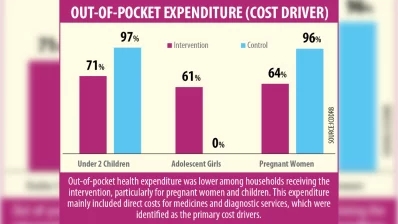
The program also brought economic benefits. Out-of-pocket health expenditure was consistently lower among intervention households, especially for pregnant women and children. While indirect costs, such as time spent accessing services, were slightly higher, total healthcare spending was lower compared to the control group. Medicines and diagnostic costs were reduced, and although human resources remained the largest component of provider costs, the study found that these could be optimized over time as the model is integrated into existing systems.
Speaking at the event Dr Mustafa Mahfuz, principal investigator of the study, explained that the program’s success stemmed from its locally rooted approach.
“This model worked because it listened to the community, trained local women, and addressed multiple barriers at once,” he said.
“The results are a testament to what is possible when evidence meets empathy.”
Dr Tahmeed Ahmed, executive director at icddr,b, said: “Slum dwellers are underserved when it comes to primary healthcare. With its adaptable and locally driven design, the Nutri-CAP model is not only effective but ready to scale in other informal settlements in Bangladesh and similar settings elsewhere.”
Edward Cabrera, first secretary – Development (Health), Canada’s International Development – Global Affairs Canada, said: "By better understanding the crucial nutrition challenges impacting adolescent children and pregnant women among persons living in underprivileged neighborhoods in urban areas, this project will be able to provide concrete evidence on effective interventions that can lead to better decision-making at the policy level."
Dr Thaddaeus David May, senior director of the Nutrition Research Division at icddr,b, delivered the opening remarks at the event.
Dr Shams El Arifeen, project director of AdSEARCH and senior scientist at icddr,b, closed the event by highlighting opportunities for scale-up and partnerships.
The seminar was attended by a wide range of stakeholders including government officials, development partners, NGOs, and researchers.
A representative from Global Affairs Canada shared reflections on Canada’s commitment to supporting community-based nutrition programs.
