




Rows of green plants, water bodies, and wildlife make Jahangirnagar University (JU) in Savar a hub of biodiversity. The university started its journey to increase focus and skills in education and research in the beautiful natural environment.
Meanwhile, in 2018, the Executive Committee of the National Economic Council (ECNEC) decided to build 21 buildings under the Greater Development Project at a cost of Tk1,445 crore for the infrastructural development of the university. Initially, they talked about constructing the buildings according to a master plan, but later the university administration started the construction without a master plan.
Since then, the traditional image of the university has changed. Buildings are being built everywhere by cutting down trees and filling lowlands on the campus. However, in 2023, in view of a movement of teachers and students, the vice chancellor of the university, Md Nurul Alam, announced the creation of a master plan. Later, a Technical Management Committee (TMC) was also formed.
But before its implementation, the administration resumed the construction again. At present, around 15 installations are in progress under the project. The administration has recently started the construction of three new buildings as part of the project. More than 150 trees were felled in one day for the construction of two particular buildings— the extended part of the Faculty of Mathematics and Physics and the Faculty of Fine Arts.
Students say that any infrastructure needs an Environmental Impact Assessment (EIA) which was not taken in the case of these buildings. The teachers and students agitating for a master plan say that a lecture theatre has been built at the university. A total of 6,500 students can attend classes simultaneously in 65 classrooms in the lecture theatre. They question the necessity of the new buildings destroying nature after such a large project that is nearly complete.
Besides, the administration is currently planning to cut down more trees close to the flying zone of the migratory birds for construction of the extended part of the Department of Fine Arts. As a result, the biodiversity of the university is now under threat.
According to sources, Tk97.89 crore has been allocated jointly by Bangladesh and India for the construction of a six-story building for the Department of Fine Arts. Of the amount, the Indian government is funding Tk50 crore. On the other hand, a six-storey building is being constructed for Tk48 crore for the extension of the Faculty of Arts and Humanities. This particular building will be built on a waterbody, students complained.
This correspondent visited the campus on Sunday and saw at least 50 trees being uprooted by excavators on the spot.
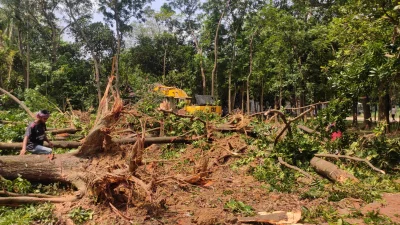
The dean of the faculty, Professor Mozammel Haque, along with several teachers inspected the tree felling. Besides, trees were also cut in the same manner for the construction of a six-story building for the Department of Fine Arts. When some agitating students wanted to enter the venue, the project director, the teachers and students of the relevant department obstructed them.
Meanwhile, when asked about the felling of the trees, Dean of the Faculty of Arts and Humanities Professor Mozammel Haque said: "We have started the construction at the designated place. Later, it will be coordinated with the master plan.”
Associate Professor MM Moejuddin, project director, told the media: “We will plant more trees to replace those that have been cut down. We will take the suggestions of all the stakeholders and form a team so that they can monitor our progress.”
Alif Mahmud, president of JU Chhatra Union, said: “The culture of cutting trees on holidays is very old. If students are not present on the spot, they (the authorities) take this as an opportunity to cut trees. The Department of Fine Arts used the students as shields while cutting down trees.”
Kanoj Kanti Roy, a drama and theater student, said: “Once upon a time, the university administration used to cut trees like thieves in the morning. Now the students are being sent home and trees are being felled in broad daylight. Students are being threatened if they oppose the felling of trees. This administration has embarked on a project to destroy the university.”
Arif Sohail, a student of the Department of International Relations, said: “We have only one demand since the beginning which is a master plan. However, the administration never considers the demands of the students. Therefore, they are killing the trees in an unplanned manner to achieve their own interests. We have repeatedly said that we are not against the buildings.”
A recent study published in the 'Bangladesh Journal of Environmental Research' shows that in the last 35 years from 1988 to 2023, the amount of vegetation and water bodies in JU has decreased by about 26.5%, while the number of buildings constructed has increased by 159.3%.
Sohail Ahmed, vice-president of the university's teachers' association and professor of the Department of Biochemistry and Biosciences, said: “The unique feature and beauty of this university is its life—nature, natural environment and biodiversity. It is being damaged and such endeavors are never appreciated. Buildings are definitely needed for education and research, but not at the cost of the nature. The two lakes of the university attract migratory birds. Now there is doubt whether the migratory birds will come to Bangladesh at all.”
Students said that four years ago, during the pandemic, three residential halls were constructed next to Shaheed Rafiq-Jabbar Hall and Maulana Bhasani Hall. However, the students of Shaheed Rafiq-Jabbar Hall erected a wall on the road in front of the hall citing noise pollution and safety concerns. Recently, students of three halls clashed overnight over the demolition of that wall. At least 10 students were injured in the incident. Apart from this, three of the newly constructed buildings are located near the Dhaka-Aricha Highway, and the students get tired of the loud noise of the vehicles.
Botanist and researcher Prof Saleh Ahmed Khan said: “Developmental work can be done, but we know that EIA is essential for any infrastructure. Without this survey, the side effects and the possibility of a negative impact on the biodiversity of the university are high. If there are two buildings on both sides of the lake and if the lake remains as it is then I don't think any migratory birds will come to this lake in future. There will be quite a large imbalance in this area.
When asked what alternative measures can be taken to protect biodiversity, he said: "We have alternative places for the buildings. If buildings were constructed in those places, the amount of tree cutting would be less, or the trees could be shifted to other places. Besides, planting could have been done before cutting the trees. Now we don't know what trees were in those places.”
Auritra Sattar, a student of the university and a wildlife photographer, said that for the past few years, the university authorities have been encouraging the destruction of the natural habitat and biodiversity on the campus. As a result, various wild habitats are destroyed, and pollution is increasing. Environmentally friendly methods should be adopted to protect the natural beauty and wildlife of JU, he demanded.
Professor Jamal Uddin of the Department of Environmental Science said: “Since 2018, there has been a demand from teachers and students that an ecosystem-based development should take place keeping in mind the topography and biodiversity of the university--which was done by planner Mazharul Islam at the beginning of the university. In recent times, several infrastructures have been built without a master plan, and we are seeing the adverse effects. There is now poor health protection due to air pollution and vibration. The places where there were native species of birds, foxes and reptiles will now be open.”
Experts say these spots on both sides of the lake, with an area of about 7.15 acres, had sanctuaries of forest cats, large Indian civets, jackals and owls. Any infrastructure in such a spot would need a master plan and EIA go ahead which was not done in this case. Experts feel that if high-rise buildings are constructed on both sides, the lake will no longer be habitable for migratory birds and native wildlife due to the noise and disturbance generated during construction.
However, the VC told the protesting students that the dean of the respective department had told him that they would hold talks with the students. We want to start work there. The dean assured the VC that they were talking to everyone and there would be no problem.
“He didn't tell me anything else. It (the project) was not designed during my tenure. And this place was allocated long before I came. I have not selected the location,”
the VC explained.
