



 Business tycoon Quasem was an executive council member of Jamaat and also serving as the treasurer when he was arrested on June 17, 2012. Because of his strong foreign connections, Quasem was tasked with the matter of lobbying.Related: From militia commander to financial mastermindDuring the war, he had been the chief of al-Badr's Chittagong chapter that abducted, tortured and killed freedom fighters and Awami League leaders at various camps in the port city. However, his efforts went in vain.
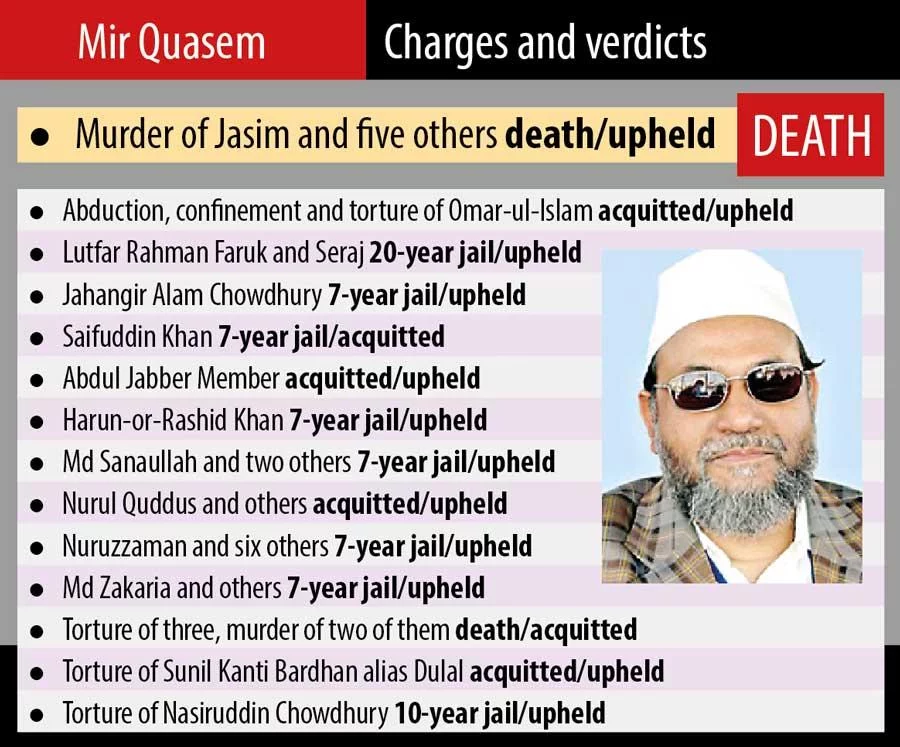
The war criminal was sentenced to death by the tribunal in 2014 and his sentence was upheld by the apex court in March this year after his counsel had failed to prove his alibi. Quasem's final legal attempt to save his life was rejected on August 30.
During the review petition hearing, his counsel urged the court to give him lenient punishment considering his status and economic contribution. But after the court dismissed his petition, Quasem was nervous about hearing about the judgement but surprisingly did not seek presidential mercy – his last lifeline.
Business tycoon Quasem was an executive council member of Jamaat and also serving as the treasurer when he was arrested on June 17, 2012. Because of his strong foreign connections, Quasem was tasked with the matter of lobbying.Related: From militia commander to financial mastermindDuring the war, he had been the chief of al-Badr's Chittagong chapter that abducted, tortured and killed freedom fighters and Awami League leaders at various camps in the port city. However, his efforts went in vain.
The war criminal was sentenced to death by the tribunal in 2014 and his sentence was upheld by the apex court in March this year after his counsel had failed to prove his alibi. Quasem's final legal attempt to save his life was rejected on August 30.
During the review petition hearing, his counsel urged the court to give him lenient punishment considering his status and economic contribution. But after the court dismissed his petition, Quasem was nervous about hearing about the judgement but surprisingly did not seek presidential mercy – his last lifeline.A top leader of Jamaat's Islami Chhatra Sangha during the 1971 Liberation War, members of which formed the atrocious al-Badr force, Mir Quasem Ali may not have thought until 2010 that he and other Jamaat leaders would have to stand in the dock for their war-time crimes committed in the name of saving Islam and undivided Pakistan.
Until that year, Quasem and the top ranks of his party had enjoyed impunity and never faced arrest for war crimes – thanks to the reluctance of subsequent governments in initiating the much-expected trials.
After the arrest of three top Jamaat leaders including its chief Motiur Rahman Nizami on June 29, 2010 – only three months after the International Crimes Tribunal was established – it became clear that there was no more respite from facing trials.
So Jamaat began conspiring to foil the trial proceedings – one of the efforts was spending money to appoint international lobbyists – so that the trials and the incumbent government would be questioned by different quarters and the party could deliver a clean image of its leadership to its supporters by blaming the government for bringing false allegations against them.
In 1971, Jamaat publicly opposed the independence of Bangladesh and formed various forces including al-Badr, Peace Committees and Razakar Bahini to collaborate with the Pakistani occupation forces in committing genocide, murder, rape, abduction and torture, arson and looting of the Bangali people. Business tycoon Quasem was an executive council member of Jamaat and also serving as the treasurer when he was arrested on June 17, 2012. Because of his strong foreign connections, Quasem was tasked with the matter of lobbying.Related: From militia commander to financial mastermindDuring the war, he had been the chief of al-Badr's Chittagong chapter that abducted, tortured and killed freedom fighters and Awami League leaders at various camps in the port city. However, his efforts went in vain.
The war criminal was sentenced to death by the tribunal in 2014 and his sentence was upheld by the apex court in March this year after his counsel had failed to prove his alibi. Quasem's final legal attempt to save his life was rejected on August 30.
During the review petition hearing, his counsel urged the court to give him lenient punishment considering his status and economic contribution. But after the court dismissed his petition, Quasem was nervous about hearing about the judgement but surprisingly did not seek presidential mercy – his last lifeline.
Business tycoon Quasem was an executive council member of Jamaat and also serving as the treasurer when he was arrested on June 17, 2012. Because of his strong foreign connections, Quasem was tasked with the matter of lobbying.Related: From militia commander to financial mastermindDuring the war, he had been the chief of al-Badr's Chittagong chapter that abducted, tortured and killed freedom fighters and Awami League leaders at various camps in the port city. However, his efforts went in vain.
The war criminal was sentenced to death by the tribunal in 2014 and his sentence was upheld by the apex court in March this year after his counsel had failed to prove his alibi. Quasem's final legal attempt to save his life was rejected on August 30.
During the review petition hearing, his counsel urged the court to give him lenient punishment considering his status and economic contribution. But after the court dismissed his petition, Quasem was nervous about hearing about the judgement but surprisingly did not seek presidential mercy – his last lifeline.
Business tycoon Quasem was an executive council member of Jamaat and also serving as the treasurer when he was arrested on June 17, 2012. Because of his strong foreign connections, Quasem was tasked with the matter of lobbying.Related: From militia commander to financial mastermindDuring the war, he had been the chief of al-Badr's Chittagong chapter that abducted, tortured and killed freedom fighters and Awami League leaders at various camps in the port city. However, his efforts went in vain.
The war criminal was sentenced to death by the tribunal in 2014 and his sentence was upheld by the apex court in March this year after his counsel had failed to prove his alibi. Quasem's final legal attempt to save his life was rejected on August 30.
During the review petition hearing, his counsel urged the court to give him lenient punishment considering his status and economic contribution. But after the court dismissed his petition, Quasem was nervous about hearing about the judgement but surprisingly did not seek presidential mercy – his last lifeline.