In the last eight years, almost 400 people have disappeared across the country. Only a fraction of them have returned. The disappearances follow a similar pattern: a group of men claiming to be law enforcement personnel pick up the victim and vanish. When asked, the respective agencies deny any involvement. Sometimes the abductors call for a ransom, but mostly they remain silent.
More disturbingly, the handful of people who return remain utterly silent about their ordeals. The few who talk can say nothing about the identity or motive of the abductors.
Numbers from various rights groups show that such disappearances are on the rise, going from 18 in 2010 to 91 in 2016 by one estimate.
Families and rights groups usually blame law enforcement agencies for the abductions, but a police spokesperson says law enforcers have nothing to do with it.
AIG Sahely Ferdous, the media spokesperson for Police Headquarters, instead blames the victims who have managed to return from their ordeals for their silence.
“If they spoke up instead of staying quiet, it would be easier for police to investigate these issues,” she says.
In May 2016, the Supreme Court ruled that law enforcement agencies could no longer arrest suspects without a warrant. The apex court observed that the incident of citizens being arrested by law enforcers in plain clothes was a “serious” issue.
Living in fear
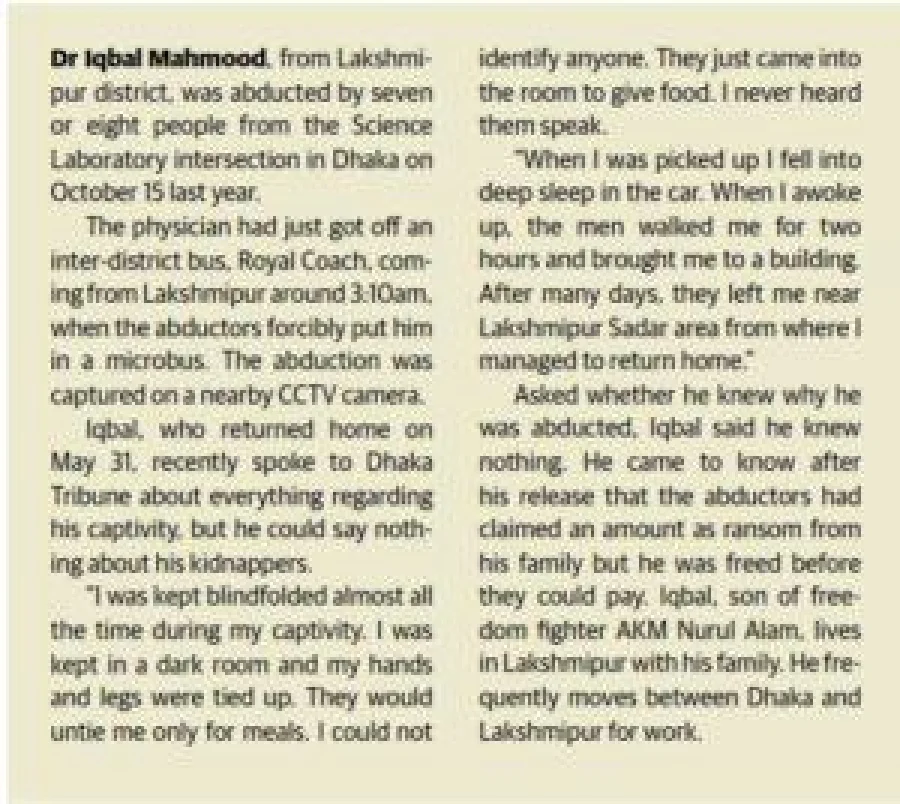
This correspondent reached out to many such persons and only two were willing to talk. One, a doctor from Lakshmipur who was picked up from Dhaka, had been missing for six months. He described being tied up and locked in a dark room. But he claimed to have no idea who his abductors were or what they wanted from him.
Pradip Kumar Saha from Chashara Narayanganj, was abducted from the capital’s Motijheel area on May 30. His kidnappers asked the family for Tk50,000 in ransom.

But before the family had paid out, he was found from New Airport Road on June 2. He said some people picked him up and forced him into a vehicle but he could not identify the abductors. Pradip’s description of his experience was almost the same as Dr Iqbal.
Sujon Ghorami, 27, from Barisal’s Babuganj, went missing from the capital’s Banani area on December 1 last year with his three friends Mehedi, Pavel and Shafayat.

Sujon discovered himself near Aminbazar on May 29. He later said they were picked up by unidentified men in a microbus. The men had sprayed something on their faces and they all lost consciousness.
Mehedi, a third year honours student of BM College, returned before Sujon on April 18. The other two, who are students of North South University, are still without trace.
On May 22, Jagannath University physics student Sadekul Islam Milon was picked up from his home by several men who claimed to be policemen.
The family asked for their ID cards but the men roughed them up and took away Milon. Later someone called the family from Milon’s phone and demanded Tk30,000 in ransom.
At least 50-60 enforced disappearances are occurring every year, said human rights activist Nur Khan Liton, former executive director of the rights organisation Ain O Salish Kendra.
“As enforced disappearances happen all the time everywhere, those who are lucky enough to return continue to live in fear. That is why they remain silent when asked about the abductors,” he said.
Powerful people
Nur said the victims believe that the abductors are powerful people in strong positions in the state apparatus. They are therefore afraid to take action against them.
Human rights organisations reported at least 320 cases of disappearances since 2009. These include people suspected of criminal activities and militancy, as well as members of the political opposition.
Local and international rights organisations such as Ain O Salish Kendra, Odhikar, Human Rights Watch and Amnesty International say many of the victims are from the political opposition.
BNP central leader Ilias Ali and his driver were last seen at midnight on April 17, 2012 in Dhaka. His private car was found by police near his Dhaka home but the two are still missing. BNP Chairperson Begum Khaleda Zia alleges Illias was kidnapped by security forces on instructions of the Awami League government.

Another top leader of BNP, Salauddin Ahmed, was allegedly picked up from his Uttara house in March 10, 2015. Local police found him in Shillong, the capital of the neighbouring Indian state of Meghalaya, after about two months. His wife Hasina Ahmed said Salauddin was picked up by the security forces while Salauddin said he was left in Shillong with his hands and legs tied.
Nur said that justice in cases such as the Narayanganj seven-murder case, in which a court sentenced to death several members of the elite Rapid Action Battalion (RAB) and a ruling party leader, can help reduce the frequency of enforced disappearance incidents across the country. Punishment of the perpetrators will give confidence to the victims, he added.
The victims, Narayanganj City Corporation Councilor Nazrul Islam and his aides, were picked up by RAB men from Dhaka-Narayanganj Highway, and their bodies were found after a couple of days.
Ain O Salish Kendra, in its latest report, said 44 people went missing in the first six months of this year. All of them were picked up by people who identified themselves as law enforcement personnel.
No Arrest without due process
Human Rights Watch said 48 disappearances were reported in the first five months of 2017 while allegations of severe torture and ill-treatment were found in secret custody.
AIG Sahely Ferdous denied allegations against law enforcement agencies regarding enforced disappearances.
She said: “No unit of Bangladesh police is involved with such offence. Some criminal rackets use the badges of security agencies. We are taking action against such gangs.”
Despite her claims, the reality is that very few such cases have been solved so far.
In May 2016, the Supreme Court ruled that law enforcement agencies could no longer arrest suspects without a warrant, or without displaying official identification.
The apex court said the incident of citizens being arrested by law enforcers without uniform was a “serious” issue.
The judges cited an instance where the son of a freedom fighter, who was a bodyguard of Bangabandhu Sheikh Mujibur Rahman, was allegedly picked up by some people claiming to be law enforcers. But he has not been found. The court noted.
Human rights activists say the court’s ruling is being widely flouted.
AIG Sahely Ferdous pointed to one incident that she said showed law enforcement agencies were getting unnecessary blame for disappearances - the recent disappearance and return of Farhad Mazhar.
Columnist and right-wing activist Farhad Mazhar, 70, claimed he was picked up by some unknown men on July 3 near his home. Police then found him on a bus headed from Jessore to Dhaka, 18 hours later.
Police later presented some evidence and suggested that Mazhar was moving freely and did not appear to be acting under duress.
Human Rights Watch, in its latest 82-page report titling ‘We Don’t Have Him: Secret Detentions and Enforced Disappearances in Bangladesh’, said Bangladesh law enforcement authorities have illegally detained hundreds of people since 2013, including scores of opposition activists, and held them in secret detention.
The report asked the government to “immediately stop this widespread practice, order prompt, impartial, and independent investigations into these allegations, provide answers to families, and prosecute security forces responsible for such egregious rights violations.”
Under international law, a forced disappearance is the deprivation of liberty by agents of the state, followed by a refusal to acknowledge the deprivation of liberty or by concealment of the fate or whereabouts of the disappeared person, which place such a person outside the protection of the law.





 But before the family had paid out, he was found from New Airport Road on June 2. He said some people picked him up and forced him into a vehicle but he could not identify the abductors. Pradip’s description of his experience was almost the same as Dr Iqbal.
Sujon Ghorami, 27, from Barisal’s Babuganj, went missing from the capital’s Banani area on December 1 last year with his three friends Mehedi, Pavel and Shafayat.
 Sujon discovered himself near Aminbazar on May 29. He later said they were picked up by unidentified men in a microbus. The men had sprayed something on their faces and they all lost consciousness.
Mehedi, a third year honours student of BM College, returned before Sujon on April 18. The other two, who are students of North South University, are still without trace.
 On May 22, Jagannath University physics student Sadekul Islam Milon was picked up from his home by several men who claimed to be policemen.
The family asked for their ID cards but the men roughed them up and took away Milon. Later someone called the family from Milon’s phone and demanded Tk30,000 in ransom.
At least 50-60 enforced disappearances are occurring every year, said human rights activist Nur Khan Liton, former executive director of the rights organisation Ain O Salish Kendra.
“As enforced disappearances happen all the time everywhere, those who are lucky enough to return continue to live in fear. That is why they remain silent when asked about the abductors,” he said.
 Another top leader of BNP, Salauddin Ahmed, was allegedly picked up from his Uttara house in March 10, 2015. Local police found him in Shillong, the capital of the neighbouring Indian state of Meghalaya, after about two months. His wife Hasina Ahmed said Salauddin was picked up by the security forces while Salauddin said he was left in Shillong with his hands and legs tied.
Nur said that justice in cases such as the Narayanganj seven-murder case, in which a court sentenced to death several members of the elite Rapid Action Battalion (RAB) and a ruling party leader, can help reduce the frequency of enforced disappearance incidents across the country. Punishment of the perpetrators will give confidence to the victims, he added.
The victims, Narayanganj City Corporation Councilor Nazrul Islam and his aides, were picked up by RAB men from Dhaka-Narayanganj Highway, and their bodies were found after a couple of days.
Ain O Salish Kendra, in its latest report, said 44 people went missing in the first six months of this year. All of them were picked up by people who identified themselves as law enforcement personnel.

