




In a landmark reversal of a 13-year-old constitutional shift, the Appellate Division of the Supreme Court on Thursday reinstated Bangladesh’s caretaker government system, ruling that the non-party election-time administration will again oversee national polls — beginning with the 14th parliamentary election.
The judgment, delivered by a seven-member bench headed by Chief Justice Dr Syed Refaat Ahmed, effectively nullifies the court’s own 2011 decision that had declared the 13th Amendment unconstitutional and paved the way for election-time governments led by the ruling party.
Thursday’s ruling restores Chapter 2A of Part IV of the Constitution — the legal foundation of the caretaker model — subject to the conditions under Articles 58B(1) and 58C(2) as originally enacted.
The court made clear that the reinstated system will not apply to the upcoming national election, but will come into force from the next one.
‘Multiple errors on the face of the record’
In its short order, the court unanimously allowed all appeals and disposed of all civil review petitions, observing that the earlier judgment abolishing the caretaker mechanism “was clearly flawed with multiple errors on the face of the record.”
The judges then set aside the 2011 judgment in its entirety, reviving the full legal architecture of the caretaker system.
Alongside the Chief Justice, the bench included Justice Md Ashfaqul Islam, Justice Zubayer Rahman Chowdhury, Justice Md Rezaul Haque, Justice SM Emdadul Haque, Justice AKM Asaduzzaman, and Justice Farah Mahbub.
The full judgment will be released later.
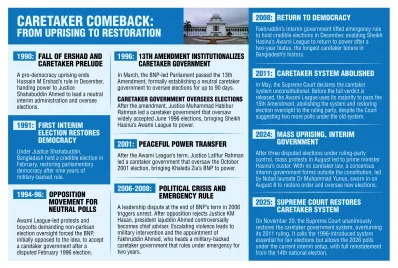
Bangladesh previously held parliamentary elections under caretaker governments in 1996, 2001, and 2008, all of which were widely regarded as competitive.
The 1991 polls, though not under a constitutional caretaker system, were similarly overseen by an interim arrangement forged through political consensus.
The system formally entered the Constitution through the 13th Amendment in 1996.
Its validity was upheld by the High Court in 2004, but the Appellate Division struck it down in 2011 in a deeply divided ruling.
Parliament subsequently passed the 15th Amendment, abolishing the caretaker model.
How the case resurfaced, and why now
The fall of the Awami League–led government on August 5, 2024 triggered a fresh wave of legal and political debate over election-time governance.
Twenty days later, on August 27, civic activist Badiul Alam Majumdar and five eminent citizens filed the first review petition, challenging the 2011 verdict.
BNP Secretary General Mirza Fakhrul Islam Alamgir filed a separate petition on October 16, followed by Jamaat-e-Islami’s Secretary General Prof Mia Golam Porwar on October 23.
Freedom fighter Md Mofazzal Hossain filed another petition soon after.
The Appellate Division granted leave to appeal on August 27 and fixed the review for full hearing.
The hearings began on October 21 and continued over ten sessions.
Dr Sharif Bhuiyan appeared on behalf of petitioner Badiul Alam Majumdar, while Advocate Mohammad Shishir Manir represented Jamaat-e-Islami.
Senior BNP lawyers Zainul Abedin and Barrister Ruhul Quddus presented arguments for the BNP, and Attorney General Md Asaduzzaman stood for the state.
Decades of legal history converge
The caretaker system’s legal journey spans nearly three decades.
After the 13th Amendment was enacted, its constitutionality was first challenged in 1998 by Advocate M Salim Ullah and two others.
The High Court rejected that challenge in 2004.
During the earlier Appellate Division proceedings, eight eminent legal minds served as amicus curiae.
Five — Dr Kamal Hossain, TH Khan, Mahmudul Islam, Barrister M Amir-ul Islam, and Barrister Rokanuddin Mahmud — supported the caretaker system.
Barrister Ajmalul Hossain KC argued to abolish it, while Barrister Rafique-ul Huq and Dr M Zahir proposed major reforms.
Their opinions helped shape the divided 2011 decision that struck down the system, a ruling now overturned.
The court’s reinstatement of the caretaker government system marks one of the most consequential judicial interventions since Bangladesh’s return to parliamentary democracy in 1991.
The decision is expected to reshape political dialogue, election strategy, and constitutional interpretation in the months ahead — and reintroduces a model long demanded by major opposition parties and civil society groups.
The full judgment is awaited for further clarity on implementation mechanisms and constitutional interpretation.
