



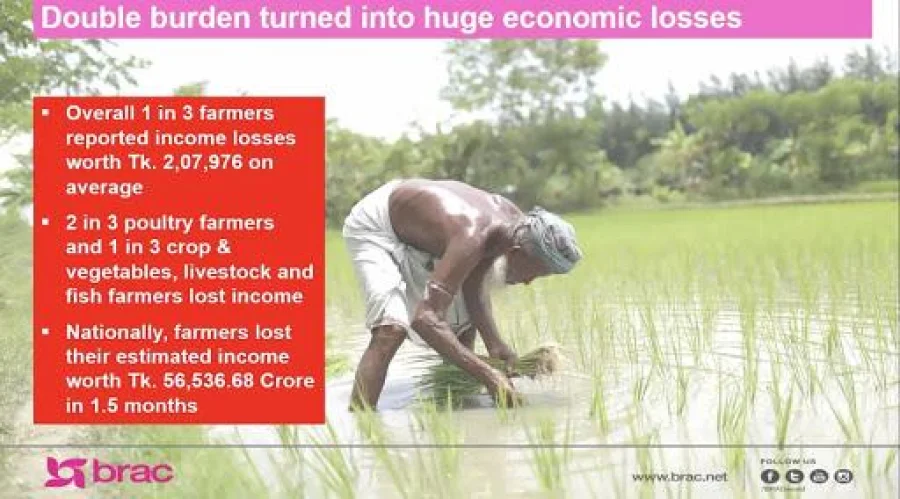
Farmers across the country have lost an estimated Tk56,536.68 crore during the Covid-19 forced shutdown across the country.
Due to the damages to their yields and low prices, each farmer suffered a loss of Tk207,976 (on an average) during the period of past 45 days.
A study conducted by Brac’s Iffat Anjum Anika and Nahrin Rahman Swarna titled “Impact of Covid-19 Pandemic on Agriculture and Implications for Food Security” revealed the estimated numbers portraying the severe loss our farmers’ have suffered in the past one and a half months between March and May.
The findings of this study were revealed on Thursday afternoon via a virtual meeting arranged by Brac, the country’s largest NGO.
Panellists in the meeting urged the government for a proper allocation for the country’s agriculture sector in the upcoming national budget for fiscal 2020-21 considering the crisis.
They also suggested smoothening of the due process for getting a loan from the special fund the central bank had announced.
Md Akram Hossain, a fish farmer from Bagura, expressed his concerns during the webinar about getting loans properly as local representatives, who prepare the list, are corrupt.
He said: “We have no problem with paying interest but we want the exact amount of money as a loan that has been allocated for us.”
Dr MA Sattar Mandal, former vice-chancellor of Bangladesh Agricultural University, also a former member of the Planning Commission said: “The retailers, distributors, agents and middlemen should be prioritized and their expertise should be utilized to tackle the current situation as they play important roles in the market.”
Meanwhile, the researchers also announced a set of recommendations including a farmer-friendly credit distribution system to reduce red-tape barriers for the betterment of the farmers of Bangladesh.
While presenting, Nahrin Rahman said that the report includes two studies -- market failure and vulnerability of farmers between the end of March and Mid May.
“Data was collected from a total of 1,581 farmers representing all of our 64 districts. These respondents were reached through telephone,” she added.
She said: “Information regarding the price of the products cultivated and produced by the country’s farmers was collected from the Department of Agricultural Marketing.”
Overall, 88% of the country’s farmers (100% of fish farmers) reported economic losses owing to production and marketing problems.
Moreover, farmers pointed out the lack of fair prices (66%), limited operation of markets (52%), higher prices of inputs (45%) and unavailability of labour (28%) as the prime causes behind their sufferings.
According to the study, during late March 2020, demand for essential commodities went up by a staggering 300% due to the panic caused by Covid-19, and later in May demands dried up which led to price drops, but the production of crops did not stop.
The researchers, through this study, also suggested the concerned authorities to ensure wide-scale injection of cash to boost people’s purchasing power.
They urged for the government’s intervention in the procurement and supply chain systems to rectify price falls such as the establishment of collection centres for agro-produces closer to smallholder producers and facilitating and providing incentives so the backward and forward linkages to adequately improve the support system to the industry.
Eleash Mridha, managing director of Pran group suggested measures for those areas where the devastation of Covid-19 is lesser to facilitate the farmers.
Echoing the same, MD Dr FH Ansarey, managing director and CEO of ACI Agribusiness, stressed on tech-based agricultural innovation, saying that: “Agro-processing technologies need to be given preference. The government should allocate at least Tk1,000 crore for improving the connectivity of farmers with the private sector, dealers and extension services.”
Of all the farmers interviewed, 42% reported that they had no way of coping with the crisis, while 60% of crop and vegetable farmers said they had to absorb the losses fully, said the study.
Whereas, around 11% of all farmers and 17% of poultry farmers had to reduce their production, while another 2% stopped production. Moreover, poultry farmers incurred huge losses as prices dropped by 44% owing to the closure of all restaurants during the Covid-19 shutdown.
“As the demand for poultry products reduced, the farmers reduced their production too, which resulted in a shortage of supply and thus the prices increased. Prices rose by 26% for farm chicken and 8% for eggs during the second week of May.
“As the demand declined by almost 33-60% with the prices going down by 12.5% at the retail level and 22% at the farmers’ end, livestock farmers had to reduce their production,” added the study.
Also, of the interviewees, 41% respondents (69% of fish farmers) are planning to depend on credit to survive, 14% will have to depend on their alternative income sources, 18% will either draw money from savings or sell their assets. Another 18% of the respondents still have no plans and 5% are planning to change their profession if they have to discontinue their production.
As many as 66% of the respondents want to get loans from the government on easy terms and around 56% farmers want fair prices for their produce, while 48% want necessary inputs at affordable prices.
Besides, 64% of our farmers are aware of incentives the government announced for them, but 79% of them had no idea or had a misconception about how to avail the facility, found the study.
Most significantly, only 20% of the respondents reported having prior experience of taking formal loans from banks.
However, all the panellists concluded by saying that in order to ensure food safety, concerned authorities have to go to the farmers.
Mohammad Anisur Rahman, director of Brac Dairy and Food Enterprise, joined the event as a panellist while KAM Morshed, senior director of Brac, moderated the session.
