




Over the years, Shobhajatra has become an integral part of Bengali New Year celebrations. Although its name has changed several times, it still plays a key role in showcasing our cultural heritage. In 2016, the procession was listed as a world cultural tradition by UNESCO, the United Nations' educational, scientific and cultural organization.
Though the procession has worn many names, from "Borshoboron Shobhajatra" in Jessore to "Anondo Shobhajatra" in Dhaka, then "Mongol Shobhajatra" for over three decades, and now "Boishakhi Shobhajatra", its festivity has never wavered.
The motifs, the drums, the scroll paintings, and the mass participation have endured through every political shift and renaming. What began as both a celebration of Bengali heritage and a defiant stand against the Ershad regime has grown into a procession recognized by UNESCO itself, proving that no change in name could diminish what it represents.
History of the procession
The procession was initially started in 1985 in Jessore by sculptor Mahbub Jamil Shamim, under the management of an organization named 'Charupith Art Research Institute', as "Borshoboron Shobhajatra." Around 400 people participated, and it later transformed into the Shobhajatra we see today under the management of the University of Dhaka's Faculty of Fine Arts.
In 1989, students from what was then known as 'Charukala Art Institute' (now the Faculty of Fine Arts) brought this tradition to the capital, as recalled by AAM Kaoser Hassan, a professor at the Sculpture Department of the Fine Arts Faculty.
"This started as a way to keep Bengali traditions alive and as a movement against the Ershad regime," stated Kaoser Hassan.
Name changes
The procession began at Dhaka University as "Anondo Shobhajatra." Under the leadership of Rafiqun Nabi, then director of Charukala Art Institute, a 101-member committee was formed to manage it. Among its members were Chhayanaut founder Dr. Sanjida Khatun, her husband Waheedul Haque, and BSCIC (Bangladesh Small and Cottage Industries Corporation) designer Emdad Hussain.
"Then a year later, in 1990, Waheedul Haque, the co-founder of Chhayanaut, and artist Emdad Hussain proposed the name 'Mongol Shobhajatra', and the tradition soon caught on and spread across the entire country," Mahbub Jamil Shamim told the media in 2017.
After continuing for 35 years as "Mongol Shobhajatra," the procession was renamed "Anondo Shobhajatra" last year, following the ousting of the Awami League regime by the student-led July Uprising.
On April 10, 2025, the New Year Celebration Committee claimed that it aimed to restore the original name of the procession, as used during the first rally in 1989. They stated that when the name was later changed, it did not happen in the same "organic manner."
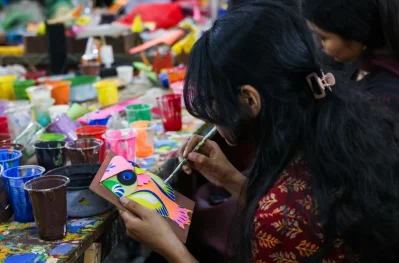
Professor Dr Azharul Islam Chanchal, convener of the committee, said: "We are not changing the name. We are just restoring the original name of the celebration, used at its inception."
He also said that the word "Mongol" had been used by the "fascist regime" in a way that left negative connotations in society. "That is why we want to return to the original spirit — a time of spontaneous participation by all people, free from political aggression disguised as cultural practice," he added.
Following that, this year the name was changed again, to 'Boishakhi Shobhajatra'. Cultural Affairs Minister Nitai Roy Chowdhury announced the decision on April 5, stating the government would forego both "Anondo Shobhajatra" and "Mongol Shobhajatra."
"We will not call it 'Anondo Shobhajatra' or 'Mongol Shobhajatra'. The procession will simply be referred to as 'Boishakhi Shobhajatra'," he told reporters after a meeting at the Secretariat.
This year’s theme and participation
This year's theme is "Harmony of the New Year, Revival of Democracy." The motifs include a Rooster, symbolizing the dawn of a democratic morning; an Elephant, referencing the iconic motif at Sonargaon; a Pigeon, representing peace; a Tepa Putul Horse, signifying rural tradition; and a Dotara, expressing solidarity with the Baul community and protesting the attacks against them.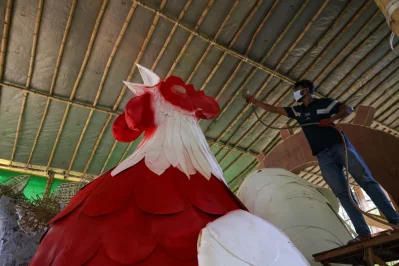
This year's procession will open with a police cavalry, trailed by 200 Dhaka University students bearing the national flag. Journalists will march next, ahead of the main banner accompanied by state guests and senior university officials. Behind them will come Deans from various faculties and Provosts from the residential halls, then Chairmen of the various departments alongside university teachers and staff. Further back, JASAS (Jatiyatabadi Samajik Sangskritik Sangstha) and the Jatiya Kabita Parishad will march together, ahead of the five large motifs, drummers, and a 150-foot scroll painting. Saimum Shilpigoshthi and representatives from 115 indigenous communities will bring up the rear.
