



Bangladesh on Sunday declared Savar, a township adjacent to the national capital Dhaka, a ‘degraded air shed,’ with the understanding that the action would help people in Dhaka breathe better.
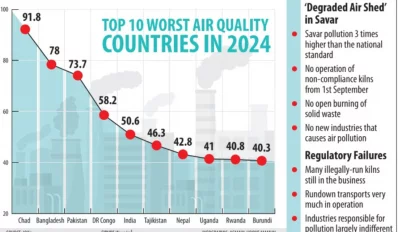
The move comes at a time when Bangladesh’s level of tiny air pollutant particles (PM2.5) exceeded the World Health Organization (WHO) threshold by 15 times, making the country the second worst in terms of air quality globally last year, after Chad.
WHO says average annual levels of PM2.5 should not exceed 5 micrograms per cubic meter (5 µg/m³). Bangladesh reached 78 µg/m³ in 2024, according to IQAir, a Swiss company that tracks global air quality.
IQAir says air pollution remains a significant health burden, reducing life expectancy by an estimated 5.2 years.
Air pollution kills an estimated seven million people worldwide every year, mainly due to increased mortality from stroke, heart disease, chronic obstructive pulmonary disease, lung cancer, and acute respiratory infections.
Declaring Savar—an area notorious for its high concentration of brick kilns—a degraded air shed essentially means no more operation of brick kilns (except Tunnel Kilns and Hybrid Hoffman Kilns) from September. In addition, open burning of solid waste and the issuance of location and environmental clearance for newly established industries that may cause air pollution have also been banned.
Why Savar only, and would it help stop the rot?
While the IQAir report shows the whole country is breathing heavily polluted air, and the Bangladesh government’s Department of Environment (DoE) has also reported unhealthy air quality in many parts of the country, why has the ‘degraded air shed’ measure been applied to Savar only?
Responding to this query, DoE officials said they had found, from the department’s nationwide air quality monitoring data, that the annual average concentration of ambient air pollutants in Savar is almost three times higher than the national standard, posing severe health risks to people.
Moreover, the special measures in Savar would help people living in the capital Dhaka breathe better.
During the dry season, winds from the northeast and northwest carry pollution from Savar into Dhaka for nearly five months, further aggravating air quality and creating grave health hazards for city residents.
The government expects that this declaration will play a vital role in curbing air pollution in both Savar and Dhaka.
In its recently published air quality monitoring report for the period 2018–2023, the DoE stated: “Bangladesh has been suffering from a heightened level of air pollution for a decade. Despite taking several measures to control the pollution, the situation has worsened in recent years, especially due to development works and adverse meteorological conditions resulting from climate change; some research has also pointed to transboundary particulate matter as responsible for this calamity.”
It added that on most days of the year, PM2.5 concentrations remained at the “unhealthy” level (in terms of the health impact index) in major cities. “Moderate” levels were the second most common in less impacted cities like Khulna, Narsingdi, Comilla, and Chittagong. However, for cities in the middle and north of the country, “very unhealthy” days were comparatively greater, with fewer “moderate” days.
Experts have long warned that unless Bangladesh enforces existing laws to contain air pollution, any piecemeal measure will make little difference. They pointed to the government’s compromises in taking action against polluting industries, mushrooming kilns, and unfit public transport.
Against this backdrop, the Savar move comes more than a month and a half after Environment Adviser Syeda Rizwana Hasan, while chairing a high-level meeting on July 1, hinted at declaring ‘degraded air sheds’ soon to control air pollution in Dhaka city.
A scientific expert committee will be formed to provide recommendations on effective measures to tackle Dhaka's worsening air quality, the meeting was told.
In September 2024, the government announced that no new permits for brick kilns would be issued. However, how much progress has been made in shutting down more than 3,000 illegally run brick kilns remains a big question. In the past, Bangladesh’s higher judiciary also ordered closures of kilns operating illegally.
The government’s move to stop buses and trucks from operating beyond their economic lifespan has also lost momentum, while efforts to make industries follow air quality protocols remain far from reality.
A report by news agency UNB said yesterday that although the High Court ordered the removal of all illegal brick kilns across the country on February 24, and kiln owners were required to submit valid documents to the respective Upazila Assistant Commissioner (Land) office by March 1, the majority failed to comply, showing blatant disregard for the law.
Under existing laws, brick kilns cannot be established near residential, protected, or commercial areas, nor in proximity to municipal towns, educational institutions, or agricultural land.
PM2.5 refers to particulate matter with a diameter of 2.5 micrometers or less. These tiny particles are a major component of air pollution and pose significant health risks due to their ability to be inhaled deep into the lungs and even enter the bloodstream.
