




The interim government headed by Prof Muhammad Yunus is placing the highest priority on mitigating flood victims' plight as the flood situation worsens in 10 districts, affecting over 3.6 million people in the country.
The sudden floods occurred shortly after the interim government assumed power following the ouster of Sheikh Hasina in a mass uprising.
On Wednesday night, the flash floods began intensifying in several districts. On Thursday morning, Chief Adviser Muhammad Yunus convened a meeting of the advisory council at his official residence to address the crisis.
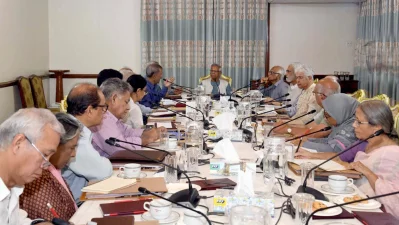
According to sources, the council discussed relief measures for flood victims and how to coordinate efforts with various government agencies. The meeting also examined the causes of the floods and potential future prevention strategies.
To address the situation, the advisory council decided on coordinated efforts involving the Army, Navy, and Anti-Discrimination Movement coordinators.
After the meeting, Shafiqul Alam, the chief adviser’s press secretary, briefed journalists on Thursday night, saying: “Professor Muhammad Yunus urged all advisers to support the flood-affected people,”
The press secretary said the chief adviser instructed the advisers to monitor the condition of flood victims around the clock.
The Disaster Management Adviser has already visited Feni district to oversee rescue and relief operations, and other advisers will soon visit the flood-affected areas.
Earlier, after the meeting, Disaster Management and Relief Adviser Farooq-e-Azam said that efforts are ongoing to maintain communication with those affected by the floods.
He stressed the urgent need to save lives as the country faces widespread flooding.
Farooq-e-Azam acknowledged that the country is dealing with an unprecedented flood situation.
Regarding India, the adviser mentioned that the flood seems to have occurred suddenly, with reports suggesting that India may have released water from its dams.
“This issue was discussed in the advisory council meeting, and steps are being taken to establish contact with India,” said the adviser.
He noted that there was no prior warning about the floods, as the sudden influx of water from upstream was unexpected.
After the meeting, Syeda Rizwana Hasan, adviser for environment, forest, and climate change, said: "We have decided that the advisers will visit all the flood-affected districts. The official responsible for relief activities will travel to Feni to assess the flood situation and coordinate relief distribution in the most severely affected areas."
She noted that heavy rainfall occurred both in upstream areas in India and within the flood-affected regions of the country.
After the meeting, Nahid Islam, Adviser for Information and Broadcasting, urged people from all walks of life to support the flood victims, stressing the need for unity, similar to that seen during the student-people revolution.
"We have observed that water coming from upstream areas is worsening the flood situation in Bangladesh. By opening a dam without providing early flood warnings, India has demonstrated an inhumane attitude," he said.
Meanwhile, later in the afternoon at a meeting with Chief Adviser Professor Yunus, the Indian High Commissioner to Bangladesh Pranay Verma claimed that the release of water into Bangladesh was an "automatic release" triggered by the high water levels caused by heavy rainfall within its territory.
The Indian high commissioner described the floods in Tripura as "very unprecedented," displacing 50,000 people and causing devastation on both sides of the Bangladesh-India border.
Prof Yunus emphasized that Bangladesh is like a "big family" and stressed the importance of high-level collaboration on water issues, especially in emergencies.
He suggested that water-sharing of shared rivers can be resolved through cooperative efforts and cited the Indus Waters Treaty between India and Pakistan as an example.
