




Government agencies tasked with money laundering prevention have long been struggling to recover laundered money due to a litany of bureaucratic hurdles and a lack of skilled lawyers.
Currently, six agencies have the jurisdiction to investigate money laundering cases: the Criminal Investigation Department (CID), Directorate of Customs Intelligence and Investigation, the Directorate of Narcotics Control (DNC), the Directorate of Environment, the Securities and Exchange Commission and the Anti-Corruption Commission (ACC). Although it may appear to be a benefit to have multiple agencies on the task, it has proven to be a barrier in reality, government officials have said.
Prior to an amendment to relevant laws in 2015, the ACC had the jurisdiction to investigate money laundering cases in their totality. Following the amendment, the commission is now only empowered to investigate bribery and corruption out of 27 money laundering-related crimes. Jurisdiction to investigate other related crimes is split among the other five agencies.
Jurisdictional issues and bureaucracy are even more of a barrier for money laundering cases at the international level, as a long and winding process needs to be followed to get information on accused from other countries.
Process to collect information
Initially, the ACC requests that the BFIU confirm information on money laundering, and then the BFIU collects information from the Financial Intelligence Unit of the respective country.
In such situations, the ACC must file a Mutual Legal Assistance Request (MLAR) with the country concerned for information under the UN Convention against Corruption. However, the ACC cannot file a MLAR directly with the authorities.
The commission must follow a 12 step process to get the information.
The first step is to write a letter to the Ministry of Home Affairs, which is then sent to the Ministry of External Affairs. If the Ministry of External Affairs deems the request feasible, the letter is sent through the embassy to the authorities of the country concerned.
The authority of the concerned country then sends its reply through its Ministry of Foreign Affairs.
The Ministry of Foreign Affairs of Bangladesh receives the information from the embassy and forwards it to the Ministry of Home Affairs. Investigators get their answers only when the Home Ministry sends them to the ACC or other investigative agencies.
Recently, the ACC has sought more power to investigate money laundering cases.
ACC Commissioner Mozammel Haque Khan said: "We have written to the government to amend the existing law to ease coordination."
In September 2021, the ACC had written to the Cabinet to speed up the process of getting information from other countries, requesting it to enter into agreements with countries where money has been laundered to.
The ACC also pointed out that filing an MLAR is no guarantee of getting the information, as the country concerned may reject the request.
Currently, Bangladesh has MLARs with only two other countries: India and South Africa.
The amount of black money and money laundered from Bangladesh in 50 years from the 1972-73 financial year to the 2022-23 financial year is Tk1,44,46,315 crore.
Out of this, the amount of accumulated black money is Tk1,32,53,500 crore, and the laundered amount is Tk11,92,815 crore, the Bangladesh Economic Association (BEA) said at a press conference on Thursday.
BEA President Prof Abul Barkat said if only 5% of that laundered money can be recovered, then the government will get Tk59,625 crore. If only 2% can be recovered, the government will get Tk2,65,070 crore.
ACC efforts to bring back money
According to ACC data, the commission has so far sought information on assets worth about $62.6 million in various countries, including Canada, USA, UK, Singapore, Australia, Malaysia, and Thailand.
Recently, the commission also sought information about Bangladeshis who had built houses in Dubai, UAE.
On condition of anonymity, an ACC official said around 75-80% of the money was laundered through over- and under-invoicing. The responsibility of investigating such cases falls under the jurisdiction of the NBR and CID.
He added that these agencies rely on public prosecutors who do not have the experience or skills to handle money laundering cases, slowing down investigations.
Overall picture of money laundering cases
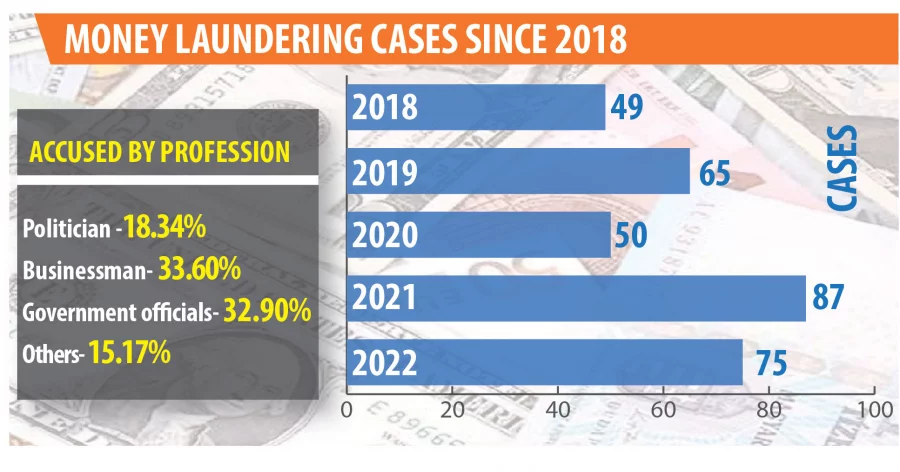
According to court sources, there are 1,512 defendants in 976 money laundering cases that have been pending since 2003. Among the accused, 915 are businessmen, 210 are politicians, and 120 are government officials.
In 2022, the commission could finish 31 out of 157 ongoing inquiries. A total seven cases were filed, while 20 of the inquiries were terminated and four were disposed of through other lawful processes, according to ACC data.
As many as 34 new money laundering investigations were launched last year. A final report was filed in one case, four charge sheets have been submitted, four were disposed of and nine were terminated.
However, data from a special judge's court on money laundering cases showed that 95% of cases had ended, with 20 cases disposed of, 19 convictions, and one acquittal.
On the other hand, CID now has around 350 money laundering cases, but only 181 charge sheets have been submitted, sources said.
4 police agencies want power
Four units of the police have been pushing for three years to get power to investigate money laundering cases.
These are the Rapid Action Battalion (RAB), Police Bureau of Investigation (PBI), Anti-Terrorism Unit (ATU), and the Counter Terrorism and Transnational Crime (CTTC) Unit of Dhaka Metropolitan Police (DMP).
Although the Anti-Terrorism Unit is empowered to investigate money laundering cases under the regulations, it is not mentioned as an investigative agency in the Prevention of Money Laundering Act.
None of the four agencies have been granted their request yet.
