




This is AMA Muhith’s last budget as the finance minister of the outgoing government, and it is supposed to be a pre-election estimation designed to make sure the ruling Awami League party gets another chance.
That means there are a few gifts in the budget for everyone, focusing on the upcoming polls.
However, considering the macroeconomic situation of the country, it was one of the toughest jobs for an 85-year old finance minister to make a responsible budget for his political party as well as for the betterment of the economy.
Here is a quick guide on how and whether Muhith managed this job:
The proposed budget for FY19 can hardly be considered overly ambitious, but it is much more than a political budget.
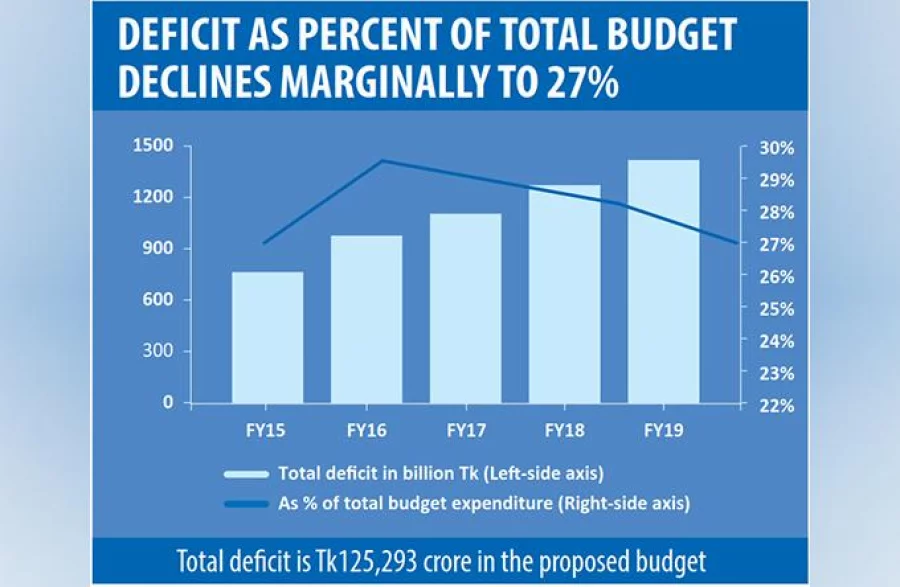
Muhith is expecting a 17.81% growth in the revenue realization target and the expenditure target has been raised by 16.01%, which means the deficit of the budget will not be very high.
However, the question always is how the budget deficit will be met. Muhith plans to meet the budget deficit from both external sources and domestic sources such as bank loans, leaning more towards the latter.
The concern here is deficit management with money from the banking sector, which is currently facing a number of crises.
The budget proposal does not contain any bold action for the reformation of the banking sector, and if the banks face a problem like liquidity crisis in the future, the government would be forced to meet the budget deficit from high interest rate-driven sources such as national savings certificates.
On the other hand, the finance minister has planned to meet the ambitious revenue target mainly from indirect tax, as the revenue target from income tax has increased only slightly from 21.78% to 21.99%, while the target
from value-added tax (VAT) has been estimated at 23.79%
from 21.91% a year ago.
Eggs in a lot of baskets
The finance minister has proposed to put a 28% import duty on rice to protect local farmers, hoping to help them get fair price for their crops. The number of people, amount in taka, as well as the beneficiary areas under the social safety net program has also been increased.
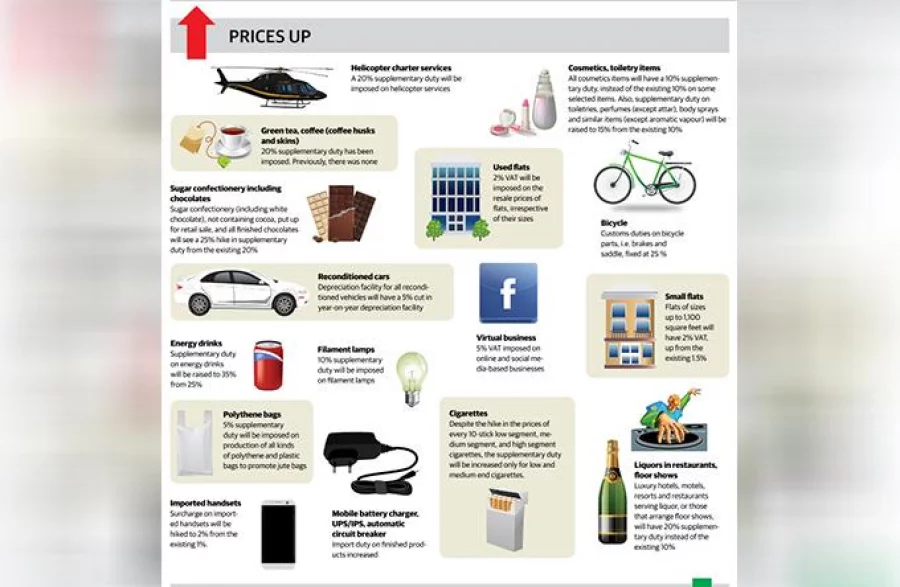
Muhith also tried to give a boost to the local manufacturing industry by imposing supplementary duties on import of competing products and materials such as mobile handsets and motor-cycle parts. Luxury items and tobacco products have also been highly taxed.
Meanwhile the finance minister has proposed cutting down the corporate tax for banks and other financial institutions, but despite the urging of stakeholders has ignored many large and flourishing industries.
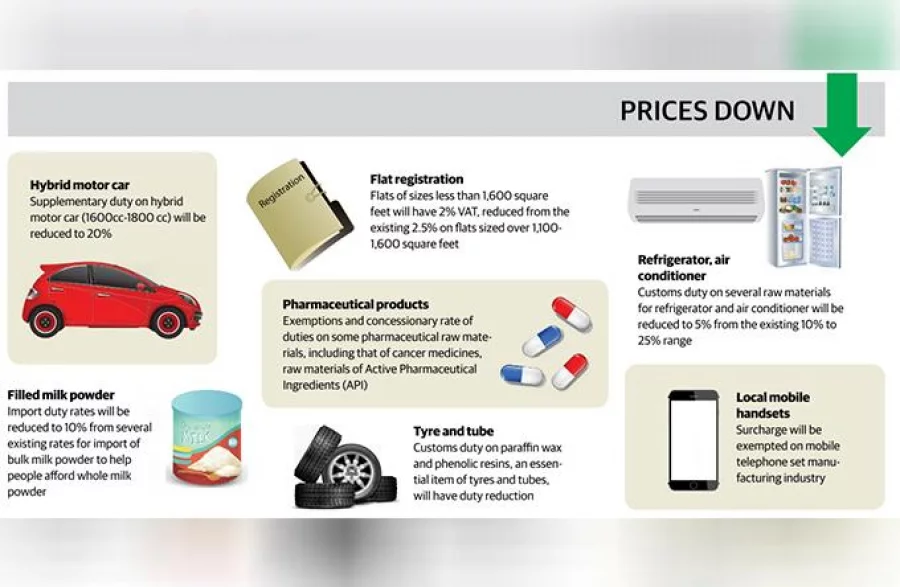
However, Muhith has not given any relief for the lower class by increasing the tax-free income ceiling, while he has raised the tax ceiling on pleasure expenditure to Tk5.50 lakh from Tk4.75 lakh. The finance minister has also proposed a 2% VAT on property registration fee for flats less than 1,600 square feet from existing two slabs of 2.5% on flats up to 1,100 square feet, and 2% on flats over 1,100 square feet to 1,600 square feet.
In these two decisions of Muhith has increased the social safety, but these might results inequality among different classes of people.
