




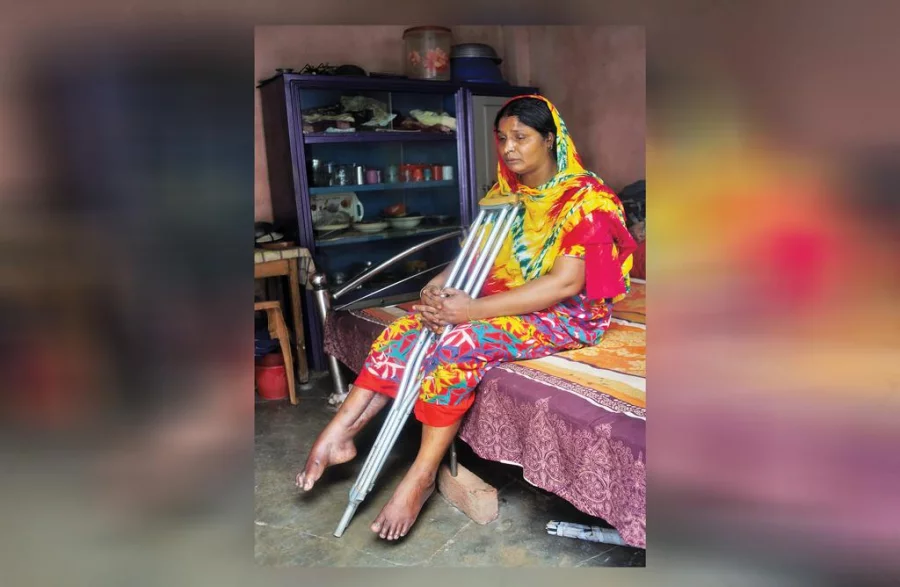
 Nilufa is now in a debt of Tk2-3 lakh, and her leg continues to worsen. Her son has stopped going to school Dhaka TribuneBut Nilufa’s doctors’ prognosis turned out to be wrong.
Two days after she went home from hospital, her leg’s condition started worsening.
She was again admitted to Ganashasthya Medical College and Hospital, and later to Uttara Modern Medical College and Hospital, but none of the hospitals was able to help her.
“I had a number of surgeries on my leg. I spent all of the Tk350,000 that I received as compensation, and an additional Tk500,000 on my treatment. All of it was wasted; my leg did not get better,” said a dejected Nilufa.
She said the initial wrong treatment of her leg had led to her current condition.
“Now I am under a debt of Tk2-3 lakh, and my leg is getting worse every day,” she added. “I don’t know how to pay off my loans, because I cannot work. Those who lost their hand or leg in the accident received Tk10-15 lakh in compensation, but I didn’t because I didn’t lose a limb on that day.
“My son stopped going to school because of my treatment. I don’t know what options I have left, other than begging.”
Frustration took Nilufa to a dark place where she even considered killing herself.
“But I could not take that step when I thought about my son.”
When asked about this situation, Syed Sultan Uddin Ahmed, assistant executive director of Bangladesh Institute of Labour Studies (BILS), said there was still a lack of proper instant assessment of victims’ conditions during a large-scale crisis in the country.
“Treatment was arranged only for the severely injured workers, while those whose injuries were less severe did not receive the same attention,” Sultan said. “Moreover, in the later years, there has been no follow-up on their progress, mental state or current condition either.
“Even the treatment funded by the trust fund for Rana Plaza victims took four years to initiate. By that time, many of the victims had gone back to work. That is why proper assessment was not conducted and many victims did not get the compensation they deserved.”
Nilufa, however, blames Sohel Rana, the owner of Rana Plaza, for her situation.
“His properties should be confiscated and compensation for the victims should be arranged using his assets,” she told the Dhaka Tribune.
Nilufa is now in a debt of Tk2-3 lakh, and her leg continues to worsen. Her son has stopped going to school Dhaka TribuneBut Nilufa’s doctors’ prognosis turned out to be wrong.
Two days after she went home from hospital, her leg’s condition started worsening.
She was again admitted to Ganashasthya Medical College and Hospital, and later to Uttara Modern Medical College and Hospital, but none of the hospitals was able to help her.
“I had a number of surgeries on my leg. I spent all of the Tk350,000 that I received as compensation, and an additional Tk500,000 on my treatment. All of it was wasted; my leg did not get better,” said a dejected Nilufa.
She said the initial wrong treatment of her leg had led to her current condition.
“Now I am under a debt of Tk2-3 lakh, and my leg is getting worse every day,” she added. “I don’t know how to pay off my loans, because I cannot work. Those who lost their hand or leg in the accident received Tk10-15 lakh in compensation, but I didn’t because I didn’t lose a limb on that day.
“My son stopped going to school because of my treatment. I don’t know what options I have left, other than begging.”
Frustration took Nilufa to a dark place where she even considered killing herself.
“But I could not take that step when I thought about my son.”
When asked about this situation, Syed Sultan Uddin Ahmed, assistant executive director of Bangladesh Institute of Labour Studies (BILS), said there was still a lack of proper instant assessment of victims’ conditions during a large-scale crisis in the country.
“Treatment was arranged only for the severely injured workers, while those whose injuries were less severe did not receive the same attention,” Sultan said. “Moreover, in the later years, there has been no follow-up on their progress, mental state or current condition either.
“Even the treatment funded by the trust fund for Rana Plaza victims took four years to initiate. By that time, many of the victims had gone back to work. That is why proper assessment was not conducted and many victims did not get the compensation they deserved.”
Nilufa, however, blames Sohel Rana, the owner of Rana Plaza, for her situation.
“His properties should be confiscated and compensation for the victims should be arranged using his assets,” she told the Dhaka Tribune.When Nilufa Begum joined Phantom Apparels Ltd in 2007, all she wanted was to bring some solvency to her family and provide some support for her husband who, with his meagre earnings from painting jobs, could hardly make ends meet.
In the next six years, life seemed to take a turn for the better for Nilufa; her family was no longer living hand to mouth, they could finally think about savings and, most importantly, good education for their only son was no longer out of reach.
But it all changed on the morning of April 24, 2013. Nilufa was one of the 2,500-odd people who were injured when the Rana Plaza, an eight-storey building which housed Phantom Apparels Ltd and four other RMG factories, collapsed, killing more than 1,100 people.
Five years later, Nilufa’s life has become a story of hopelessness and destitution.
“I can no longer work,” the 33-year-old told the Dhaka Tribune. “I am under a lot of debt because of my treatment costs. My son’s future is at stake now.”
When Nilufa was pulled out from under a massive amount of debris by a volunteer team, she had serious injuries in her head, eye, hand, chest and leg.
She was admitted at a local hospital where doctors assured her that she would recover from all her injuries.
“The doctors said if I could spend Tk30,000-40,000 on treatment, my leg would be okay,” Nilufa said. “With the help of my relatives, I had a surgery on my leg. I spent nine days and Tk118,000 in the hospital.” Nilufa is now in a debt of Tk2-3 lakh, and her leg continues to worsen. Her son has stopped going to school Dhaka TribuneBut Nilufa’s doctors’ prognosis turned out to be wrong.
Two days after she went home from hospital, her leg’s condition started worsening.
She was again admitted to Ganashasthya Medical College and Hospital, and later to Uttara Modern Medical College and Hospital, but none of the hospitals was able to help her.
“I had a number of surgeries on my leg. I spent all of the Tk350,000 that I received as compensation, and an additional Tk500,000 on my treatment. All of it was wasted; my leg did not get better,” said a dejected Nilufa.
She said the initial wrong treatment of her leg had led to her current condition.
“Now I am under a debt of Tk2-3 lakh, and my leg is getting worse every day,” she added. “I don’t know how to pay off my loans, because I cannot work. Those who lost their hand or leg in the accident received Tk10-15 lakh in compensation, but I didn’t because I didn’t lose a limb on that day.
“My son stopped going to school because of my treatment. I don’t know what options I have left, other than begging.”
Frustration took Nilufa to a dark place where she even considered killing herself.
“But I could not take that step when I thought about my son.”
When asked about this situation, Syed Sultan Uddin Ahmed, assistant executive director of Bangladesh Institute of Labour Studies (BILS), said there was still a lack of proper instant assessment of victims’ conditions during a large-scale crisis in the country.
“Treatment was arranged only for the severely injured workers, while those whose injuries were less severe did not receive the same attention,” Sultan said. “Moreover, in the later years, there has been no follow-up on their progress, mental state or current condition either.
“Even the treatment funded by the trust fund for Rana Plaza victims took four years to initiate. By that time, many of the victims had gone back to work. That is why proper assessment was not conducted and many victims did not get the compensation they deserved.”
Nilufa, however, blames Sohel Rana, the owner of Rana Plaza, for her situation.
“His properties should be confiscated and compensation for the victims should be arranged using his assets,” she told the Dhaka Tribune.
Nilufa is now in a debt of Tk2-3 lakh, and her leg continues to worsen. Her son has stopped going to school Dhaka TribuneBut Nilufa’s doctors’ prognosis turned out to be wrong.
Two days after she went home from hospital, her leg’s condition started worsening.
She was again admitted to Ganashasthya Medical College and Hospital, and later to Uttara Modern Medical College and Hospital, but none of the hospitals was able to help her.
“I had a number of surgeries on my leg. I spent all of the Tk350,000 that I received as compensation, and an additional Tk500,000 on my treatment. All of it was wasted; my leg did not get better,” said a dejected Nilufa.
She said the initial wrong treatment of her leg had led to her current condition.
“Now I am under a debt of Tk2-3 lakh, and my leg is getting worse every day,” she added. “I don’t know how to pay off my loans, because I cannot work. Those who lost their hand or leg in the accident received Tk10-15 lakh in compensation, but I didn’t because I didn’t lose a limb on that day.
“My son stopped going to school because of my treatment. I don’t know what options I have left, other than begging.”
Frustration took Nilufa to a dark place where she even considered killing herself.
“But I could not take that step when I thought about my son.”
When asked about this situation, Syed Sultan Uddin Ahmed, assistant executive director of Bangladesh Institute of Labour Studies (BILS), said there was still a lack of proper instant assessment of victims’ conditions during a large-scale crisis in the country.
“Treatment was arranged only for the severely injured workers, while those whose injuries were less severe did not receive the same attention,” Sultan said. “Moreover, in the later years, there has been no follow-up on their progress, mental state or current condition either.
“Even the treatment funded by the trust fund for Rana Plaza victims took four years to initiate. By that time, many of the victims had gone back to work. That is why proper assessment was not conducted and many victims did not get the compensation they deserved.”
Nilufa, however, blames Sohel Rana, the owner of Rana Plaza, for her situation.
“His properties should be confiscated and compensation for the victims should be arranged using his assets,” she told the Dhaka Tribune.
Nilufa is now in a debt of Tk2-3 lakh, and her leg continues to worsen. Her son has stopped going to school Dhaka TribuneBut Nilufa’s doctors’ prognosis turned out to be wrong.
Two days after she went home from hospital, her leg’s condition started worsening.
She was again admitted to Ganashasthya Medical College and Hospital, and later to Uttara Modern Medical College and Hospital, but none of the hospitals was able to help her.
“I had a number of surgeries on my leg. I spent all of the Tk350,000 that I received as compensation, and an additional Tk500,000 on my treatment. All of it was wasted; my leg did not get better,” said a dejected Nilufa.
She said the initial wrong treatment of her leg had led to her current condition.
“Now I am under a debt of Tk2-3 lakh, and my leg is getting worse every day,” she added. “I don’t know how to pay off my loans, because I cannot work. Those who lost their hand or leg in the accident received Tk10-15 lakh in compensation, but I didn’t because I didn’t lose a limb on that day.
“My son stopped going to school because of my treatment. I don’t know what options I have left, other than begging.”
Frustration took Nilufa to a dark place where she even considered killing herself.
“But I could not take that step when I thought about my son.”
When asked about this situation, Syed Sultan Uddin Ahmed, assistant executive director of Bangladesh Institute of Labour Studies (BILS), said there was still a lack of proper instant assessment of victims’ conditions during a large-scale crisis in the country.
“Treatment was arranged only for the severely injured workers, while those whose injuries were less severe did not receive the same attention,” Sultan said. “Moreover, in the later years, there has been no follow-up on their progress, mental state or current condition either.
“Even the treatment funded by the trust fund for Rana Plaza victims took four years to initiate. By that time, many of the victims had gone back to work. That is why proper assessment was not conducted and many victims did not get the compensation they deserved.”
Nilufa, however, blames Sohel Rana, the owner of Rana Plaza, for her situation.
“His properties should be confiscated and compensation for the victims should be arranged using his assets,” she told the Dhaka Tribune.