A massive imbalance exists in the level of support given to the urban poor and the rural poor under the social safety net programmes (SSNPs) initiated by the government, research by Concern Worldwide Bangladesh has found.
The study showed that among the two major SSNPs – the Old Age Allowance and Widowed and Distressed Women Allowance – there is a vast discrepancy in the distribution of support between the urban poor and the rural poor.
Of the Old Age Allowance, 94.03% covers the rural poor while only 5.97% goes to the urban poor. The Widowed and Distressed Women Allowance is even more lopsided, loaded 98.32% in favour of the rural poor and only 1.68% to the urban poor.
Gazi Mohammad Nurul Kabir, director general of the Department of Social services, said the programmes are partly designed to reduce the migration of lower income groups to urban areas.
“One of the major intentions of the SSNPs is to provide more support to rural areas [and] that is why the government has been running different programmes as an incentive to have them return to the villages,” he said.
However, the National Social Security Strategy 2015 acknowledges the shortcomings of the safety net programmes and aims to reform the provisions to ensure “more efficient and effective use of resources, strengthened delivery systems and progress towards a more inclusive form of Social Security”.
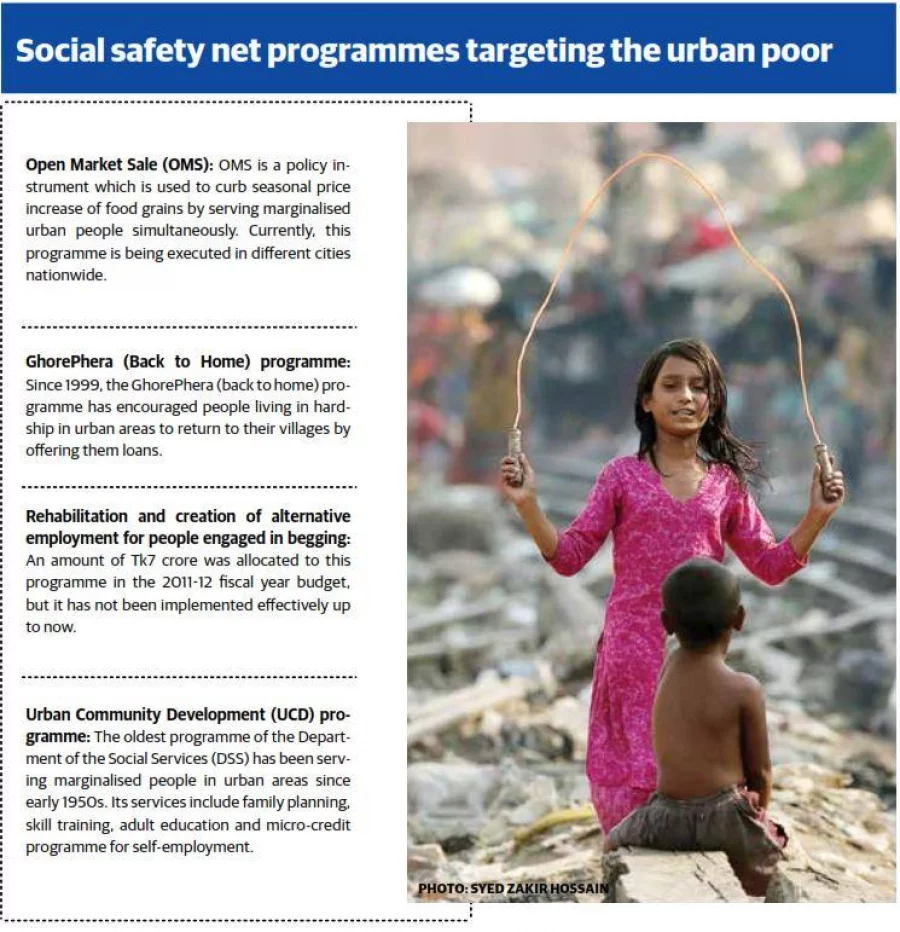
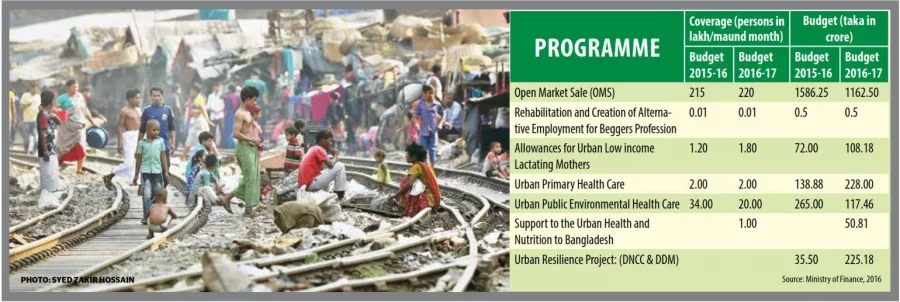
To give the urban poor as equal access as their rural counterparts, the strategy plans to provide services for the elderly, children, vulnerable women and people with disabilities.
Amela Begum, 50, is originally from Jamalpur but lives in a shanty near Khilgaon flyover and earns Tk2,000 a month working as a maid. Despite living in Dhaka for almost 20 years, she has no idea about the SSNPs that she can access when sick or as a vulnerable woman.
Quazi Shahbuddin, an economist and the former director general of Bangladesh Institute of Development Studies (BIDS), told the Dhaka Tribune: “The reason why people still keep migrating to urban areas might have something to do with finding better employment opportunities. As the government’s resources are limited, it has to choose where the support goes first.”
“Urban social safety nets have yet to develop to the necessary scale and capacity to address the growing number of the urban extreme poor," said AKM Musha, country director of Concern Worldwide. "There is still a large scope of formulating and revising national development strategies to address the challenges of urban poverty and deprivations.”
No permanent address? No NIDThere are more than 594,861 people living in slums or are homeless according to the Census of Slum Areas and Floating Population 2014, who by the nature of their living situation are unable to get a National Identity Card (NID) or a birth certificate even though these documents have been made mandatory by the government.
The problem is that Dhaka is home to a large number of migrant workers who usually work in the informal sector and move from one job to another very frequently. Their addresses change along with their jobs.
Ultimately, the children of these people are unable to enrol in school as they do have a birth certificate, which also needs a permanent address.
Razia Sultana and her family has been living in Dhaka for 20 years usually in shanties or on the footpaths. She now lives in a shanti in Maniknagar area and because of this, she cannot acquire a NID or get birth certificates for her children.
“For last three years, my husband and I along with our three children have been living here. I tried to enroll my youngest child, Alamin in school but they refused to take him because he does not have a birth certificate,” she told the Dhaka Tribune.
Because she works from down to dusk, she said they had no idea how to even get a NID.
Director of (operations) of National Identity Registration Wing, Abdul Baten said, according to the law, a permanent address is mandatory when applying for a NID. “We cannot help people without a permanent address.”
AKM Musha, country director of Concern Worldwide, said the situation was rather distressing.
“Our experience reveals an unfortunate condition of the urban extreme poor in Bangladesh," he told the Dhaka Tribune. "The extreme poor residing on footpaths, in squatters and underdeveloped slums are still facing challenges in accessing birth certificates and NIDs due to their nature of living under the open sky and perceived lack of address. Without a directive or policy provision from the government, these large portion of the urban population remain beyond the citizen benefits and recognition that they rightfully deserve.”




 To give the urban poor as equal access as their rural counterparts, the strategy plans to provide services for the elderly, children, vulnerable women and people with disabilities.
Amela Begum, 50, is originally from Jamalpur but lives in a shanty near Khilgaon flyover and earns Tk2,000 a month working as a maid. Despite living in Dhaka for almost 20 years, she has no idea about the SSNPs that she can access when sick or as a vulnerable woman.
Quazi Shahbuddin, an economist and the former director general of Bangladesh Institute of Development Studies (BIDS), told the Dhaka Tribune: “The reason why people still keep migrating to urban areas might have something to do with finding better employment opportunities. As the government’s resources are limited, it has to choose where the support goes first.”
“Urban social safety nets have yet to develop to the necessary scale and capacity to address the growing number of the urban extreme poor," said AKM Musha, country director of Concern Worldwide. "There is still a large scope of formulating and revising national development strategies to address the challenges of urban poverty and deprivations.”No permanent address? No NIDThere are more than 594,861 people living in slums or are homeless according to the Census of Slum Areas and Floating Population 2014, who by the nature of their living situation are unable to get a National Identity Card (NID) or a birth certificate even though these documents have been made mandatory by the government.
The problem is that Dhaka is home to a large number of migrant workers who usually work in the informal sector and move from one job to another very frequently. Their addresses change along with their jobs.
Ultimately, the children of these people are unable to enrol in school as they do have a birth certificate, which also needs a permanent address.
To give the urban poor as equal access as their rural counterparts, the strategy plans to provide services for the elderly, children, vulnerable women and people with disabilities.
Amela Begum, 50, is originally from Jamalpur but lives in a shanty near Khilgaon flyover and earns Tk2,000 a month working as a maid. Despite living in Dhaka for almost 20 years, she has no idea about the SSNPs that she can access when sick or as a vulnerable woman.
Quazi Shahbuddin, an economist and the former director general of Bangladesh Institute of Development Studies (BIDS), told the Dhaka Tribune: “The reason why people still keep migrating to urban areas might have something to do with finding better employment opportunities. As the government’s resources are limited, it has to choose where the support goes first.”
“Urban social safety nets have yet to develop to the necessary scale and capacity to address the growing number of the urban extreme poor," said AKM Musha, country director of Concern Worldwide. "There is still a large scope of formulating and revising national development strategies to address the challenges of urban poverty and deprivations.”No permanent address? No NIDThere are more than 594,861 people living in slums or are homeless according to the Census of Slum Areas and Floating Population 2014, who by the nature of their living situation are unable to get a National Identity Card (NID) or a birth certificate even though these documents have been made mandatory by the government.
The problem is that Dhaka is home to a large number of migrant workers who usually work in the informal sector and move from one job to another very frequently. Their addresses change along with their jobs.
Ultimately, the children of these people are unable to enrol in school as they do have a birth certificate, which also needs a permanent address. Razia Sultana and her family has been living in Dhaka for 20 years usually in shanties or on the footpaths. She now lives in a shanti in Maniknagar area and because of this, she cannot acquire a NID or get birth certificates for her children.
“For last three years, my husband and I along with our three children have been living here. I tried to enroll my youngest child, Alamin in school but they refused to take him because he does not have a birth certificate,” she told the Dhaka Tribune.
Because she works from down to dusk, she said they had no idea how to even get a NID.
Director of (operations) of National Identity Registration Wing, Abdul Baten said, according to the law, a permanent address is mandatory when applying for a NID. “We cannot help people without a permanent address.”
AKM Musha, country director of Concern Worldwide, said the situation was rather distressing.
“Our experience reveals an unfortunate condition of the urban extreme poor in Bangladesh," he told the Dhaka Tribune. "The extreme poor residing on footpaths, in squatters and underdeveloped slums are still facing challenges in accessing birth certificates and NIDs due to their nature of living under the open sky and perceived lack of address. Without a directive or policy provision from the government, these large portion of the urban population remain beyond the citizen benefits and recognition that they rightfully deserve.”
Razia Sultana and her family has been living in Dhaka for 20 years usually in shanties or on the footpaths. She now lives in a shanti in Maniknagar area and because of this, she cannot acquire a NID or get birth certificates for her children.
“For last three years, my husband and I along with our three children have been living here. I tried to enroll my youngest child, Alamin in school but they refused to take him because he does not have a birth certificate,” she told the Dhaka Tribune.
Because she works from down to dusk, she said they had no idea how to even get a NID.
Director of (operations) of National Identity Registration Wing, Abdul Baten said, according to the law, a permanent address is mandatory when applying for a NID. “We cannot help people without a permanent address.”
AKM Musha, country director of Concern Worldwide, said the situation was rather distressing.
“Our experience reveals an unfortunate condition of the urban extreme poor in Bangladesh," he told the Dhaka Tribune. "The extreme poor residing on footpaths, in squatters and underdeveloped slums are still facing challenges in accessing birth certificates and NIDs due to their nature of living under the open sky and perceived lack of address. Without a directive or policy provision from the government, these large portion of the urban population remain beyond the citizen benefits and recognition that they rightfully deserve.”