Mohammad Alam’s parents came to Bangladesh in 1992 from their home in Rakhine state of Myanmar. The third eldest among his siblings, Alam was born in the Kutupalong refugee camp.
He is currently preparing for JSC exams at a school where he was only granted admission with the help of an NGO.
“I want to be an engineer, but I do not know if my dream will ever be fulfilled,” Alam told the Dhaka Tribune.
“We have no any access to education after grade eight. The Rohingya children are not allowed to work outside the camp because they are refugees. They end up working in tea stalls or as day labourers.”
He said the children in the refugee camps had no future as they do not have access to decent work or education or the right to move freely.
“It is similar to a prisoner’s life,” he said, before quickly adding that he was grateful to Bangladesh for sheltering the displaced Rohingyas.
He hopes one day he will be able to go back and settle in his motherland. “Myanmar is where I belong. I am still hopeful that peace will be restored and I will return with my parents and enjoy the rights of a citizen,” he said.
Myanmar does not recognise the Rohingya and calls them illegal immigrants from Bangladesh despite the ethnic group having lived there for centuries.
The recent wave of targeted violence in Rakhine state has forced over 600,000 Rohingyas into Bangladesh. The UN has called the persecution “ethnic cleansing” and the mass exodus of refugees “the fastest growing humanitarian crisis in the world”.
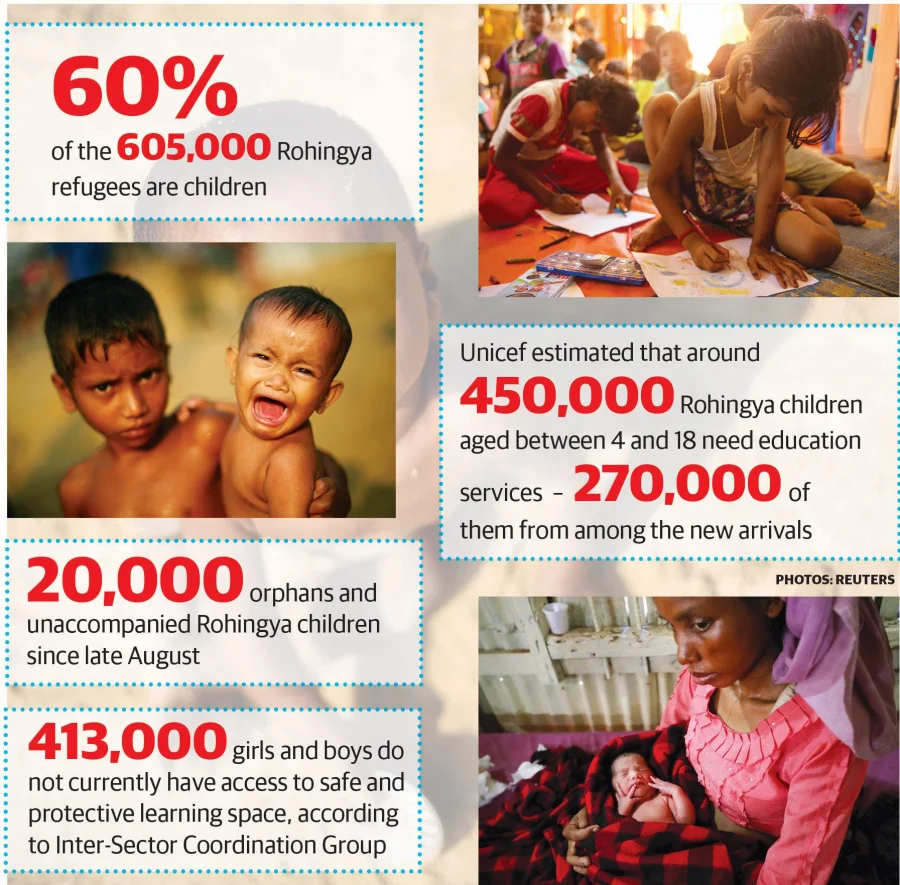
Almost 60% of the new arrivals are children. Many have been separated from their close families and relatives; all of them have suffered tremendous loss.
Risk of being abused
Many of the children who came to Bangladesh are severely traumatised after witnessing the Myanmar military and local mobs attack their homes and kill their families.
These youngsters are vulnerable and there are fears that radical groups can manipulate them to embrace militancy. They could pose security threats to Bangladesh in future.
“This crisis is stealing their childhoods. We must not let it steal their futures at the same time or the region will pay the price for many years to come,” Unicef executive director Anthony Lake said in a report this month.
In the same Unicef report, the agency’s Bangladesh Representative, Edouard Beigbeder, described the conditions faced by the children in the camps on a daily basis.
“The appalling dangers that children here face are plain to see. Living in the open, with food, safe water and sanitation in desperately short supply, the risk of waterborne and other diseases is impossible to ignore,” he said.
“A whole generation of Rohingya people – and the children as much as any – feels rejected by the world. This may already be planting the seeds of future enmity and hatred – unless we act now to help them, and the young especially.”
Mohammad Ayaz, 16, fled to Bangladesh in early September after losing his family during an attack by the Myanmar army. He was shot in the chest.
“I saw the military shooting my sister and mother and then chopping them into pieces. I jumped into a canal near my house to save myself. They killed everyone in my family,” Ayaz said.
He has worked as a day labourer since his childhood and was unsure how to support himself in Bangladesh.
“I will do anything for money,” he said. “I am alone now and I am not afraid of anything anymore.”
‘Cycle of ethnic violence’
There are many children who feel the same way as Ayaz. He is only one of around 20,000 orphans and unaccompanied children who have arrived in Bangladesh since August.
“They (the children) have to understand that crimes committed against them were not normal and that they should not behave like this when they grow up,” said Peter Bouckaert, the emergencies director of Human Rights Watch and an expert in humanitarian crises. “Otherwise, we will have a cycle of ethnic violence which can also affect Bangladesh.”
The Rohingya refugees have already started getting involved in crimes. Police say they have arrested 12 Rohingyas carrying a total of 30,200 contraband yaba pills in Chittagong since the latest influx began in late August.
Alam, another 16-year-old refugee, said there were possibilities of being abused in the camp.
“Most of the children are suffering from severe trauma. They can easily be manipulated and abused,” he said. “Life is difficult here. It is like a nightmare.”
Dr Jena Derakhshani Hamadani, an ICDDRB researcher, told the Dhaka Tribune that experiences of violence and trauma were passed down from generation to generation.
“Many of these refugee children who have witnessed such violence, might become prone to crime in future,” she said.
Bouckaert said the children would be exposed to various dangers if they were left alone, especially the girls.
“They can be trafficked, forced into marriages, or even prostitution,” he said. “Radical groups can also come and recruit the children.”
He emphasised the importance of ensuring a normal life for these children in order to protect them.
Nurturing refugee children
Three children aged between three and nine were travelling from Ukhiya to Teknaf with their aunt, Rashida Begum. They were unlike other children their age: silent and very hard to communicate with.
“We found them standing beside the body of their mother, who had been chopped to pieces by the military and a local mob in Myanmar,” Rashida said.
Human rights activist Nur Khan said he had interviewed two boys who said they had seen their father being shot dead. Their mother and younger siblings were taken into a house that was later set on fire. One of their siblings was thrown into the fire.
“These traumatised children need psycho-social counselling. The orphans also need family support structures,” he told the Dhaka Tribune.
Right now, however, the support system simply does not exist.
“It is a very chaotic situation. The children do not have anybody to talk to about what they saw and they do not even have any support for their daily needs,” Nur said.
“Children who have witnessed violence in Myanmar might go astray and join armed rebellions if we fail to provide them with a normal life. They can have a somewhat normal life if they are given refugee status.”
Access to education
According to figures provided by the Inter-Sector Coordination Group, an estimated 453,000 Rohingya children need education while 413,000 girls and boys do not currently have access to a safe and protective learning space.
Only 40,000 children have received early learning and non-formal basic education.
Unicef has estimated that around 450,000 Rohingya children aged between 4 and 18 years need education services – 270,000 of them from among the new arrivals.
In his report, Lake quoted Unicef education officer Laila Apnan Banu as saying that providing learning opportunities was critical for children who had been through so much.
“In addition, when they are in the centres, the children can be shielded from the dangers that they face in the camps,” she said.
The UN says it is planning to reach up to 150,000 Rohingya children and 50,000 host community children of 4–14 years. The remainder will be supported by other sector partners.
HRW’s Bouckaert suggested that the Rohingya children be provided with counselling and access to school to help them return to normal lives in the shelter. He advised Bangladesh to seek support from the international community.
Mark Lowcock, the United Nations under secretary-general for Humanitarian Affairs and Emergency Relief Coordinator, told a press briefing this month that the UN had been clear that the solution to Rohingya crisis needed to involve the refugees being able to return to where they came from.
“But they need to be able to do that in a way which is safe and voluntary and secure, and to an environment where they feel they can make a decent life and won’t be subject to the kind of things that force them to flee,” he said.




 Dr Jena Derakhshani Hamadani, an ICDDRB researcher, told the Dhaka Tribune that experiences of violence and trauma were passed down from generation to generation.
“Many of these refugee children who have witnessed such violence, might become prone to crime in future,” she said.
Bouckaert said the children would be exposed to various dangers if they were left alone, especially the girls.
“They can be trafficked, forced into marriages, or even prostitution,” he said. “Radical groups can also come and recruit the children.”
He emphasised the importance of ensuring a normal life for these children in order to protect them.
Nurturing refugee children
Three children aged between three and nine were travelling from Ukhiya to Teknaf with their aunt, Rashida Begum. They were unlike other children their age: silent and very hard to communicate with.
“We found them standing beside the body of their mother, who had been chopped to pieces by the military and a local mob in Myanmar,” Rashida said.
Human rights activist Nur Khan said he had interviewed two boys who said they had seen their father being shot dead. Their mother and younger siblings were taken into a house that was later set on fire. One of their siblings was thrown into the fire.
“These traumatised children need psycho-social counselling. The orphans also need family support structures,” he told the Dhaka Tribune.
Right now, however, the support system simply does not exist.
“It is a very chaotic situation. The children do not have anybody to talk to about what they saw and they do not even have any support for their daily needs,” Nur said.
“Children who have witnessed violence in Myanmar might go astray and join armed rebellions if we fail to provide them with a normal life. They can have a somewhat normal life if they are given refugee status.”
